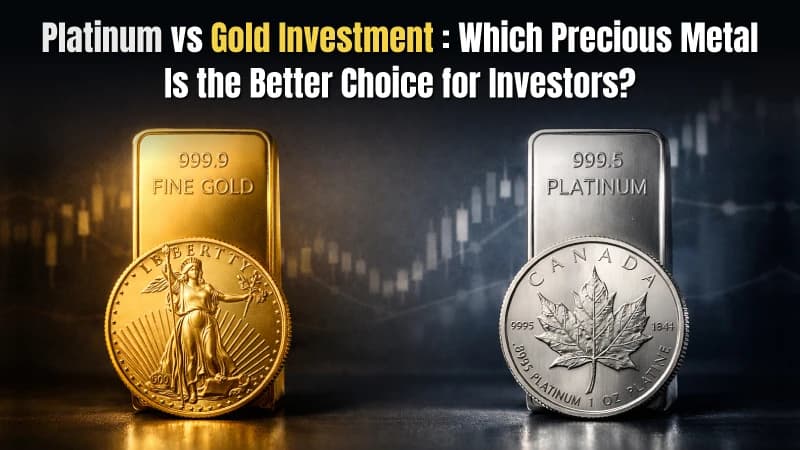
Investing in platinum vs gold is not like comparing two precious metals; investors are comparing both. The two investment behaviors, risk profiles, and long-term roles in the diversified portfolio being decided upon by them differ radically.
Gold has been considered a haven and store of value in times of inflation and even in economic uncertainty. Platinum, on the other hand, is more uncommon and industrially significant, yet volatile and cyclic. The difference in 2026 is more than ever before as the global markets are still getting used to constant inflation, increased interest rates, geopolitical turmoil, and shifting industrial requirements.
This is the most investor-friendly platinum vs gold guide explaining why each type of metal performs well, when to invest, and in what type of investor the metals are best suited for.
Platinum vs Gold Investment: The 2026 Market Environment
The investment landscape in 2026 is shaped by several overlapping forces:
- Inflation remains elevated compared to pre-2020 norms
- Interest rates are higher and more volatile
- Geopolitical risk continues to influence commodity supply chains
- Industrial demand is shifting toward clean energy, medical technology, and advanced manufacturing
These forces affect gold and platinum very differently, which is why investors cannot treat them as interchangeable precious metals.
Quick Comparison: Platinum vs Gold (Investor Perspective)
| Factor |
Platinum |
Gold |
| Rarity |
Extremely rare |
Relatively abundant |
| Main Demand Driver |
Industrial use |
Investment & jewelry |
| Price Volatility |
High |
Low to moderate |
| Liquidity |
Limited |
Very high |
| Inflation Hedge |
Moderate |
Strong |
| Crisis Performance |
Weak |
Strong |
| Portfolio Role |
Growth & diversification |
Capital preservation |
Understanding Platinum as an Investment in 2026
Platinum is also a very rare precious metal on earth, with its yearly supply by the mines being much less than that of gold. Platinum is especially vulnerable to labor and energy shortages coupled with geopolitical upheavals because most of the world's output is concentrated in South Africa and Russia.
Why Investors Consider Platinum
Platinum attracts investors for several reasons:
- Extreme scarcity relative to gold
- Essential industrial applications
- Potential for sharp price rebounds
- Diversification benefits beyond traditional precious metals
Platinum finds a lot of applications in automotive catalyst converters, chemicals, medical apparatuses, and new hydrogen developments. It is through this industrial dependence that platinum attains intrinsic value, but economic sensitivity is brought about.
Platinum’s Investment Risk Profile
Platinum does not always do well during recessions, unlike gold. In case of slow industrial production, the demand for platinum tends to be weak, and the price is expected to be volatile. In the past, the platinum prices have had deeper downturns and steeper upsurges compared to gold.
Platinum is a cyclical asset, and in 2026, its performance will be the most effective when the economy is growing and industrializing, and when it is not under a financial strain.
For this reason, platinum is generally better suited for:
- Experienced investors
- Long-term holders
- Portfolios that already include gold or silver
- Investors seeking diversification rather than stability
Platinum Bullion: What Investors Should Know
Platinum bullion consists of investment-grade bars and coins, usually of up to .9995 purity. The platinum products are not common and usually come at a higher premium compared to the gold bullion.
Key Platinum Bullion Considerations
- Higher purchase premiums than gold
- Limited availability during supply disruptions
- Smaller resale market
- Wider bid-ask spreads
Platinum bullion is not a trading investment but a diversification investment in the long run. Investors are supposed to be ready to have platinum in terms of price cycles instead of expecting a steady increase.
Understanding Gold as an Investment in 2026
In 2026, gold will continue to form the basis of precious-metal investing. Competition with digital assets and other investments has not led to a loss of its value as a store of value.
The strength of gold is its monetary character. In contrast to platinum, the demand for gold is not strongly correlated with industrial activity. Rather, it is propelled by demand for investment, consumption of jewels, and central bank reserves.
Why Gold Continues to Dominate
Gold remains attractive to investors because it:
- Is globally recognized and accepted
- Maintains high liquidity across all market conditions
- Performs well during inflationary periods
- Acts as a hedge against currency devaluation
In times of economic uncertainty, gold benefits from psychological trust. Investors, institutions, and governments continue to view gold as a reliable asset when confidence in financial systems weakens.
Liquidity and Market Accessibility: Gold vs Platinum
Liquidity is one of the most important—but often overlooked—factors in the platinum vs gold investment decision.
Gold Liquidity Advantages
Gold is one of the most liquid assets in the world:
- Traded globally around the clock
- Deep futures and over-the-counter markets
- Narrow bid-ask spreads
- Easy resale even during market stress
Platinum Liquidity Limitations
Platinum markets are much smaller:
- Lower daily trading volumes
- Fewer active buyers and sellers
- Wider spreads on physical bullion
- Slower liquidation during downturns
For investors who value flexibility and fast exits, gold clearly offers superior liquidity.
Volatility and Price Behavior
Gold and platinum behave very differently in response to market conditions.
- Gold prices tend to move gradually and respond to macroeconomic factors such as inflation expectations, interest rates, and currency strength.
- Platinum prices react sharply to industrial demand changes, supply disruptions, and economic cycles.
In 2026:
- Gold continues to act as a defensive, risk-off asset
- Platinum behaves more like a specialty industrial commodity
This difference makes platinum riskier but also creates opportunities for investors who understand market timing.
Inflation Protection: Platinum vs Gold
Gold has a proven track record as an inflation hedge. As currencies lose purchasing power, gold often retains or increases its value because it cannot be created by monetary policy.
Platinum, while scarce, does not respond to inflation in the same consistent way. Its price depends more on industrial demand than on monetary conditions.
Inflation Hedge Comparison
- Gold: Strong, consistent inflation protection
- Platinum: Indirect and less reliable hedge
For investors primarily concerned with preserving purchasing power, gold remains the preferred choice.
Portfolio Role: How Investors Use Platinum and Gold
Gold’s Role in a Portfolio
Gold is commonly used for:
- Capital preservation
- Risk reduction
- Inflation protection
- Long-term wealth storage
Gold often serves as a portfolio stabilizer, helping offset volatility in equities and other risk assets.
Platinum’s Role in a Portfolio
Platinum is typically used for:
- Diversification
- Exposure to industrial growth
- Tactical or opportunistic investments
Platinum works best as a satellite holding, not a core asset.
Platinum vs Gold Investment: Which Is Better for You?
Platinum May Be Suitable If You:
- Have a higher risk tolerance
- Want exposure to industrial demand cycles
- Already hold gold or silver
- Are investing with a long-term horizon
Gold May Be Better If You:
- Prioritize stability and liquidity
- Want protection against inflation
- Prefer predictable price behavior
- Need easy entry and exit options
How Investors Invest in Platinum and Gold
Investors can gain exposure through several methods:
- Physical bullion (coins and bars)
- Exchange-traded funds (ETFs)
- Mining stocks
- Precious-metal retirement accounts
Each option has different risks, costs, and tax implications. Physical bullion offers direct ownership, while paper assets provide convenience and liquidity.
Conclusion
There is no single “better” metal for every investor.
The reason why precious-metal investing continues to be based on gold is that it is more stable, liquid, and hedges against inflation.
Platinum is more diversified and has growth potential, but is more volatile and risky.
Limited exposure to platinum is a balance for most investors who have a gold-first strategy. During good economic times, platinum can be used to increase returns, whereas in times of uncertainty, gold will save wealth.
Portfolio allocation, as well as any other investment, should reflect personal objectives, time load, and risk exposure.
Frequently Asked Questions FAQs
Is platinum a better investment than gold in 2026?
For most investors, gold remains the better choice in 2026 due to stability, liquidity, and inflation protection. Platinum is better suited for diversification and higher-risk portfolios.
Why is platinum more volatile than gold?
Platinum prices depend heavily on industrial demand and concentrated mining supply, making them more sensitive to economic cycles and supply disruptions.
Is gold still a safe-haven asset in 2026?
Yes. Gold continues to perform as a safe-haven asset during inflation, geopolitical tension, and financial market volatility.
Does platinum have long-term investment potential?
Platinum has long-term potential due to its rarity and industrial importance, but returns are less predictable than gold and depend on economic growth.
Which metal is easier to sell: platinum or gold?
Gold is significantly easier to sell due to higher liquidity, deeper markets, and broader global demand.
Is platinum a good hedge against inflation?
Platinum provides limited inflation protection but does not offer the same consistency or reliability as gold.
Should investors own both gold and platinum?
Experienced investors may hold both. Gold provides stability, while platinum adds diversification and growth potential.
Is physical bullion better than ETFs for platinum and gold?
Physical bullion offers direct ownership and no counterparty risk, while ETFs provide convenience and liquidity. The choice depends on investment strategy and personal preference.