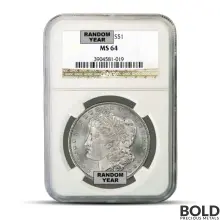
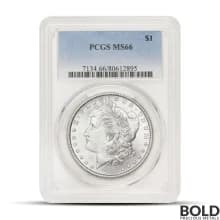
Graded Morgan Silver Dollars are PCGS- and NGC-certified coins with a verified grade, authenticated silver content, and a tamper-evident slab that eliminates uncertainty at resale. Browse BOLD's inventory of certified Morgans from MS-60 through MS-65 — all graded by the two most trusted third-party services in the numismatic market.

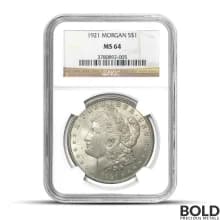
1921 Morgan Silver Dollar (MS64, NGC)
Out of Stock

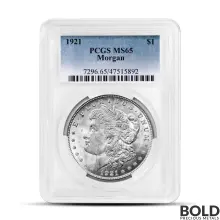
1921 Morgan Silver Dollar (MS65, PCGS)
Out of Stock

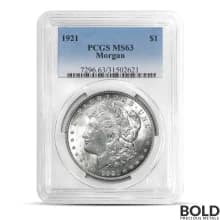
1921 Morgan Silver Dollar (MS63, PCGS)
Out of Stock

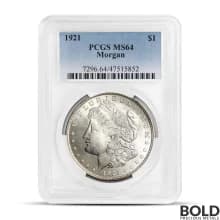
1921 Morgan Silver Dollar (MS64, PCGS)
Out of Stock

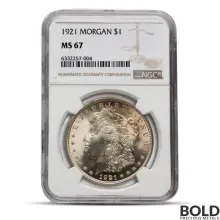
Pre-1921 Morgan Silver Dollar (MS67, NGC)
Out of Stock

A Morgan Silver Dollar in a PCGS or NGC slab is structurally different from the same coin raw — even if the two coins came out of the same original bag. The slab adds three things that the raw coin cannot provide: verified authenticity, a standardized grade, and tamper-evident protection. Each of these translates directly into higher resale value, better liquidity, and lower dispute risk at the buyback counter.
For any Morgan Dollar above a few hundred dollars in value — key dates, MS-63 and higher common dates, Carson City issues, proof strikes — certification is not optional. The collector market pays a premium for graded coins precisely because the grade is no longer a matter of disagreement between buyer and seller. It has been evaluated by trained numismatic professionals and permanently encapsulated against tampering.
The Grading Premium Formula
A raw MS-65 Morgan and a PCGS MS-65 Morgan are priced differently in the market. The certification premium covers the grading fee (typically $30–$100 per coin), dealer profit margin, and the real market value of authentication assurance. For entry-level graded Morgans, expect 15–40% over raw equivalents. For key dates and top-pop registry coins, the slab premium can be multiples of the raw coin's value.
PCGS and NGC are the two grading services whose slabs carry full market liquidity. Together they have graded tens of millions of coins since the 1980s. Both are excellent. Each has structural characteristics worth understanding before you build a collection around either one.
Founded 1986 — Based in Newport Beach, California
PCGS pioneered the modern third-party grading industry when it was founded in 1986 by seven coin dealers including David Hall. PCGS slabs carry a distinctive blue label (standard) or gold label (Secure Plus designation for higher-security coins). The CoinFacts database — free to the public — provides population reports, photographic references, and auction records for every US coin. The PCGS Set Registry is the largest competitive collector community in numismatics, with registered sets for every Morgan series variant.
Dealer Insight — PCGS Is Widely Considered Stricter
Across the numismatic community, PCGS is generally considered to grade half a point stricter than NGC on Morgan Dollars. An NGC MS-65 might cross over to PCGS MS-64. This is not a rule — it is a market perception backed by auction data over decades. The practical consequence: a PCGS MS-65 typically commands a small premium over an NGC MS-65 on the secondary market.
Founded 1987 — Based in Sarasota, Florida
NGC was founded in 1987, a year after PCGS, and is now part of Certified Collectibles Group (CCG). NGC slabs carry a distinctive brown, black, or gold label, with the "brown label" being the classic standard and "gold label" indicating Star (exceptional eye appeal) or First Releases designations. NGC's Census database provides population data across every certified coin. The NGC Registry competes with PCGS Set Registry and has its own dedicated collector community.
Dealer Insight — NGC's Star Designation
NGC's Star (?) designation is awarded to coins with exceptional eye appeal beyond what the numerical grade requires — typically involving superior toning, strike, or luster. A Morgan Dollar graded MS-65? (MS-65 Star) commands a premium over a standard MS-65, sometimes equivalent to an MS-66 price. PCGS has no direct equivalent to the Star designation — it uses a "+" modifier (e.g., MS-65+) for high-end examples within a grade.
Founded 2007 — Sticker Verification Layer
CAC is not a grading service — it is a verification sticker applied to already-graded PCGS or NGC coins. Founded by John Albanese (a PCGS co-founder), CAC reviews graded coins and awards a green bean sticker to those the reviewers judge as "solid for the grade" (A or B quality within the grade) or a gold bean sticker to those judged undergraded. A CAC-stickered Morgan typically commands a 10–30% premium over the same coin in the same grade without a sticker. For serious registry collectors, CAC verification is often considered essential.
The Sheldon Coin Grading Scale was developed by Dr. William H. Sheldon in 1949 for his book Penny Whimsy and has become the universal standard for US coin grading. The scale runs from 1 (barely identifiable) to 70 (perfect, no flaws visible under 5x magnification). Every PCGS and NGC grade on a Morgan Dollar slab references a specific point on this scale.
| Grade | Designation | What It Means for a Morgan Dollar |
|---|---|---|
| MS-60 | Uncirculated (basal) | No circulation wear but heavy bag marks, weak luster. Entry-level slabbed grade. |
| MS-61 to MS-62 | Uncirculated | Multiple distracting bag marks. Luster present but impaired by contact marks. |
| MS-63 | Choice Uncirculated | Moderate bag marks, good overall luster. Standard entry-level investor grade. |
| MS-64 | Choice Uncirculated | Fewer contact marks than MS-63, stronger luster. Solid investment-grade. |
| MS-65 | Gem Uncirculated | Minor contact marks only, full luster, sharp strike. Registry-eligible. |
| MS-66 | Gem Uncirculated | Only 2–3 minor contact marks on primary focal areas. Premium Gem. |
| MS-67 | Superb Gem | Near-perfect preservation. Extremely tight populations for most dates. |
| MS-68 to MS-70 | Ultra / Perfect | Extreme rarity for Morgan Dollars — most dates have zero known MS-68+ examples. |
| PR / PF | Proof Strike | Mirror-finish specimen strikes. Morgan proofs are scarce (1878–1904, 1921). |
Registry Collector Tip
For most common-date Morgans, the MS-63 to MS-65 band is where collector-grade coins trade most actively. MS-66 and MS-67 examples jump dramatically in price due to population scarcity — often 3–10x MS-65 prices for the same date. Registry competitors chase MS-66+ specimens because the population data makes them visibly rare in PCGS CoinFacts and NGC Census reports.
A graded Morgan's "slab" is a tamper-evident plastic holder engineered to preserve the coin indefinitely and prevent undetected swapping. Both PCGS and NGC slabs contain several authentication features that professional dealers verify before every transaction.
Before purchasing any graded Morgan Dollar above $500, read the population report for that specific date, mint mark, and grade combination. Population data is the single most important pricing signal in the slabbed coin market — it tells you exactly how many examples exist at each grade level.
Both PCGS CoinFacts and NGC Census are free, public databases. Type in "1884-O Morgan Dollar MS-65" on PCGS.com and you'll see: (a) how many coins have been graded MS-65 for that date, (b) how many have been graded higher ("finer"), and (c) current auction records. This "pop report" directly determines the coin's fair market value.
How Population Drives Price
A "top pop" or "finest known" designation means no certified example exists at a higher grade. These coins command auction prices that can be 10–50x the next-lowest grade.
Not every coin submitted to PCGS or NGC receives a straight numerical grade. When a coin has a genuine authentication confirmed but suffers from a disqualifying issue that prevents assignment of a straight grade, the service returns a "Details" grade. Details-graded Morgans still ship in a PCGS or NGC slab — but the label includes a modifier that dramatically affects market value.
| Details Designation | What Happened | Typical Value Impact |
|---|---|---|
| Cleaned | Coin surface shows hairlines from wiping, polishing, or dipping | 30–70% below straight-graded equivalent |
| Improperly Cleaned | More severe cleaning damage, abrasive removal of surface metal | 50–80% below straight grade |
| Damage | Scratches, dents, edge damage, post-mint impairment | Varies by severity; typically 40–90% reduction |
| Altered Surfaces | Artificial toning, chemical treatment, re-engraving | Severe reduction; some become unsellable |
| Genuine (no grade) | Authentic but not gradeable (environmental damage, e.g.) | Typically at bullion value only |
Buyer Warning — Read the Label Carefully
A slab with "MS-63" on the label and a slab with "MS Details — Cleaned" are fundamentally different assets. Both are in PCGS or NGC holders; only one is a straight graded coin. Sellers occasionally list Details-graded coins with pricing closer to straight-graded equivalents. Always read the full label text and verify the cert number on the grading service website before any purchase above a few hundred dollars.
Beyond the base grade, both PCGS and NGC assign special designations that identify coins with notable attributes or early-release significance. These modifiers can substantially increase or decrease market premium.
For collectors who want to build structured, verifiable collections and compete with peers globally, both PCGS and NGC operate competitive registry programs. Registry sets are where the most serious Morgan Dollar collecting happens.
The PCGS Set Registry and NGC Registry each allow collectors to register certified coins toward pre-defined sets — Morgan Complete Date/Mint sets, Morgan Proof sets, Carson City Morgan sets, VAM variety sets, and dozens more. Each registered coin scores points based on grade, and collectors compete for top rankings globally. Top registry sets are often displayed at major coin shows and occasionally sell intact for dramatic premiums over the sum of individual coin values.
Why Registry Matters for Your Collection
Registry participation is free and adds documented provenance to every graded Morgan you own. Coins in registered sets command measurably higher resale prices because buyers can verify the coin's placement in a ranked, documented collection. For any collector building a Morgan Dollar set above $10,000 in total value, registry participation is effectively free marketing for the eventual sale.
BOLD sources graded Morgan Dollar inventory through vetted primary channels — direct consignments from established collectors, certified dealer networks, and major auction house consignments. Every slab is verified before it enters our inventory, and every certification number is confirmed against the issuing service's database.
This page covers certified, professionally graded Morgan Silver Dollars in PCGS and NGC slabs. For the complete Morgan series background — 1878 Bland-Allison Act origin, George T. Morgan designer biography, all five mint marks explained, Morgan vs Peace Dollar comparison, and circulated grade coverage for bullion-focused stackers — visit the Morgan Silver Dollars hub page.
A graded Morgan Dollar has been submitted to PCGS or NGC, evaluated by professional numismatic graders, assigned a grade on the Sheldon scale (1 to 70), and sealed in a tamper-evident plastic holder ("slab") with a unique certification number. The grade is an objective market standard that eliminates buyer-seller disagreement about the coin's condition.
Visit pcgs.com for PCGS slabs or ngccoin.com for NGC slabs, and enter the certification number printed on the label. The grading service database will return the coin's date, mint mark, grade, and certification year — confirming the slab is authentic. Always verify cert numbers before purchasing high-value graded coins.
Both are excellent and both carry full market liquidity. PCGS is generally considered to grade slightly stricter than NGC on Morgan Dollars, which results in PCGS slabs commanding small premiums at the same numerical grade. NGC's Star (?) designation for exceptional eye appeal is unique and highly valued. Many serious collectors own both.
CAC (Certified Acceptance Corporation) is a verification sticker applied to already-graded PCGS or NGC coins after a second review. A green bean indicates the coin is solid for its assigned grade (A or B quality within the grade). A gold bean indicates the coin is undergraded. CAC-stickered Morgans typically command 10–30% premiums over the same coin without a sticker, and CAC is considered essential by many serious registry collectors.
A "Details" grade means PCGS or NGC authenticated the coin as genuine but determined it could not receive a straight numerical grade due to a disqualifying issue — typically cleaning, damage, altered surfaces, or environmental damage. Details-graded Morgans trade at 30–90% less than the same coin would straight-graded. Always read the full label text carefully before purchasing.
PL (Proof-Like) and DMPL (Deep Mirror Proof-Like) are surface designations awarded to uncirculated Morgans with mirror-like reflective fields rivaling proof strikes. DMPL is rarer than PL and is awarded only to coins with reflectivity of 6+ inches. A DMPL Morgan can command 2–10x the price of the same date in standard MS finish — the designation is a major value driver.
No. Cracking a coin out of its PCGS or NGC slab destroys the grade, authentication, and certification number permanently. The coin becomes a raw coin again and must be resubmitted for grading (with no guarantee of receiving the same grade). Always keep graded Morgans in their original holders unless you are a professional resubmitter with specific strategic reasons.
The PCGS Set Registry and NGC Registry are competitive platforms where collectors register their certified coins toward pre-defined sets (Morgan Complete Date/Mint, Carson City Morgans, Morgan Proof sets, VAM varieties, etc.). Each registered coin scores points based on grade, and collectors compete for global rankings. Registry participation is free, adds provenance to individual coins, and measurably improves resale prices. Top registry sets occasionally sell intact for significant premiums over individual coin values.
Yes. BOLD's Sell to Us program purchases graded Morgan Dollars at competitive market prices based on current PCGS and NGC auction comparables. Pricing accounts for the specific date, mint mark, grade, special designations (CAC, Star, +, DMPL/PL), and current population data. Contact BOLD directly for high-value graded lots or complete registry sets.


Affiliations


Copyright BOLD Precious Metals 2026