Platinum has been considered a symbol of luxury, rarity, and permanence. Since engagement rings and
investment-grade bullion, such as platinum bullion, this precious metal is exhibited because of its strength and
natural white luster. However, one question would always arise before you purchase platinum jewelry or platinum
in your investment portfolio, and that is:
Does platinum tarnish?
You might not be new to silver, and you might already be conversant with tarnish - that dark and dull layer that
forms as time passes. Of course, customers would like to know whether platinum will react in the same way.
The reply is also encouraging, but it has an interesting twist concerning the way the platinum ages.
Key Takeaways
- Platinum does not tarnish because it is a highly stable noble metal.
- Instead of tarnishing, platinum develops a natural patina from everyday wear.
- Platinum’s patina is a soft, matte finish that many collectors appreciate.
- Unlike silver, platinum does not react with sulfur or oxygen easily.
- Any surface changes can be easily polished to restore the original shine.
- Platinum retains its metal mass over time, making it extremely durable for jewelry and long-term
investments.
Does Platinum Tarnish?
The simple answer is no — platinum does not tarnish.
Tarnish is a chemical reaction between a metal and substances in the surrounding, especially sulfur or
oxygen.
The Silver reacts with sulfur in the air and gets covered with a dark layer over it.
The same thing does not happen to platinum.
Platinum is a noble metal that is highly resistant to chemical reactions and oxidation. This implies that it
is
not easily reactive to air, moisture, and other usual environmental factors.
Due to this stability, platinum does not fade or disintegrate in tens or even centuries, so it can be
commonly
applied not only in jewelry but also in platinum bullion investing.
Platinum is also very scarce compared to other precious metals. It is estimated that the world is producing
15-20
times of platinum than what is produced of gold, which is an added advantage to the value and demand in the
jewelry and bullion industry.
But platinum does alter into something different, just not according to what people tend to believe.
What Actually Happens to Platinum Over Time?
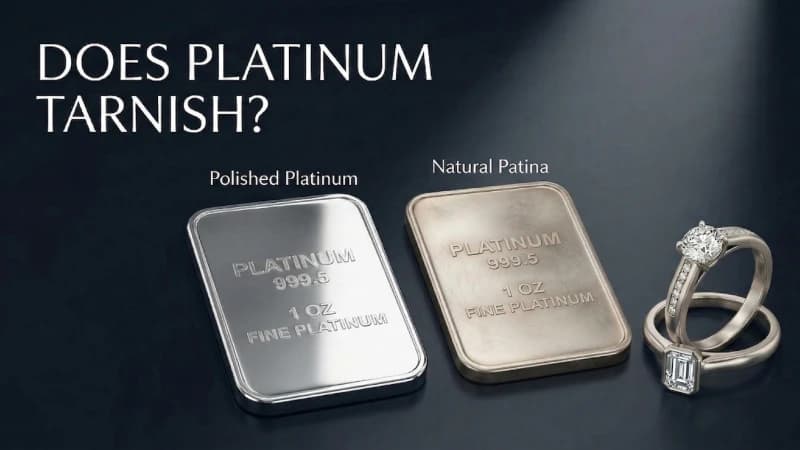
Although platinum does not tarnish, it tends to develop the so-called patina.
Patina is a natural type of surface finish that is left after wear. Platinum does not turn black or corrode,
but progressively obtains a soft and satin colour.
This is due to the fact that at the point of daily usage, the metal is not cleared but rather recrystallized
by tiny scratch marks across the surface.
That is to say that platinum does not lose metal; it just moves it around.
To most jewelry lovers, this patina would, in a way, add beauty to platinum as it would give it a vintage and
old look.
Platinum Patina vs Tarnish
Tarnish is something very unlike patina, a term that many people cannot differentiate.
| Feature |
Platinum Patina |
Tarnish |
| Cause |
Natural surface wear |
Chemical reaction with air or sulfur |
| Appearance |
Soft and satin color |
Dark layer or discoloration |
| Metal Damage |
No loss of metal |
Can damage or degrade the surface |
| Removal |
Simple polishing |
Requires chemical cleaning |
Patina is simply the natural aging of platinum; aging well and tarnish is generally the injury.
Why Platinum Resists Tarnishing
Platinum resists tarnishing because of its chemical structure and noble metal properties.
This is due to several factors, including:
Noble Metal Properties
Platinum is naturally resistant to corrosion and oxidation.
High Density
The atoms of platinum are close together, and therefore, it becomes difficult for the environmental
elements to interact with the metal.
High Purity in Jewelry
Pure platinum jewelry is approximately 95 percent purer than the usual platinum jewelry alloys.
Such purity also contributes to ensuring that platinum does not require further plating since it is
naturally white.
Does Platinum Jewelry Require Maintenance?
The first benefit of platinum is that it does not need much maintenance compared to other metals.
Although platinum does not tarnish, simple maintenance will ensure it is in good shape.
Simple Platinum Care Tips
Clean Occasionally
Light soap, warm water, and a soft cloth are normally sufficient to clean the dirt of everyday life.
Avoid Harsh Chemicals
Platinum is tough and is not affected by chemicals; however, gemstones embedded in the jewelry may
be influenced.
Professional Polishing
A jeweler can polish platinum easily, should you wish that platinum has a bright, mirror-like finish
other than the natural patina.
Proper Storage
It is worth keeping the platinum jewelry in a different storage to avoid hard material scratches.
Platinum vs Other Precious Metals
The comparison of platinum with other metals can be used to explain why it is the favorite of
most customers.
| Metal |
Tarnishes? |
Long-Term Appearance |
| Platinum |
No |
Develops soft patina |
| Silver |
Yes |
Dark tarnish forms |
| Gold |
Rarely |
Can be dull depending on the alloy |
| Palladium |
No |
Similar to platinum |
When considering, platinum vs silver tarnish, Silver needs to be polished regularly, whereas
platinum does
not need any polishing despite daily use as we know, does platinum tarnish? No.
This is what makes platinum mostly used in engagement rings and heirloom jewelry because of its durability.
Why Many Collectors Prefer Platinum’s Aging Process
Platinum does not wear out with age, as is the case with other metals.
The patina is valued by many collectors and jewelry owners as it is a somewhat worn-out antique-like finish
that accentuates the authenticity of the metal.
It even goes as far as some believing that platinum patina is an indication that the work has been truly
spent upon and loved throughout the years.
And what is even better, this appearance can be undone in case of polishing.
Expert Insight
Along with Gold, Platinum
is a
noble metal, meaning it can resist oxidation and corrosion. Since it is a noble metal, platinum is
extensively used in jewelry but also in scientific and industrial applications where non-reactivity is a
boon.
Frequently Asked Questions (FAQs)
1. Does platinum tarnish over time?
No, platinum does not tarnish. Platinum is a noble metal that is very difficult to react with oxygen and sulfur
in the atmosphere. Platinum obtains a soft surface patina, which does not tarnish and cannot harm the metal with
time.
2. Does platinum jewelry tarnish?
The platinum jewelry may become somewhat dull due to the natural patina in the course of years of wear. This
happens when minute scratches on the surface redistribute the metal on the surface instead of abrasiveness. The
outcome is a matte finish that is soft to touch and is much liked by many due to its antique and classy look. A
jeweler can also conduct platinum jewelry care by polishing platinum to a desired effect to recover what was
originally shiny.
3. Does platinum change color or turn black?
No, platinum does not turn black or change its color under normal conditions. Since platinum is highly immune to
corrosion and oxidation, it does not lose its natural white color in the course of time. When platinum jewelry
looks dark, it is likely to be dirty or has formed patina and not tarnished.
4. How do you clean platinum jewelry?
Platinum jewelry is easy to clean. Warm water, mild soap, and a soft cloth or brush may be used to cleanse away
dirt and oils. Frequent cleaning is used to preserve the natural shine of platinum. When the jewelry acquires a
patina, and you want it to be as shiny as before, it is easy to have a jeweler do the professional polishing to
make it look like it originally did.
Conclusion
So, does platinum tarnish? The answer is clearly no.
Platinum is a precious metal that is also one of the most stable in terms of chemistry and this implies that
it does not tarnish, corrode as well as does not discolour. Rather than wearing out, platinum also forms a
natural patina that is admired by most as classy and timeless.
No matter what your investment is in buying platinum jewellery or in investing in the physical bullion, such
as platinum coins and platinum bars, platinum is
one of the most durable precious metals you can find.
Platinum is one of the surest options to find a precious metal that has a combination of rarity, strength,
and future visual appeal.