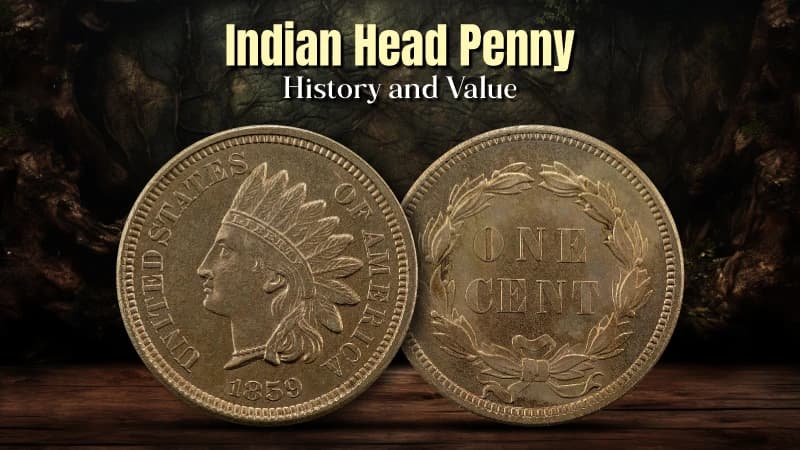
Cents? Are cents valuable? Are you one of those people who think the same? Buckle Up! This article may surprise you. The featured Indian Head Penny, minted from 1859 to 1909, has values ranging from about $1.50 to more than $3,600 in this guide’s value table. This article will enlighten you on why these pennies have such worth, market demand, and their profound history.
The Indian Head Penny, also known as the Indian Head Cent, was minted by the United States Bureau of the Mint from 1859 to 1909. These pennies were designed by James Barton Longacre, the Chief Engraver at the Philadelphia Mint. James is also the iconic and worldwide renowned engraver for his creation, the first Double Eagle of 1849. This summarized background has interesting beginnings and history! Keep reading to clarify the Indian head Penny's history and values.
History

The introduction of the Indian Head Penny was as fascinating as learning about its values. The US Mint introduced Indian Head Pennies or Indian Head Cents ($0.01), in 1859. From 1859 to 1864, these pennies comprised 88% Copper and 12% Nickel. In 1864 the metal changed to bronze (95% copper and 5% tin and zinc), used until 1909.
The Story begins in the 1850s when copper cents were as large as a half dollar. During the same period, the discovery of gold in California caused major inflation in metal prices. As copper prices rose, the mint directors were forced to look for composition alternatives, which resulted in the Flying Eagle Cent in 1857. However, the Flying Eagle brought production difficulties and complications, causing them to be replaced. Browse gold bullion at BOLD Precious Metals. Browse precious metals at BOLD Precious Metals.
Thus, in 1859, the Flying Eagle was succeeded by the Indian Head Cent, designed by James Barton Longacre. The Indian Head Penny was the second U.S. small cent, after the large cent was discontinued in 1857.
Did You Know?
The Indian Head Penny was phased out, and the Lincoln Wheat Penny followed in 1909, the centennial year of Abraham Lincoln’s birth.
Indian Head Penny Value

Indian Head Pennies, like other old coins, are valued based on three factors:
1. Years of mintage
2. Age, and
3. Rarity.
The Indian Head pennies comprise a spectrum of choices considering these three factors. They are primarily popular for their years of mintage, complemented by profound stories and events revolving around them.
The initial years of production, specifically the first ten years of production cents, are worth more than the later productions. Collectors consider the initial productions more valuable since they were made just before and during the American Civil War.
Secondly, these coins have lived a century, meaning their age also significantly contributes to the Indian Head Penny's Value. When considering age, the better the coin's condition, the more valuable it is. Finding an excellent condition for the initial release of the Indian Head Penny is something collectors and investors prize.
Lastly, the Indian Head Penny's popularity and value also depend on release to release. This comes into consideration, as different releases have different mintage and availability. The rarity of the coin, its condition, and its year of mintage are combined to determine its value. Some releases are highly rare and valuable, while others are lower priced since they are abundant.
To summarize, the Indian Head penny value breakdown, the coin bearing mintage date of the first ten years in excellent condition will be the most valuable.
Indian Head Penny Design
The Indian Head Penny's design resulted from James Barton Longacre's art. It underwent a few changes in 1860. Some say the portrait on the obverse is based on Longacre’s daughter Sarah, but it is also said to be based on a statue of the Crouching Venus in Philadelphia. Lady Liberty is depicted wearing a Native American headdress and surrounded by the inscriptions “UNITED STATES OF AMERICA,” with the year of issue.
The reverse showcases the imprints “ONE CENT,” encircled within two tied laurel wreaths across the coin's circumference. In 1860, the reverse experienced a change in the design, introducing the oak wreaths, a narrow shield, and the “ONE CENT” inscriptions.
Indian Head Penny Value Table (1859-1909)
Frequently Asked Questions (FAQs)
How much is an Indian Head penny worth?
Most later dates, from the 1880s to 1909, are worth a few dollars in Good condition and more in Mint State. Rare dates are worth much more: the value table in this guide lists the 1877 at $425 in Good and $3,603 in Mint State.
Which Indian Head pennies are the most valuable?
In this guide’s table the 1877 is the most valuable date, followed by the 1909-S ($228 in Good to $743 in Mint State) and the 1908-S ($56 to $295). Early dates from 1859 to the 1870s in top condition also bring strong prices.
What years were Indian Head pennies made?
The U.S. Mint made Indian Head pennies from 1859 to 1909. In 1909, the 100th anniversary of Abraham Lincoln’s birth, the Lincoln Wheat penny replaced it.
What are Indian Head pennies made of?
From 1859 to 1864 they were 88% copper and 12% nickel. From 1864 to 1909 they were bronze: 95% copper and 5% tin and zinc.
Who designed the Indian Head penny?
James Barton Longacre, Chief Engraver at the Philadelphia Mint. He also designed the first Double Eagle gold coin of 1849.
What changed on the Indian Head penny in 1860?
The reverse changed from a laurel wreath to an oak wreath with a narrow shield at the top, still around the words ONE CENT.
Conclusion
If you encounter an Indian Head Penny and are curious about its value, you know where to go! With this article, you now have everything you need to know about the Indian Head Penny, its history, and value. BOLD has discussed all the points that justify and explain the Indian Head Penny value. Furthermore, to enhance and ease this experience, we have included a comprehensive and extensive table of the Indian head penny values from 1859 to 1909.
Stumbled upon another rare coin? Explore our coin value blog section to find the value of your coin!