

Share
| Quantity | Cash/Check | Credit Card | Paypal/Pay |
|---|---|---|---|
| Any Quantity | $70.50 | $73.46 | $74.38 |
Share
The 1 oz Scottsdale Nutcracker Silver Round is a Christmas collectible silver round and is packaged in a plastic ornament capsule with a top hanging loop to hang directly on your Christmas tree, while the reverse is colored to capture the spirit of the season. This round is a combination of precious metals investment and holiday tradition—it is worth the same as silver, and it is also a holiday decoration piece.It has no date marked on the round, making it collectible year after year.
Reverse — Scott's design
On the obverse, it is Scottsdale Mint's famous Lion design centered in a circle of festive wreath boughs, which is similar to their standard round obverse but adapted for a festive design.The outer ring also has a background of snowflakes behind the hallmark seal.The full set of inscriptions is the arc of text from Luke 2:14, “GLORY TO GOD IN THE HIGHEST, AND ON EARTH PEACE, GOOD WILL TOWARD MEN,” and “ONE TROY OZ 9999 SILVER” and “SCOTTSDALE MINT.”Before the obverse is even revealed, the wreath, the snowflakes, and the angel's message from the nativity make this obverse theologically complete.
Reverse — The Nutcracker
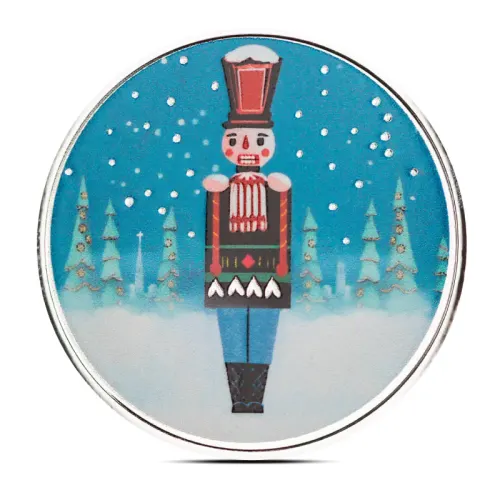
On the back is the colored nutcracker soldier in a winter landscape.He is clad in the traditional nutcracker colors, red and green, and in blue pants, which is the traditional toymaking color in Germany, as well as in the 19th-century, high-crowned military hat of the era—the shako.There is a white field behind him, and it is snowing gently.
The coloration is applied directly to the .9999 silver relief, and the beautiful contrast of the bright reds, greens, and blues with the white and silver of the snow field brings a vividness to the round that makes it feel like a Christmas illustration, reduced to precious metal.
The nutcracker figure originated in the Erzgebirge (Ore Mountains) area of Saxony, Germany, where decorative nut-cracking figures were made by the woodworkers as early as the 1600s.The figurines, which were usually portrayed as foresters, kings, or soldiers, often displayed their authority with exaggerated jaws and lever-like handles, capable of splitting open walnuts and hazelnuts.They came to be linked to good luck and protection from evil spirits; as gifts, they were given to usher good fortune and protection into households at New Year's.The Nutcracker made his debut in world literature in 1816 in the book Nussknacker und Mausekönig by German author E.T.A. Hoffmann.
This story is about Hoffmann's young girl Marie, who receives a nutcracker on Christmas Eve, which comes to life and battles the Mouse King to become a prince.
The tale had the melancholy undertones that are characteristic of Hoffmann's writings from the Romantic era.It is a version which has been more widely publicized—not directly from Hoffmann, but from Pyotr Ilyich Tchaikovsky's ballet, which was first performed on December 18, 1892, in the Imperial Mariinsky Theatre, in St. Petersburg, Russia.
Lev Ivanov choreographed the adaptation of the libretto, which was rewritten by Marius Petipa from a softened version of the Hoffmann story in French.
Though not a hit in its early days of release (mixed reviews came at the time), the ballet's score, consisting of the "Dance of the Sugar Plum Fairy" (one of the first uses of the celesta in orchestral music), the "Waltz of the Snowflakes," and the "Russian Dance," eventually became part of the most recognized music in the classical canon.
Today, The Nutcracker is responsible for almost 40% of the annual revenue of many American ballet companies and is performed throughout the year from professional shows to children's recitals, usually in December. The figurine that gave birth to the story is still one of the most manufactured Christmas decorations in the world.
The obverse inscription, "GLORY TO GOD IN THE HIGHEST, AND ON EARTH PEACE, GOOD WILL TOWARD MEN," is the King James Version of Luke 2:14, which are the words of the angel host to the shepherds on the night of Christ's birth.It is one of the most well-known passages in the New Testament and is used as the Gloria in Excelsis Deo in liturgical music of Christian denominations.The appearance of a Christmas silver round links the theme of the fairy and the Nutcracker with the religious roots of the holiday.
The 1 oz Scottsdale Nutcracker Silver Round is a Christmas collectible silver round and is packaged in a plastic ornament capsule with a top hanging loop to hang directly on your Christmas tree, while the reverse is colored to capture the spirit of the season. This round is a combination of precious metals investment and holiday tradition—it is worth the same as silver, and it is also a holiday decoration piece.It has no date marked on the round, making it collectible year after year.
Reverse — Scott's design
On the obverse, it is Scottsdale Mint's famous Lion design centered in a circle of festive wreath boughs, which is similar to their standard round obverse but adapted for a festive design.The outer ring also has a background of snowflakes behind the hallmark seal.The full set of inscriptions is the arc of text from Luke 2:14, “GLORY TO GOD IN THE HIGHEST, AND ON EARTH PEACE, GOOD WILL TOWARD MEN,” and “ONE TROY OZ 9999 SILVER” and “SCOTTSDALE MINT.”Before the obverse is even revealed, the wreath, the snowflakes, and the angel's message from the nativity make this obverse theologically complete.
Reverse — The Nutcracker
On the back is the colored nutcracker soldier in a winter landscape.He is clad in the traditional nutcracker colors, red and green, and in blue pants, which is the traditional toymaking color in Germany, as well as in the 19th-century, high-crowned military hat of the era—the shako.There is a white field behind him, and it is snowing gently.
The coloration is applied directly to the .9999 silver relief, and the beautiful contrast of the bright reds, greens, and blues with the white and silver of the snow field brings a vividness to the round that makes it feel like a Christmas illustration, reduced to precious metal.
The nutcracker figure originated in the Erzgebirge (Ore Mountains) area of Saxony, Germany, where decorative nut-cracking figures were made by the woodworkers as early as the 1600s.The figurines, which were usually portrayed as foresters, kings, or soldiers, often displayed their authority with exaggerated jaws and lever-like handles, capable of splitting open walnuts and hazelnuts.They came to be linked to good luck and protection from evil spirits; as gifts, they were given to usher good fortune and protection into households at New Year's.The Nutcracker made his debut in world literature in 1816 in the book Nussknacker und Mausekönig by German author E.T.A. Hoffmann.
This story is about Hoffmann's young girl Marie, who receives a nutcracker on Christmas Eve, which comes to life and battles the Mouse King to become a prince.
The tale had the melancholy undertones that are characteristic of Hoffmann's writings from the Romantic era.It is a version which has been more widely publicized—not directly from Hoffmann, but from Pyotr Ilyich Tchaikovsky's ballet, which was first performed on December 18, 1892, in the Imperial Mariinsky Theatre, in St. Petersburg, Russia.
Lev Ivanov choreographed the adaptation of the libretto, which was rewritten by Marius Petipa from a softened version of the Hoffmann story in French.
Though not a hit in its early days of release (mixed reviews came at the time), the ballet's score, consisting of the "Dance of the Sugar Plum Fairy" (one of the first uses of the celesta in orchestral music), the "Waltz of the Snowflakes," and the "Russian Dance," eventually became part of the most recognized music in the classical canon.
Today, The Nutcracker is responsible for almost 40% of the annual revenue of many American ballet companies and is performed throughout the year from professional shows to children's recitals, usually in December. The figurine that gave birth to the story is still one of the most manufactured Christmas decorations in the world.
The obverse inscription, "GLORY TO GOD IN THE HIGHEST, AND ON EARTH PEACE, GOOD WILL TOWARD MEN," is the King James Version of Luke 2:14, which are the words of the angel host to the shepherds on the night of Christ's birth.It is one of the most well-known passages in the New Testament and is used as the Gloria in Excelsis Deo in liturgical music of Christian denominations.The appearance of a Christmas silver round links the theme of the fairy and the Nutcracker with the religious roots of the holiday.


Affiliations


Copyright BOLD Precious Metals 2026