

Share
Out of Stock
Share
The 1 oz Secondary Market Palladium Bar is the most cost-efficient entry point into physical palladium ownership, delivering one full troy ounce of .9995 fine palladium at the lowest available premium in the 1 oz bar category. These bars from various recognized manufacturers are an ideal choice for investors wanting to add physical palladium to their portfolio at a lower premium than brand-new, mint-sealed products.
Palladium is the least familiar of the four major investment-grade precious metals, yet it is arguably the most industrially essential. Its primary application lies in automotive catalytic converters for gasoline-powered vehicles, where it converts harmful pollutants into water and carbon dioxide. This critical industrial role, combined with a geographically concentrated global supply, gives palladium a unique market dynamic that behaves differently from traditional safe-haven metals. Every bar in inventory is verified for weight and purity before shipping. While the specific brand, design, and physical condition vary based on available stock, the underlying metal content, one full troy ounce of certified .9995 fine palladium, is guaranteed.
Secondary market palladium bars describe bullion pieces that were previously sold, kept in private storage, or reacquired through dealer buybacks rather than being freshly struck. Because these bars are sourced outside of a mint's initial retail release, they eliminate new-production fabrication costs, retail markups, and brand-specific premium surcharges. This allows investors to trade much closer to the current market spot price.
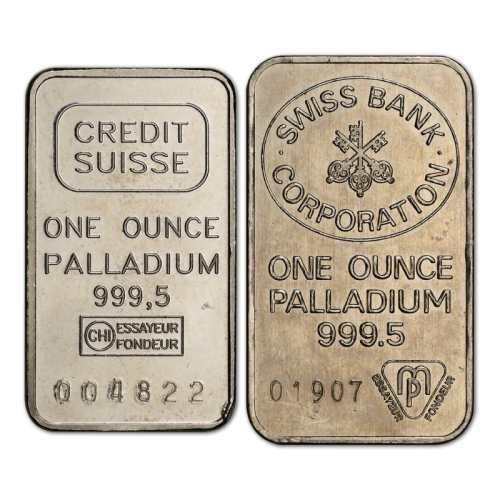
The physical condition of secondary market bars can range from pristine to showing light wear, scuffs, or surface marks from handling. These minor cosmetic variations do not alter the inherent market value of the underlying palladium. Obverse and reverse designs vary by manufacturer, but the weight and purity are consistently stamped onto each piece. Individual bars are securely shipped in protective plastic flips, though original assay certificates are not guaranteed to be included.
Palladium is one of the rarest metals on Earth, with primary production concentrated in a handful of specific geological formations. Unlike gold, which is mined on nearly every continent, global palladium production is heavily dominated by just two nations: Russia and South Africa, which combine to account for approximately 80% of the world's total mine output. This extreme geographic concentration makes the global palladium supply structurally vulnerable to geopolitical disruptions or labor disputes, creating sharp supply-and-demand dynamics.
The global market for this metal relies heavily on its functional industrial properties. Its primary demand sectors are distributed across automotive at 80.7%, industrial applications at 14.1%, physical investment at 2.9%, and jewelry at 2.3%. It is utilized in minute quantities to enable passenger vehicles to comply with stringent international air quality regulations. The global palladium market continues to see long-term expansion, driven by evolving emissions standards in emerging automotive markets.
Because palladium's price drivers are tied directly to automotive production cycles, environmental mandates, and industrial supply lines, its market behavior differs significantly from the macroeconomic factors that influence gold and silver. Adding physical palladium to precious metals holdings introduces a distinct price correlation profile, helping to balance a broader investment portfolio.
To qualify for placement within a Self-Directed Precious Metals IRA, palladium bullion must meet a strict minimum purity threshold of .9995 fine. The secondary market bars in our inventory fully satisfy this IRS requirement. Common brands frequently found in stock, such as PAMP Suisse, Credit Suisse, Baird & Co., and Johnson Matthey, are all produced by recognized, accredited refiners that satisfy institutional custodian standards. We recommend confirming specific onboarding and depository requirements with your chosen IRA custodian prior to finalizing your purchase.
The 1 oz Secondary Market Palladium Bar is the most cost-efficient entry point into physical palladium ownership, delivering one full troy ounce of .9995 fine palladium at the lowest available premium in the 1 oz bar category. These bars from various recognized manufacturers are an ideal choice for investors wanting to add physical palladium to their portfolio at a lower premium than brand-new, mint-sealed products.
Palladium is the least familiar of the four major investment-grade precious metals, yet it is arguably the most industrially essential. Its primary application lies in automotive catalytic converters for gasoline-powered vehicles, where it converts harmful pollutants into water and carbon dioxide. This critical industrial role, combined with a geographically concentrated global supply, gives palladium a unique market dynamic that behaves differently from traditional safe-haven metals. Every bar in inventory is verified for weight and purity before shipping. While the specific brand, design, and physical condition vary based on available stock, the underlying metal content, one full troy ounce of certified .9995 fine palladium, is guaranteed.
Secondary market palladium bars describe bullion pieces that were previously sold, kept in private storage, or reacquired through dealer buybacks rather than being freshly struck. Because these bars are sourced outside of a mint's initial retail release, they eliminate new-production fabrication costs, retail markups, and brand-specific premium surcharges. This allows investors to trade much closer to the current market spot price.
The physical condition of secondary market bars can range from pristine to showing light wear, scuffs, or surface marks from handling. These minor cosmetic variations do not alter the inherent market value of the underlying palladium. Obverse and reverse designs vary by manufacturer, but the weight and purity are consistently stamped onto each piece. Individual bars are securely shipped in protective plastic flips, though original assay certificates are not guaranteed to be included.
Palladium is one of the rarest metals on Earth, with primary production concentrated in a handful of specific geological formations. Unlike gold, which is mined on nearly every continent, global palladium production is heavily dominated by just two nations: Russia and South Africa, which combine to account for approximately 80% of the world's total mine output. This extreme geographic concentration makes the global palladium supply structurally vulnerable to geopolitical disruptions or labor disputes, creating sharp supply-and-demand dynamics.
The global market for this metal relies heavily on its functional industrial properties. Its primary demand sectors are distributed across automotive at 80.7%, industrial applications at 14.1%, physical investment at 2.9%, and jewelry at 2.3%. It is utilized in minute quantities to enable passenger vehicles to comply with stringent international air quality regulations. The global palladium market continues to see long-term expansion, driven by evolving emissions standards in emerging automotive markets.
Because palladium's price drivers are tied directly to automotive production cycles, environmental mandates, and industrial supply lines, its market behavior differs significantly from the macroeconomic factors that influence gold and silver. Adding physical palladium to precious metals holdings introduces a distinct price correlation profile, helping to balance a broader investment portfolio.
To qualify for placement within a Self-Directed Precious Metals IRA, palladium bullion must meet a strict minimum purity threshold of .9995 fine. The secondary market bars in our inventory fully satisfy this IRS requirement. Common brands frequently found in stock, such as PAMP Suisse, Credit Suisse, Baird & Co., and Johnson Matthey, are all produced by recognized, accredited refiners that satisfy institutional custodian standards. We recommend confirming specific onboarding and depository requirements with your chosen IRA custodian prior to finalizing your purchase.


Affiliations


Copyright BOLD Precious Metals 2026