
Share
Out of Stock
Share
The Gold $20 Liberty Double Eagle NGC/PCGS Graded Coin (MS61) is a valuable piece of American currency from the 19th and early 20th centuries. The Liberty Head Double Eagle, created by James B. Longacre, was manufactured between 1850 and 1907 and went on to become one of the biggest vintage American gold coins.
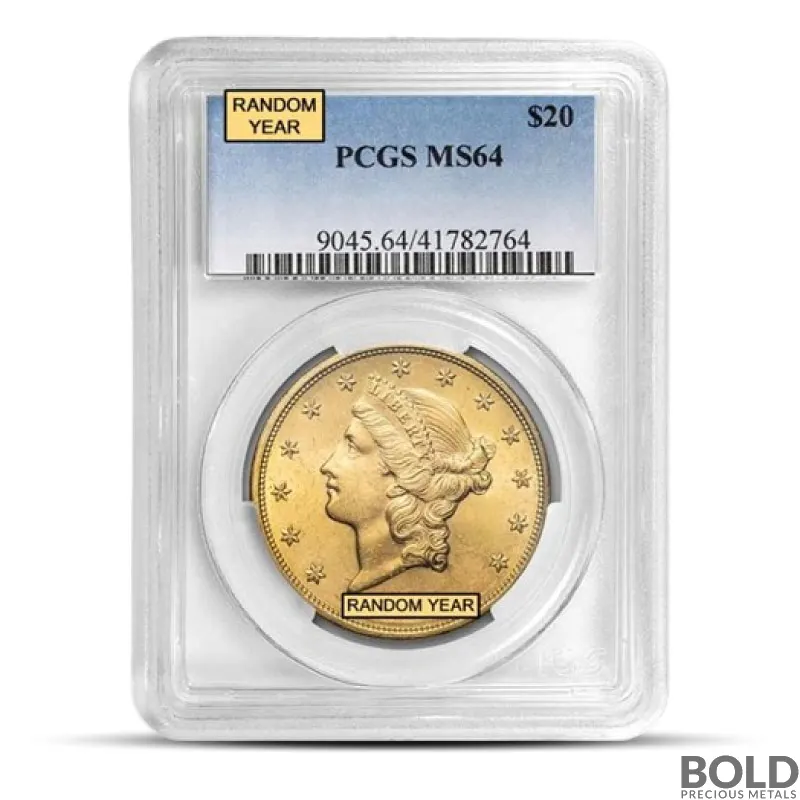
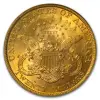
Each coin contains 0.9675 troy ounces of gold, weighs roughly 33.44 grams, and is made from .900 pure gold. The back has a heraldic eagle and various design elements that change depending on the coin's period and subtype, while the obverse shows Liberty wearing her engraved coronet.
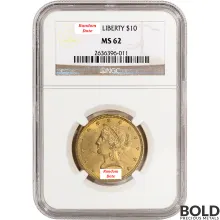
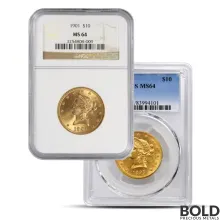
Most importantly, the coin has been independently authenticated, encapsulated, and assigned a Mint State 61 (MS61) grade by either NGC or PCGS. The exact year, mint, certification service, and holder style may vary according to available inventory.
The history of the Liberty Double Eagle is closely connected with the dramatic increase in American gold supplies following discoveries in California beginning in 1848.
The expanding supply of gold contributed to the authorization of new U.S. gold denominations, including the Double Eagle. Although initial patterns were prepared in 1849, regular production began in 1850.
Chief Engraver James B. Longacre created the Liberty Head design used on the Double Eagle throughout its long production period.
The series continued for more than half a century, surviving several design modifications before its final year in 1907.
Its combination of substantial size, high gold content, historical importance, and distinctive Longacre artwork has made the Liberty Gold Coins an enduring category among collectors of classic U.S. coinage.
The obverse features a left-facing portrait of Liberty wearing a coronet inscribed with the word “LIBERTY.”
Her hair is arranged in an elaborate style with curls descending behind her neck. A circle of 13 stars surrounds the portrait, representing the original states, while the individual coin's date appears below.
Longacre's Greco-Roman-inspired portrait gives the coin a distinctly mid-19th-century appearance and remained the foundation of the Liberty Double Eagle throughout the series.
Because this listing can include different dates, small design characteristics may vary depending on the specific subtype supplied.
The reverse centers on a detailed heraldic American eagle with outstretched wings.
A shield appears across the eagle's breast, while additional symbolic elements include stars and rays arranged above the central design.
The reverse evolved during the Liberty Double Eagle's lengthy production period. The motto “IN GOD WE TRUST” was introduced in 1866, and beginning in 1877 the denomination inscription was changed from an abbreviated form to “TWENTY DOLLARS.”
Mintmarks, when present, appear on the reverse and identify the U.S. Mint facility responsible for striking the individual coin.
The MS61 grade is one of the most important characteristics of this product.
“MS” stands for Mint State, indicating a coin that shows no wear from circulation. The numerical portion comes from the 70-point Sheldon grading scale used by major professional grading services.
An MS61 Liberty Double Eagle remains uncirculated but will generally display noticeable contact marks, abrasions, or other surface characteristics.
These marks are especially understandable on historic Double Eagles because the coins are large and heavy. Contact with other coins during original handling, transportation, and storage frequently produced marks even on examples that never circulated.
Strike quality and visual appearance can also differ from coin to coin. An MS61 grade therefore identifies the overall certified condition but does not mean that every MS61 example will look identical.
Each coin in this listing has been certified by either NGC (Numismatic Guaranty Company) or PCGS (Professional Coin Grading Service).
Professional certification provides several important pieces of information in one presentation.
The grading service examines the coin, authenticates it, identifies its date and mint attribution, assigns the MS61 grade, and encapsulates the coin inside a protective holder.
A certification label inside the holder displays identifying information and a unique certification number.
Because this listing includes NGC/PCGS assorted certification, buyers may receive a coin graded by either service. A particular grading company, label style, or holder generation should not be assumed unless specifically stated.
The protective holder should remain intact to preserve the certified presentation.
Although the Liberty Head Double Eagle maintained the same basic Longacre composition from 1850 through 1907, collectors generally divide the series into three major types.
Type 1 (1850–1866) features the original design without the motto above the eagle.
Type 2 (1866–1876) introduced “IN GOD WE TRUST” to the reverse and incorporated additional modifications to the eagle and shield.
Type 3 (1877–1907) changed the denomination inscription to its fully spelled-out form and included further refinements to Liberty's portrait.
The exact subtype received with an assorted-date product depends on available inventory.
These changes allow collectors to study how a single U.S. coin design evolved over more than five decades without losing its fundamental Longacre identity.
Liberty Double Eagles were produced at multiple U.S. Mint facilities during the series.
Depending on the date, examples can originate from Philadelphia, San Francisco, Carson City, New Orleans, or Denver.
Philadelphia coins generally carry no mintmark, while branch-mint examples use identifying letters such as S, CC, O, or D.
Not every facility produced Double Eagles throughout the entire 1850–1907 period. Production varied significantly by year and location.
Because this is an assorted-date certified listing, the exact date and mint should be confirmed from the certification label on the individual coin received.
The combination of date, mint, subtype, and certified grade gives each Liberty Double Eagle its own numismatic identity.
Collectors encountering an MS61 Double Eagle for the first time may wonder why an uncirculated coin can still have visible marks.
The explanation lies largely in the coin's physical characteristics.
At approximately 33.44 grams and 34 mm in diameter, Liberty Double Eagles are considerably larger and heavier than many other classic U.S. coins.
When newly struck coins came into contact with one another during handling and storage, their weight could produce noticeable marks and abrasions.
For grading purposes, important areas include Liberty's face and surrounding fields on the obverse, as well as prominent portions of the eagle on the reverse.
An MS61 example can therefore remain fully Mint State while displaying numerous marks consistent with its assigned grade.
| Specification | Details |
|---|---|
| Issuer | United States Mint |
| Series | Liberty Head Double Eagle |
| Designer | James B. Longacre |
| Years of Series | 1850–1907 |
| Metal | Gold |
| Gold Content | 0.9675 Troy oz |
| Purity | .900 Fine Gold |
| Composition | 90% Gold / 10% Copper |
| Approx. Gross Weight | 33.44 Grams |
| Diameter | Approx. 34 mm |
| Edge | Reeded |
| Grade | MS61 |
| Condition | Mint State / Uncirculated |
| Certification | NGC or PCGS |
| Date | Varies |
| Mint | Varies |
| Obverse | Coronet Head of Liberty |
| Reverse | Heraldic Eagle |
| Denomination | $20 |
| Packaging | Certified Protective Holder |
Add the Gold $20 Liberty Double Eagle NGC/PCGS Graded Coin (MS61) to your collection of classic U.S. gold coinage.
Containing 0.9675 troy oz of gold at .900 fineness, this historic James B. Longacre design combines substantial gold content with more than half a century of U.S. Mint history. Professional MS61 certification by NGC or PCGS adds independent authentication, grading, and protective encapsulation.
Buy the Gold $20 Liberty Double Eagle NGC/PCGS Graded Coin (MS61) from BOLD Precious Metals and add a professionally certified example of this historic American gold series to your collection.


Affiliations








Copyright BOLD Precious Metals 2026