

Share
| Quantity | Cash/Check | Credit Card | Paypal/Pay |
|---|---|---|---|
| 1 - 4 | $635.29 | $661.97 | $670.23 |
| 5 - 14 | $630.29 | $656.76 | $664.96 |
| 15 or more | $625.29 | $651.55 | $659.68 |
Share
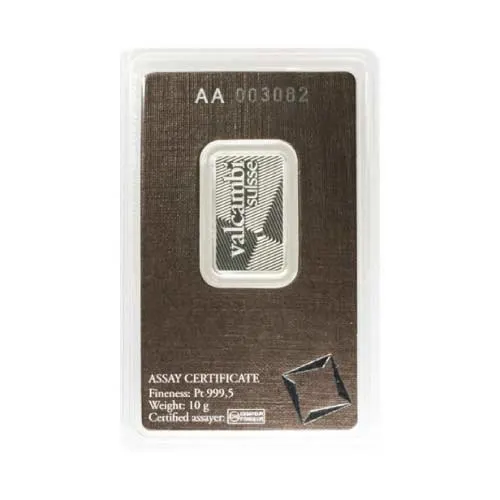
The Valcambi 10 Gram Platinum Bar is a practical, fractional, institutional-quality platinum investment, made in .9995 fine from one of the most highly credentialed precious metals refineries, and sealed in the highly secure and tamper-evident assay card that includes a uniquely serialized number matching the bar itself and the documentation.
This bar is 10 grams and thus finds itself in an important niche in the platinum bar market. It's large enough to offer a meaningful per-gram premium over 1 gram, and 2.5 gram bars, small enough to still be accessible to easy incremental accumulation, and provided with the full authentication suite that makes Valcambi platinum bars globally recognised by dealers and easily liquidated on the secondary market: sealed assay, matched serial number, ESSAYEUR FONDEUR assayer certification.
One of the most popular types of platinum bullion in the market is platinum bars. The demand for platinum is not only in the jewelry sector but also in several other industries, and the annual production of this precious metal is limited, making investing in platinum bars a safe bet against other market factors. BOLD Precious Metals.
With its 10 gram weight, the Valcambi bar is positioned on the investment-efficiency-and-accessibility cross-over. It offers an advantage to those investors who are accumulating their holdings in platinum and are buying several times over the course of years, over fractional bars, but still doesn't require the same amount of outlay as a 1 oz bar. Investors looking to diversify an existing gold and silver portfolio into platinum are looking for the perfect exploratory position—enough platinum to be an allocation, at a price point that doesn't force overcommitment.
The platinum bars supplied by BOLD Precious Metals are all from authorized distribution sources. All bars are packaged in their original factory packaging and have not been opened or touched with an assay card.
These elegant and modern platinum bars are 10 grams in weight and have a mirror finish. The obverse features Valcambi's full authentication and identification with a clear vertical format. Valcambi's logo, which is a rotating square with four triangles intersecting, is at the top—an emblem that resembles the visual cross-section of four LBMA Good Delivery bars. It's a special view of the logo that's believed to be created by cutting four LBMA Good Delivery bars in a cross-section.
The inscriptions below the logo certify purity and weight: 10 G · PLATINUM · 9995. The ESSAYEUR FONDEUR assayer's mark is below the inscription of the purity, indicating that the bar was certified by a certified assayer independent of the manufacturer, according to the Swiss Precious Metals Control Law. The stamp's peculiar serial number is also present on the packaging of the assay card and printed on the bar at the base of the obverse, forming a matched authentication pair, using Valcambi's two-letter and six-number coding system.
On the back is the clean, modern typeface "Valcambi Suisse," which includes the name of the refinery. The radiating (geometrical) design from the edge of the Valcambi square logo spreads out in an expanding form to the edges of the bar—a radiating form which seems to reach out from the edges of the square logo towards the bar's edges. Valcambi's signature across their platinum bar range is this distinctive expanding-square reverse, and one of the most instantly recognisable hallmark reverses in the precious metals bar market.
Valcambi Suisse began in Balerna, Canton Ticino, Switzerland, in 1961 as a private enterprise called “Valori & Cambi” and is now a family company owned by the Bally family. The company is located in the town of Balerna, Switzerland, and has a rich history dating back to its establishment in 1961. In over 60 years, it has developed to become one of the largest and most qualified precious metals refineries in the world, handling around 2,000 metric tonnes of precious metals a year for gold, silver, platinum, and palladium.
Valcambi's headquarters and refinery are in Balerna, Switzerland. The Valcambi brand is well known globally and is one of the few metal refiners that received accreditation from the London Bullion Market Association (LBMA), New York Mercantile Exchange (NYMEX), COMEX Division, Tokyo Commodity Exchange (TOCOM) and Dubai Multi Commodities Centre (DMCC).
Valcambi's worldwide institutional recognition is based on this multi-exchange accreditation system. These four so-called "big four exchanges" keep their own approved lists of producers, and a bar producer is subject to certain production requirements, purity standards and traceability criteria to be accepted onto each list. By being listed on all four, Valcambi's platinum bars are available for settlement on any major precious metals exchange around the world and will be immediately recognized and accepted by institutional dealers, banks and refiners worldwide without further verification.
The platinum-specific equivalent of LBMA Good Delivery status, LPPM (London Platinum and Palladium Market) accreditation is particularly advantageous to Valcambi's platinum operations, as it is the accepted benchmark for platinum institutional bars that are being settled on the London market.
Platinum isn't just another precious metal. A metal in which basic supply and demand forces are setting the stage for investment exposure to be in a long-term favorable position.
The platinum market has suffered three annual deficits in a row, with mine supply dropping to its lowest point in five years to 5.51 million ounces in 2025, according to the World Platinum Investment Council (WPIC). The market gaps for platinum are expected to remain at a sustainable level of over 500,000 ounces per year at least until 2029.
However, institutional investors are growing more bullish as the supply constraints of platinum seem more structural than cyclical. The market could have to endure deficits for years as inventories are falling and mine supply remains sluggish with rising prices. This has resulted in analysts setting price targets such as $2,450 an ounce by Bank of America for 2026.
The geopolitical risks and structural problems faced by South Africa are compounded by mining shortages—over 486,000 ounces are expected to be in short supply in 2026. South Africa produces about 80% of the world's platinum and continues to face difficulties with production, resulting in contractions to the supply structure. If the disruption stemmed from any disruption of South Africa's mining production, whether from instability in the power sector or from strikes or from infrastructure problems, it would directly tighten the global supply balance, and there simply aren't any quick substitutes for South African production.
More than 40% of the world's demand for platinum is in the automotive industry, where it is applied to automotive catalytic converters, which help to lower emissions. Platinum is used in the technology of hydrogen fuel cells, which are an important element of renewable energy, and the fuel cell catalyst market is expected to expand at a CAGR of 8.4% from 2025 to 2033. CoinWeek
The WPIC forecasts that by 2030 hydrogen end-use demand will comprise about 875,000 ounces per year, a relatively insignificant amount at this time, but one that is entirely new structural demand for the platinum market that has not been absorbed before.
For a lot of its trading history, platinum was sold at a higher price than gold. The price of the two metals has drastically parted ways since 2015, when gold was selling at a premium compared to platinum per ounce. Many analysts and institutional investors believe that this divergence is structurally unusual—and the third annual platinum supply deficit, along with growing demand for green energy, will most likely be the mix of factors that will bring the gap back in balance over the medium to long term.
Physical platinum bars offer direct exposure to platinum price movements, with no counterparty risk, management fees, or rollover costs for futures-based exposure. Platinum's resistance to corrosion, as well as its malleability and high unreactivity, makes it a sought-after metal for use in catalytic converters, laboratory equipment, and electrical contacts, and its industrial properties are reflected in its use at the floor level as well—properties gold does not have. The price rise associated with physical bar holders is a result of the increase in the price of their bars and an increase in the demand for them in industry.
The 10 gram size is the best initial investment option for serious investors who are looking for fractional holdings at a higher level than the smallest sizes but are not ready to jump in at 1 oz. Offering meaningful platinum exposure at a manageable outlay in the most credentialed form of platinum bar, it offers a way to get some exposure to the precious metal.
Precious metal investors who hold all their assets as monetary metals will enjoy having the added dimension of platinum's demand structure. The difference in demand structure is a bonus for gold and silver investors who have all their assets invested in monetary metals. The price of platinum is influenced by conditions in the automotive industry, the development of the hydrogen industry, and conditions in South African mines, among other factors, but these factors are not as related to monetary inflation and dollar strength as they are to gold and silver. Once an investor has established a gold and silver position, a 10 gram bar is a logical next step.
Retirement investors can access .9995 purity 10 gram format IRA eligibility systematically over time—via multiple separate donations. The Valcambi institutional credentials and LPPM accreditation meet most IRA custodial requirements in addition to the basic purity.
Some of the most unique visual identities in bar production worldwide are the expanding-square logo and the rotating-square logo, both created by Valcambi. The 10 gram is the middle denomination for collectors who collect by the refinery—the middle size to create a collection and the large size to display the design with maximum visual impact.
An elegant, unforgettable gift: a 10 gram Valcambi platinum bar in a sealed assay card. Valcambi's name resonates with 60 years of Swiss refinery heritage. The sealed blister packaging guarantees the bar and clearly displays it. The platinum is a gift, and it is truly rare, even more so than gold—and in its third straight year of structural shortage.
The Valcambi 10 Gram Platinum Bar is a practical, fractional, institutional-quality platinum investment, made in .9995 fine from one of the most highly credentialed precious metals refineries, and sealed in the highly secure and tamper-evident assay card that includes a uniquely serialized number matching the bar itself and the documentation.
This bar is 10 grams and thus finds itself in an important niche in the platinum bar market. It's large enough to offer a meaningful per-gram premium over 1 gram, and 2.5 gram bars, small enough to still be accessible to easy incremental accumulation, and provided with the full authentication suite that makes Valcambi platinum bars globally recognised by dealers and easily liquidated on the secondary market: sealed assay, matched serial number, ESSAYEUR FONDEUR assayer certification.
One of the most popular types of platinum bullion in the market is platinum bars. The demand for platinum is not only in the jewelry sector but also in several other industries, and the annual production of this precious metal is limited, making investing in platinum bars a safe bet against other market factors. BOLD Precious Metals.
With its 10 gram weight, the Valcambi bar is positioned on the investment-efficiency-and-accessibility cross-over. It offers an advantage to those investors who are accumulating their holdings in platinum and are buying several times over the course of years, over fractional bars, but still doesn't require the same amount of outlay as a 1 oz bar. Investors looking to diversify an existing gold and silver portfolio into platinum are looking for the perfect exploratory position—enough platinum to be an allocation, at a price point that doesn't force overcommitment.
The platinum bars supplied by BOLD Precious Metals are all from authorized distribution sources. All bars are packaged in their original factory packaging and have not been opened or touched with an assay card.
These elegant and modern platinum bars are 10 grams in weight and have a mirror finish. The obverse features Valcambi's full authentication and identification with a clear vertical format. Valcambi's logo, which is a rotating square with four triangles intersecting, is at the top—an emblem that resembles the visual cross-section of four LBMA Good Delivery bars. It's a special view of the logo that's believed to be created by cutting four LBMA Good Delivery bars in a cross-section.
The inscriptions below the logo certify purity and weight: 10 G · PLATINUM · 9995. The ESSAYEUR FONDEUR assayer's mark is below the inscription of the purity, indicating that the bar was certified by a certified assayer independent of the manufacturer, according to the Swiss Precious Metals Control Law. The stamp's peculiar serial number is also present on the packaging of the assay card and printed on the bar at the base of the obverse, forming a matched authentication pair, using Valcambi's two-letter and six-number coding system.
On the back is the clean, modern typeface "Valcambi Suisse," which includes the name of the refinery. The radiating (geometrical) design from the edge of the Valcambi square logo spreads out in an expanding form to the edges of the bar—a radiating form which seems to reach out from the edges of the square logo towards the bar's edges. Valcambi's signature across their platinum bar range is this distinctive expanding-square reverse, and one of the most instantly recognisable hallmark reverses in the precious metals bar market.
Valcambi Suisse began in Balerna, Canton Ticino, Switzerland, in 1961 as a private enterprise called “Valori & Cambi” and is now a family company owned by the Bally family. The company is located in the town of Balerna, Switzerland, and has a rich history dating back to its establishment in 1961. In over 60 years, it has developed to become one of the largest and most qualified precious metals refineries in the world, handling around 2,000 metric tonnes of precious metals a year for gold, silver, platinum, and palladium.
Valcambi's headquarters and refinery are in Balerna, Switzerland. The Valcambi brand is well known globally and is one of the few metal refiners that received accreditation from the London Bullion Market Association (LBMA), New York Mercantile Exchange (NYMEX), COMEX Division, Tokyo Commodity Exchange (TOCOM) and Dubai Multi Commodities Centre (DMCC).
Valcambi's worldwide institutional recognition is based on this multi-exchange accreditation system. These four so-called "big four exchanges" keep their own approved lists of producers, and a bar producer is subject to certain production requirements, purity standards and traceability criteria to be accepted onto each list. By being listed on all four, Valcambi's platinum bars are available for settlement on any major precious metals exchange around the world and will be immediately recognized and accepted by institutional dealers, banks and refiners worldwide without further verification.
The platinum-specific equivalent of LBMA Good Delivery status, LPPM (London Platinum and Palladium Market) accreditation is particularly advantageous to Valcambi's platinum operations, as it is the accepted benchmark for platinum institutional bars that are being settled on the London market.
Platinum isn't just another precious metal. A metal in which basic supply and demand forces are setting the stage for investment exposure to be in a long-term favorable position.
The platinum market has suffered three annual deficits in a row, with mine supply dropping to its lowest point in five years to 5.51 million ounces in 2025, according to the World Platinum Investment Council (WPIC). The market gaps for platinum are expected to remain at a sustainable level of over 500,000 ounces per year at least until 2029.
However, institutional investors are growing more bullish as the supply constraints of platinum seem more structural than cyclical. The market could have to endure deficits for years as inventories are falling and mine supply remains sluggish with rising prices. This has resulted in analysts setting price targets such as $2,450 an ounce by Bank of America for 2026.
The geopolitical risks and structural problems faced by South Africa are compounded by mining shortages—over 486,000 ounces are expected to be in short supply in 2026. South Africa produces about 80% of the world's platinum and continues to face difficulties with production, resulting in contractions to the supply structure. If the disruption stemmed from any disruption of South Africa's mining production, whether from instability in the power sector or from strikes or from infrastructure problems, it would directly tighten the global supply balance, and there simply aren't any quick substitutes for South African production.
More than 40% of the world's demand for platinum is in the automotive industry, where it is applied to automotive catalytic converters, which help to lower emissions. Platinum is used in the technology of hydrogen fuel cells, which are an important element of renewable energy, and the fuel cell catalyst market is expected to expand at a CAGR of 8.4% from 2025 to 2033. CoinWeek
The WPIC forecasts that by 2030 hydrogen end-use demand will comprise about 875,000 ounces per year, a relatively insignificant amount at this time, but one that is entirely new structural demand for the platinum market that has not been absorbed before.
For a lot of its trading history, platinum was sold at a higher price than gold. The price of the two metals has drastically parted ways since 2015, when gold was selling at a premium compared to platinum per ounce. Many analysts and institutional investors believe that this divergence is structurally unusual—and the third annual platinum supply deficit, along with growing demand for green energy, will most likely be the mix of factors that will bring the gap back in balance over the medium to long term.
Physical platinum bars offer direct exposure to platinum price movements, with no counterparty risk, management fees, or rollover costs for futures-based exposure. Platinum's resistance to corrosion, as well as its malleability and high unreactivity, makes it a sought-after metal for use in catalytic converters, laboratory equipment, and electrical contacts, and its industrial properties are reflected in its use at the floor level as well—properties gold does not have. The price rise associated with physical bar holders is a result of the increase in the price of their bars and an increase in the demand for them in industry.
The 10 gram size is the best initial investment option for serious investors who are looking for fractional holdings at a higher level than the smallest sizes but are not ready to jump in at 1 oz. Offering meaningful platinum exposure at a manageable outlay in the most credentialed form of platinum bar, it offers a way to get some exposure to the precious metal.
Precious metal investors who hold all their assets as monetary metals will enjoy having the added dimension of platinum's demand structure. The difference in demand structure is a bonus for gold and silver investors who have all their assets invested in monetary metals. The price of platinum is influenced by conditions in the automotive industry, the development of the hydrogen industry, and conditions in South African mines, among other factors, but these factors are not as related to monetary inflation and dollar strength as they are to gold and silver. Once an investor has established a gold and silver position, a 10 gram bar is a logical next step.
Retirement investors can access .9995 purity 10 gram format IRA eligibility systematically over time—via multiple separate donations. The Valcambi institutional credentials and LPPM accreditation meet most IRA custodial requirements in addition to the basic purity.
Some of the most unique visual identities in bar production worldwide are the expanding-square logo and the rotating-square logo, both created by Valcambi. The 10 gram is the middle denomination for collectors who collect by the refinery—the middle size to create a collection and the large size to display the design with maximum visual impact.
An elegant, unforgettable gift: a 10 gram Valcambi platinum bar in a sealed assay card. Valcambi's name resonates with 60 years of Swiss refinery heritage. The sealed blister packaging guarantees the bar and clearly displays it. The platinum is a gift, and it is truly rare, even more so than gold—and in its third straight year of structural shortage.


Affiliations


Copyright BOLD Precious Metals 2026