

Share
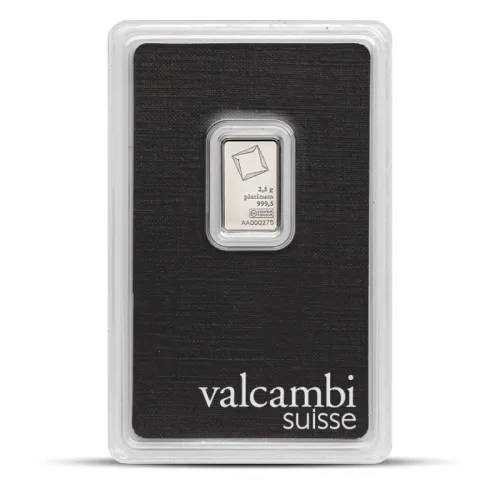
This platinum bar from the renowned Valcambi Refinery contains 2.5 grams of .9995 platinum in a compact size and carries excellent investment potential!
Out of Stock
Share
The 2.5 Gram Valcambi Suisse Platinum Bar has become the entry point for physical platinum bullion for one of the world's most highly qualified precious metals refiners. The small minted ingot contains 0.08037 troy ounces of .9995 pure platinum bullion, at the highest standard of pure bullion and is sealed in the tamper-evident assay packaging from Valcambi, the Swiss federal regulated refinery, and comes with a unique serial number for complete authentication from refinery to hand.
Valcambi's precision-stamped identification is neatly displayed on the obverse face. Valcambi's unique rotating-square logo can be found at the top, which is one of the most widely recognized symbols in the worldwide market for precious metals – the four-triangle emblem. Under the logo, there are the following inscriptions: 2.5 G · PLATINUM · 999.5. The assayer's stamp, the traditional French name ESSAYEUR FONDEUR, and the bar's unique serial number are located below the purity marking. It is printed on the assay card as well as on the bar, ensuring consistent documentation and authentication of the metal.
The bars are designed in a modern and elegant manner and have a mirror finish. The 2,5 gram bar has a polished surface of platinum and the correct markings have been carefully minted, adding to the bar's overall aesthetic appeal, given its compact, small size.
When the design field is displayed in landscape mode, the reverse displays the Valcambi Suisse name at the top of the design field. The field is filled with the mint logo in a repeating pattern, adding depth to the scene. The minted bar range utilizes this Valcambi anti-counterfeiting detail and design throughout, with a repeating Valcambi logo on the reverse of each bar being an extra visual authentication marker.
There is a unique aspect to Valcambi Suisse's platinum refiners that not many refineries in the world can boast of: it is one of the five referees in the London Platinum and Palladium Market (LPPM) Good Delivery List for platinum. Valcambi is also one of the five referees of the prestigious Good Delivery Refiner list of Platinum London Platinum and Palladium Market (LPPM) which is a list of the world's leading Platinum refineries.
This LPPM referee status is not limited to just meeting Good Delivery criteria; it is the rare few refineries that set and test Good Delivery criteria for the global platinum market. This is not possible with any private mint. It's a level of institutional platinum credibility that is truly rare.
Valcambi SA’s refinery is accredited with the most prestigious entities such as the London Platinum and Palladium Market (LPPM), the New York Mercantile Exchange (NYMEX), CME Group (COMEX), the Tokyo Commodity Exchange (TOCOM) and Dubai Multi Commodities Centre (DMCC). These certifications emphasize Valcambi's dedication to quality and integrity.
Valcambi 1 oz platinum bars undergo testing for purity by independent certified precious metals assayers according to the Swiss Precious Metals Control Law and are sealed in a protective plastic blister pack with a unique assay certificate. The .9995 fine platinum bullion bars are ISO 9001 Registered and conform to all the LPPM Good Delivery requirements.
Valcambi was established in 1961 in Balerna, Switzerland, with one of the biggest precious metals refinery complexes in the world, covering an area of 3.3 hectares and processing about 2000 mT of precious metals per year. Each 2.5 gram platinum bar shipped to BOLD customers is created under the same set of standards for refinery, staff, and accreditation that led to the designation of LPPM.
For the most part, investors know gold is scarce. Not many realize that platinum is much more scarce. The world mines about 3,000 metric tons of gold each year and about 190 metric tons of platinum. That is equivalent to about 16 times more gold, in metric tons, than platinum is mined annually worldwide. This extreme scarcity is key to the long-term value proposition of platinum.
The platinum is being produced mainly in two countries: South Africa produces approximately 70% of the amount coming from the world and Russia approximately 12%. The close interdependence in production creates systemic supply concentration risk, which is now being considered by institutional portfolio allocators as an institutional portfolio variable. The price surges have been caused by mining disruption in South Africa (due to flooding, power failure, and infrastructure) and geopolitical concerns on Russian supply, which have resulted in severe supply shortages in the platinum market on several occasions and which have benefited physical holders.
The World Platinum Investment Council estimates that more than 35% of the platinum mined per year is used in vehicles in catalytic converters. Twenty-five percent of the demand in the key markets, such as China, India and North America, is for jewelry. Other applications are chemical processing, refining, medical devices and new technologies in green applications.
The advent of the green energy transition is a new, long-term driver of platinum demand. The industrial demand for platinum is expected to be solid as emission standards get tighter and hydrogen technology is growing. Platinum is a catalyst utilized in the production of hydrogen fuel cells, which are the technology behind fuel-cell vehicles and large-scale hydrogen energy storage, and therefore establishes a growing structure bottom floor that is not the case with gold or silver.
Platinum market is experiencing an increasing shortage of supply. South Africa accounts for 70% of global output, and a lack of expansion capital investment is putting a drag on mine supply and exacerbating the deficit. Owners of physical platinum enjoy the upside of the price movement that ensues when supply is constrained and industry demand is steady.
Most of the time in market history, the price of platinum has been higher than the price of gold. Historically the price of platinum has been at or above the price of gold, but since 2015 the prices of the two have fallen apart with gold on the up climb. Many analysts see this spread as a temporary phenomenon that will come to an end, and those who buy physical platinum at current prices are likely to profit in the future when this spread reverses.
The 2.5 Gram Valcambi Suisse Platinum Bar has become the entry point for physical platinum bullion for one of the world's most highly qualified precious metals refiners. The small minted ingot contains 0.08037 troy ounces of .9995 pure platinum bullion, at the highest standard of pure bullion and is sealed in the tamper-evident assay packaging from Valcambi, the Swiss federal regulated refinery, and comes with a unique serial number for complete authentication from refinery to hand.
Valcambi's precision-stamped identification is neatly displayed on the obverse face. Valcambi's unique rotating-square logo can be found at the top, which is one of the most widely recognized symbols in the worldwide market for precious metals – the four-triangle emblem. Under the logo, there are the following inscriptions: 2.5 G · PLATINUM · 999.5. The assayer's stamp, the traditional French name ESSAYEUR FONDEUR, and the bar's unique serial number are located below the purity marking. It is printed on the assay card as well as on the bar, ensuring consistent documentation and authentication of the metal.
The bars are designed in a modern and elegant manner and have a mirror finish. The 2,5 gram bar has a polished surface of platinum and the correct markings have been carefully minted, adding to the bar's overall aesthetic appeal, given its compact, small size.
When the design field is displayed in landscape mode, the reverse displays the Valcambi Suisse name at the top of the design field. The field is filled with the mint logo in a repeating pattern, adding depth to the scene. The minted bar range utilizes this Valcambi anti-counterfeiting detail and design throughout, with a repeating Valcambi logo on the reverse of each bar being an extra visual authentication marker.
There is a unique aspect to Valcambi Suisse's platinum refiners that not many refineries in the world can boast of: it is one of the five referees in the London Platinum and Palladium Market (LPPM) Good Delivery List for platinum. Valcambi is also one of the five referees of the prestigious Good Delivery Refiner list of Platinum London Platinum and Palladium Market (LPPM) which is a list of the world's leading Platinum refineries.
This LPPM referee status is not limited to just meeting Good Delivery criteria; it is the rare few refineries that set and test Good Delivery criteria for the global platinum market. This is not possible with any private mint. It's a level of institutional platinum credibility that is truly rare.
Valcambi SA’s refinery is accredited with the most prestigious entities such as the London Platinum and Palladium Market (LPPM), the New York Mercantile Exchange (NYMEX), CME Group (COMEX), the Tokyo Commodity Exchange (TOCOM) and Dubai Multi Commodities Centre (DMCC). These certifications emphasize Valcambi's dedication to quality and integrity.
Valcambi 1 oz platinum bars undergo testing for purity by independent certified precious metals assayers according to the Swiss Precious Metals Control Law and are sealed in a protective plastic blister pack with a unique assay certificate. The .9995 fine platinum bullion bars are ISO 9001 Registered and conform to all the LPPM Good Delivery requirements.
Valcambi was established in 1961 in Balerna, Switzerland, with one of the biggest precious metals refinery complexes in the world, covering an area of 3.3 hectares and processing about 2000 mT of precious metals per year. Each 2.5 gram platinum bar shipped to BOLD customers is created under the same set of standards for refinery, staff, and accreditation that led to the designation of LPPM.
For the most part, investors know gold is scarce. Not many realize that platinum is much more scarce. The world mines about 3,000 metric tons of gold each year and about 190 metric tons of platinum. That is equivalent to about 16 times more gold, in metric tons, than platinum is mined annually worldwide. This extreme scarcity is key to the long-term value proposition of platinum.
The platinum is being produced mainly in two countries: South Africa produces approximately 70% of the amount coming from the world and Russia approximately 12%. The close interdependence in production creates systemic supply concentration risk, which is now being considered by institutional portfolio allocators as an institutional portfolio variable. The price surges have been caused by mining disruption in South Africa (due to flooding, power failure, and infrastructure) and geopolitical concerns on Russian supply, which have resulted in severe supply shortages in the platinum market on several occasions and which have benefited physical holders.
The World Platinum Investment Council estimates that more than 35% of the platinum mined per year is used in vehicles in catalytic converters. Twenty-five percent of the demand in the key markets, such as China, India and North America, is for jewelry. Other applications are chemical processing, refining, medical devices and new technologies in green applications.
The advent of the green energy transition is a new, long-term driver of platinum demand. The industrial demand for platinum is expected to be solid as emission standards get tighter and hydrogen technology is growing. Platinum is a catalyst utilized in the production of hydrogen fuel cells, which are the technology behind fuel-cell vehicles and large-scale hydrogen energy storage, and therefore establishes a growing structure bottom floor that is not the case with gold or silver.
Platinum market is experiencing an increasing shortage of supply. South Africa accounts for 70% of global output, and a lack of expansion capital investment is putting a drag on mine supply and exacerbating the deficit. Owners of physical platinum enjoy the upside of the price movement that ensues when supply is constrained and industry demand is steady.
Most of the time in market history, the price of platinum has been higher than the price of gold. Historically the price of platinum has been at or above the price of gold, but since 2015 the prices of the two have fallen apart with gold on the up climb. Many analysts see this spread as a temporary phenomenon that will come to an end, and those who buy physical platinum at current prices are likely to profit in the future when this spread reverses.


Affiliations


Copyright BOLD Precious Metals 2026