


Share
| Quantity | Cash/Check | Credit Card | Paypal/Pay |
|---|---|---|---|
| Any Quantity | $74.61 | $77.74 | $78.71 |
Share
The 2022 Tokelau Hibernia 1 oz Silver BU Coin from the European Mint celebrates Hibernia, the classical personification of Ireland, having been used by the Greek and Roman authors for more than 2,000 years.The coin is made from 50,000 .9999 fine silver, has a Brilliant Uncirculated (BU) finish, and was minted globally at a limited mintage.
On the front, it has the last portrait of Queen Elizabeth II and Hibernia herself, Irish harp at her side, holding a spear.Each coin comes in an acrylic capsule issued by the mints. Face value: $2 New Zealand dollars, with the backing of the Tokelau government.
Obverse — The theme is based on the one from the 1990 series
On the obverse is the Ian Rank-Broadley Fourth Portrait of Her Majesty Queen Elizabeth II, a coin portrait that was used on British Commonwealth coins for decades and is the definitive portrait of the Queen in a right-facing profile depiction wearing the Girls of Great Britain and Ireland Tiara.The numbers on the surrounding inscriptions are "ELIZABETH II. TOKELAU 2022 . TWO DOLLARS.
Reverse — Hibernia
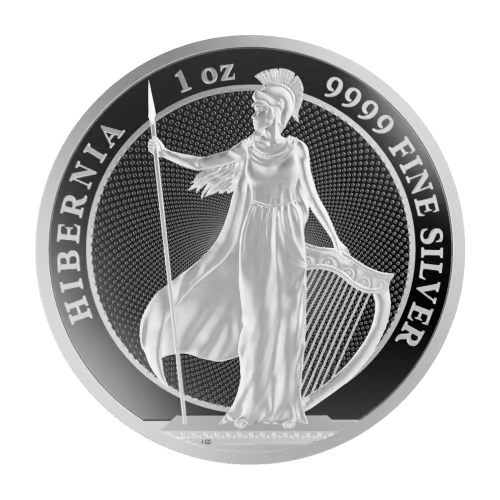
On the reverse is depicted the classical female personification of Ireland, Hibernia, standing.She is standing erect, looking directly at the viewer, in a heroic mold from Greek and Roman art. In her right hand she holds a spear, the ancient weapon of sovereignty and defense.She is holding the harp, which is the national instrument and the only national symbol of Ireland that is a musical instrument.Hibernianum: "HIBERNIA" and "1 oz 9999 FINE SILVER.
Hibernia has come to be the name of Ireland over more than two millennia.It is the earliest known as the Greek "Ierne," which was first recorded by Pytheas of Massilia, a Greek explorer and geographer, who wrote in the 4th century BC in his lost work. On the Ocean.Later writers of Greek and Roman descent were designers of the name and changed it to their own phonetic systems.The Latinized version "Hibernia" was now commonly used by the Romans in the 1st century BC.It was used by Julius Caesar in his Commentarii de Bello Gallico, the most popular Latin prose of all time, which made the name indelible in European literary history.The name "hibernus" was borrowed from Latin, but its true origin is likely to have been quite different, as the name sounds nothing like it.It is believed to have originated in the Q-Celtic word, Īweriū, which means “fertile land” or “abundant land," a word to refer to the fertile landmass of Ireland, not the weather.The association with "winter" is a folk etymology that has become popular.Hibernia as a personification, or female figure representing the island, first appears visually in the 17th century and develops into a recognizable figure in the 18th and 19th centuries, with Hibernians becoming a familiar symbol in art, coinage, and nationalistic images, inspired by classical Greek and Roman allegories.The physical representation that's still with us today is a statue of Hibernia holding a harp and spear, which was created by Edward Smyth and erected in the center of Dublin on the top of the General Post Office in O'Connell Street, home to the revolutionary headquarters of the 1916 Easter Rising.The harp that she carries is not just for decoration. It's Ireland's national symbol and is featured on the state seals, passports, and euro coins. A musical instrument is the only symbol of Ireland used in the entire world.
European Mint is a private bullion coin manufacturer located in Tallinn, Estonia, that has been in operation since 2013.The European Mint manufactures official legal coins for Tokelau in the New Zealand Dollar using coins issued by the Tokelau government and minted by the European Mint, employing European mint techniques with Tokelau's legal coin-issuing authority.Tokelau is a small island territory of New Zealand in the South Pacific, comprising three atolls, with a population of about 1,500.
It is recognized as legal tender and is backed by the Tokelau government and has a genuine face value in New Zealand dollars, although it is used and collected for bullion and collector purposes.
The 2022 Tokelau Hibernia 1 oz Silver BU Coin from the European Mint celebrates Hibernia, the classical personification of Ireland, having been used by the Greek and Roman authors for more than 2,000 years.The coin is made from 50,000 .9999 fine silver, has a Brilliant Uncirculated (BU) finish, and was minted globally at a limited mintage.
On the front, it has the last portrait of Queen Elizabeth II and Hibernia herself, Irish harp at her side, holding a spear.Each coin comes in an acrylic capsule issued by the mints. Face value: $2 New Zealand dollars, with the backing of the Tokelau government.
Obverse — The theme is based on the one from the 1990 series
On the obverse is the Ian Rank-Broadley Fourth Portrait of Her Majesty Queen Elizabeth II, a coin portrait that was used on British Commonwealth coins for decades and is the definitive portrait of the Queen in a right-facing profile depiction wearing the Girls of Great Britain and Ireland Tiara.The numbers on the surrounding inscriptions are "ELIZABETH II. TOKELAU 2022 . TWO DOLLARS.
Reverse — Hibernia
On the reverse is depicted the classical female personification of Ireland, Hibernia, standing.She is standing erect, looking directly at the viewer, in a heroic mold from Greek and Roman art. In her right hand she holds a spear, the ancient weapon of sovereignty and defense.She is holding the harp, which is the national instrument and the only national symbol of Ireland that is a musical instrument.Hibernianum: "HIBERNIA" and "1 oz 9999 FINE SILVER.
Hibernia has come to be the name of Ireland over more than two millennia.It is the earliest known as the Greek "Ierne," which was first recorded by Pytheas of Massilia, a Greek explorer and geographer, who wrote in the 4th century BC in his lost work. On the Ocean.Later writers of Greek and Roman descent were designers of the name and changed it to their own phonetic systems.The Latinized version "Hibernia" was now commonly used by the Romans in the 1st century BC.It was used by Julius Caesar in his Commentarii de Bello Gallico, the most popular Latin prose of all time, which made the name indelible in European literary history.The name "hibernus" was borrowed from Latin, but its true origin is likely to have been quite different, as the name sounds nothing like it.It is believed to have originated in the Q-Celtic word, Īweriū, which means “fertile land” or “abundant land," a word to refer to the fertile landmass of Ireland, not the weather.The association with "winter" is a folk etymology that has become popular.Hibernia as a personification, or female figure representing the island, first appears visually in the 17th century and develops into a recognizable figure in the 18th and 19th centuries, with Hibernians becoming a familiar symbol in art, coinage, and nationalistic images, inspired by classical Greek and Roman allegories.The physical representation that's still with us today is a statue of Hibernia holding a harp and spear, which was created by Edward Smyth and erected in the center of Dublin on the top of the General Post Office in O'Connell Street, home to the revolutionary headquarters of the 1916 Easter Rising.The harp that she carries is not just for decoration. It's Ireland's national symbol and is featured on the state seals, passports, and euro coins. A musical instrument is the only symbol of Ireland used in the entire world.
European Mint is a private bullion coin manufacturer located in Tallinn, Estonia, that has been in operation since 2013.The European Mint manufactures official legal coins for Tokelau in the New Zealand Dollar using coins issued by the Tokelau government and minted by the European Mint, employing European mint techniques with Tokelau's legal coin-issuing authority.Tokelau is a small island territory of New Zealand in the South Pacific, comprising three atolls, with a population of about 1,500.
It is recognized as legal tender and is backed by the Tokelau government and has a genuine face value in New Zealand dollars, although it is used and collected for bullion and collector purposes.


Affiliations


Copyright BOLD Precious Metals 2026