

Share
| Quantity | Cash/Check | Credit Card | Paypal/Pay |
|---|---|---|---|
| 1 - 19 | $68.31 | $71.18 | $72.07 |
| 20 - 49 | $67.81 | $70.66 | $71.54 |
| 50 or more | $67.31 | $70.14 | $71.01 |
Share
The Gibraltar War Elephant 2023 1 oz Silver BU Coin is the second of the War Elephant Series coins issued by Scottsdale Mint for the Government of Gibraltar. Each is produced in .999 fine silver in Brilliant Uncirculated finish with a limited mintage of 15,000 worldwide, which is the same as the first 2022 issue. It is 1 Pound in face value and is legal tender in Gibraltar. Every coin is in its own plastic capsule on chipboard. Scottsdale Mint has since suspended the War Elephant Series, and the 2022 and 2023 strikes are its only two years in the mint's life.
Obverse – Heraldic Arms of Gibraltar
The obverse is made up of two distinct coats of arms set vertically. The Coat of Arms of Gibraltar is in the lower tier, the dominant seal, a three-towered white castle on a red field with a golden key hanging from the central tower, from the reign of Richard I.Apparently, in the lower tier is the Coat of Arms of Gibraltar, a three-towered white castle, with a golden key from the central tower, hanging on a red field, the heraldic seal of the English Crown from the reign of Richard I.The castle is the Castle of Castile, Gibraltar's history before it came under the possession of the British.The key is Gibraltar's defining symbol, the key to the Mediterranean for more than 300 years, literally due to Gibraltar's location at the entry point to the Mediterranean Sea and figuratively because of Gibraltar's role in the global geopolitical shifting of powers for much longer.The inscriptions indicate the weight, purity, and "1 POUND" face value of the coin.
Reverse - The War Elephant
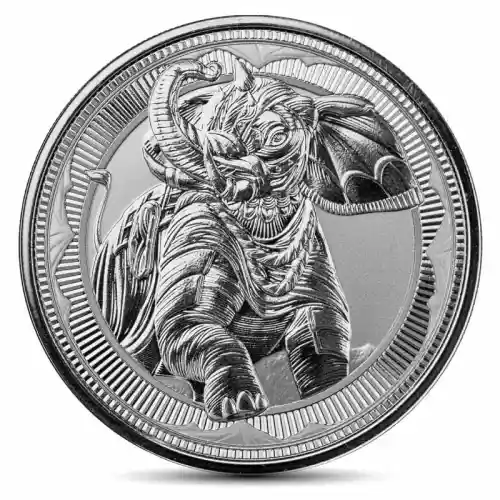
On the reverse, a war elephant in high relief, in full battle dress.The animal boldly gallops over the coin, with its trunk lifted victoriously and fitted with combat equipment over its head and shoulders.The scale of the coin's field is maximized—the elephant's huge size encompasses the design, and it is just the physical supremacy of these beasts on ancient battlefields.The elephant takes up the whole reverse of the stamp; there is no decorative border.
Using elephants as war machines was one of the most significant military inventions of the ancient world—and one of the most psychologically devastating.The use of war elephants on a regular basis began with India and the Maurya Empire. The army of the Mauryans under Ashoka included thousands of military-trained elephants.It is estimated that Ashoka lost more than 100,000 soldiers in the Battle of Kalinga (around 262 BCE), one of the bloodiest battles of antiquity that used large numbers of war elephants and which, it is said, convinced Ashoka to become a Buddhist and abandon his desire for further conquest.The technology was disseminated to the West.War elephants were used by Alexander the Great in the Battle of the Hydaspes (326 BCE), where King Porus of the Paurava kingdom attacked the Macedonian phalanx with 200 Indian war elephants.Alexander's troops of infantry, who had never seen the animals in battle, were thrown into panic—the horses were panicking, and the formations were breaking up.The battle was achieved not through sheer force but through strategy, and it had a lasting impact on the military history of both Greece and the West. War elephants came to the western Mediterranean by two routes.
In 279, Pyrrhus of Epirus arrived in Italy with his army of 20 elephants, the first the Romans had ever encountered. The animals, they did not know, had names and were known as “Lucanian oxen” after the area of Italy where the battle took place. No Roman cavalry horses would come near. Eventually, they were outsmarted by Rome, but the jolt of encountering them first is well chronicled. Most notably, Hannibal Barca was in charge of ~37 war elephants in 218 BCE during the Second Punic War, who crossed the Alps.
Heavy casualties of elephants were suffered at the crossing, with only a few surviving the Italian campaign. The small number that was active in northern Italy, however, had a major impact on the Romans and directly on the Battle of Trebia (218 BCE). Hannibal's army had marched from Carthage through North Africa and across Iberia, over the Strait of Gibraltar and the Pyrenees and Alps—one of the most remarkable campaigns ever attempted. This coin's subject and its issuing territory are so well matched for this reason: the geography, the Strait of Gibraltar, is a mere 14 km across between Europe and Africa.
Gibraltar is a 6.7 square kilometer British Overseas Territory located at the southern tip of the Iberian Peninsula.The Rock was captured by British troops in the War of the Spanish Succession in 1704.In the Treaty of Utrecht (1713), Spain formally ceded it to Great Britain, a cession disputed by Spain from then on.The Rock of Gibraltar stands 426 meters high over the strait and dominates the traffic of all ships or boats between the Atlantic Ocean and the Mediterranean Sea.For this reason, it has been one of the most strategically important pieces of real estate in the military history of Europe for more than 300 years.It lies on the border of two continents—and at the narrowest stretch of land between them—making it directly linked to the ancient military world of the reverse of this coin.For two thousand years, all armies that marched between Africa and Europe came near the Rock.
The Gibraltar War Elephant 2023 1 oz Silver BU Coin is the second of the War Elephant Series coins issued by Scottsdale Mint for the Government of Gibraltar. Each is produced in .999 fine silver in Brilliant Uncirculated finish with a limited mintage of 15,000 worldwide, which is the same as the first 2022 issue. It is 1 Pound in face value and is legal tender in Gibraltar. Every coin is in its own plastic capsule on chipboard. Scottsdale Mint has since suspended the War Elephant Series, and the 2022 and 2023 strikes are its only two years in the mint's life.
Obverse – Heraldic Arms of Gibraltar
The obverse is made up of two distinct coats of arms set vertically. The Coat of Arms of Gibraltar is in the lower tier, the dominant seal, a three-towered white castle on a red field with a golden key hanging from the central tower, from the reign of Richard I.Apparently, in the lower tier is the Coat of Arms of Gibraltar, a three-towered white castle, with a golden key from the central tower, hanging on a red field, the heraldic seal of the English Crown from the reign of Richard I.The castle is the Castle of Castile, Gibraltar's history before it came under the possession of the British.The key is Gibraltar's defining symbol, the key to the Mediterranean for more than 300 years, literally due to Gibraltar's location at the entry point to the Mediterranean Sea and figuratively because of Gibraltar's role in the global geopolitical shifting of powers for much longer.The inscriptions indicate the weight, purity, and "1 POUND" face value of the coin.
Reverse - The War Elephant
On the reverse, a war elephant in high relief, in full battle dress.The animal boldly gallops over the coin, with its trunk lifted victoriously and fitted with combat equipment over its head and shoulders.The scale of the coin's field is maximized—the elephant's huge size encompasses the design, and it is just the physical supremacy of these beasts on ancient battlefields.The elephant takes up the whole reverse of the stamp; there is no decorative border.
Using elephants as war machines was one of the most significant military inventions of the ancient world—and one of the most psychologically devastating.The use of war elephants on a regular basis began with India and the Maurya Empire. The army of the Mauryans under Ashoka included thousands of military-trained elephants.It is estimated that Ashoka lost more than 100,000 soldiers in the Battle of Kalinga (around 262 BCE), one of the bloodiest battles of antiquity that used large numbers of war elephants and which, it is said, convinced Ashoka to become a Buddhist and abandon his desire for further conquest.The technology was disseminated to the West.War elephants were used by Alexander the Great in the Battle of the Hydaspes (326 BCE), where King Porus of the Paurava kingdom attacked the Macedonian phalanx with 200 Indian war elephants.Alexander's troops of infantry, who had never seen the animals in battle, were thrown into panic—the horses were panicking, and the formations were breaking up.The battle was achieved not through sheer force but through strategy, and it had a lasting impact on the military history of both Greece and the West. War elephants came to the western Mediterranean by two routes.
In 279, Pyrrhus of Epirus arrived in Italy with his army of 20 elephants, the first the Romans had ever encountered. The animals, they did not know, had names and were known as “Lucanian oxen” after the area of Italy where the battle took place. No Roman cavalry horses would come near. Eventually, they were outsmarted by Rome, but the jolt of encountering them first is well chronicled. Most notably, Hannibal Barca was in charge of ~37 war elephants in 218 BCE during the Second Punic War, who crossed the Alps.
Heavy casualties of elephants were suffered at the crossing, with only a few surviving the Italian campaign. The small number that was active in northern Italy, however, had a major impact on the Romans and directly on the Battle of Trebia (218 BCE). Hannibal's army had marched from Carthage through North Africa and across Iberia, over the Strait of Gibraltar and the Pyrenees and Alps—one of the most remarkable campaigns ever attempted. This coin's subject and its issuing territory are so well matched for this reason: the geography, the Strait of Gibraltar, is a mere 14 km across between Europe and Africa.
Gibraltar is a 6.7 square kilometer British Overseas Territory located at the southern tip of the Iberian Peninsula.The Rock was captured by British troops in the War of the Spanish Succession in 1704.In the Treaty of Utrecht (1713), Spain formally ceded it to Great Britain, a cession disputed by Spain from then on.The Rock of Gibraltar stands 426 meters high over the strait and dominates the traffic of all ships or boats between the Atlantic Ocean and the Mediterranean Sea.For this reason, it has been one of the most strategically important pieces of real estate in the military history of Europe for more than 300 years.It lies on the border of two continents—and at the narrowest stretch of land between them—making it directly linked to the ancient military world of the reverse of this coin.For two thousand years, all armies that marched between Africa and Europe came near the Rock.


Affiliations


Copyright BOLD Precious Metals 2026