

Share
| Quantity | Cash/Check | Credit Card | Paypal/Pay |
|---|---|---|---|
| 1 - 9 | $4,392.90 | $4,577.40 | $4,634.51 |
| 10 - 19 | $4,382.90 | $4,566.98 | $4,623.96 |
| 20 or more | $4,372.90 | $4,556.56 | $4,613.41 |
Share
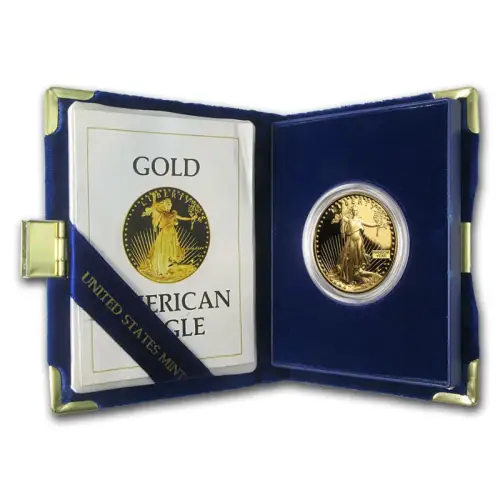
The 1 oz American Gold Eagle Proof Coin is struck exclusively at the West Point Mint, identifiable by its "W" mint mark, and finished to a mirror-like proof standard rather than the satin luster of a standard bullion strike. Each coin ships in its original U.S. Mint presentation box, a black clamshell case with the Mint seal, inside a gold-foil Liberty sleeve, along with a matching Certificate of Authenticity. Struck in .9167 fine (22-karat) gold with a $50 face value, this coin's gold content and U.S. government backing are identical to the standard bullion Eagle; the proof finish and presentation packaging are what carry the added premium.
Obverse
Augustus Saint-Gaudens' full-length figure of Liberty with flowing hair, torch in her right hand, and an olive branch in her left, the same design used on every American Gold Eagle since the program's 1986 launch, struck here to a proof finish with sharply mirrored fields.
Reverse
Depending on the strike year, either the original 1986–2021 "family of eagles" nest design by Miley Busiek Frost or the 2021-onward close-up eagle-head portrait by Jennie Norris, both rendered with the frosted, raised-relief detail that distinguishes a proof strike from a bullion coin's flat satin finish.
Since the American Gold Eagle program began in 1986, the U.S. Mint has struck a parallel proof version of the coin exclusively at the West Point Mint, reserved for collectors rather than bulk bullion buyers. The "W" mint mark, found on every proof Eagle since the practice began, is the Mint's way of guaranteeing the coin was struck using specially polished dies and hand-fed blanks: a slower, more deliberate process than standard bullion production, which is why proof mintages run dramatically lower than bullion mintages in any given year. Each proof coin's box and Certificate of Authenticity are issued together as a matched set for that coin's specific strike year, a detail that matters because the packaging itself documents the coin's production year. Unlike random-date bullion coins, a proof coin's box and COA can't be separated from their correct year without breaking the matched set.
The 1 oz American Gold Eagle Proof Coin is struck exclusively at the West Point Mint, identifiable by its "W" mint mark, and finished to a mirror-like proof standard rather than the satin luster of a standard bullion strike. Each coin ships in its original U.S. Mint presentation box, a black clamshell case with the Mint seal, inside a gold-foil Liberty sleeve, along with a matching Certificate of Authenticity. Struck in .9167 fine (22-karat) gold with a $50 face value, this coin's gold content and U.S. government backing are identical to the standard bullion Eagle; the proof finish and presentation packaging are what carry the added premium.
Obverse
Augustus Saint-Gaudens' full-length figure of Liberty with flowing hair, torch in her right hand, and an olive branch in her left, the same design used on every American Gold Eagle since the program's 1986 launch, struck here to a proof finish with sharply mirrored fields.
Reverse
Depending on the strike year, either the original 1986–2021 "family of eagles" nest design by Miley Busiek Frost or the 2021-onward close-up eagle-head portrait by Jennie Norris, both rendered with the frosted, raised-relief detail that distinguishes a proof strike from a bullion coin's flat satin finish.
Since the American Gold Eagle program began in 1986, the U.S. Mint has struck a parallel proof version of the coin exclusively at the West Point Mint, reserved for collectors rather than bulk bullion buyers. The "W" mint mark, found on every proof Eagle since the practice began, is the Mint's way of guaranteeing the coin was struck using specially polished dies and hand-fed blanks: a slower, more deliberate process than standard bullion production, which is why proof mintages run dramatically lower than bullion mintages in any given year. Each proof coin's box and Certificate of Authenticity are issued together as a matched set for that coin's specific strike year, a detail that matters because the packaging itself documents the coin's production year. Unlike random-date bullion coins, a proof coin's box and COA can't be separated from their correct year without breaking the matched set.


Affiliations


Copyright BOLD Precious Metals 2026