

Share
| Quantity | Cash/Check | Credit Card | Paypal/Pay |
|---|---|---|---|
| Any Quantity | $88.53 | $92.25 | $93.40 |
Share
The 1921-S Morgan Silver Dollar in Brilliant Uncirculated condition is the final San Francisco Mint issue of America's most beloved silver coin series. After the original Morgan Dollar program ended in 1904, the design returned for a single revival year in 1921 before being permanently replaced by the Peace Dollar. The "S" mintmark, located just above the denomination on the reverse, identifies the 21,695,000 coins struck in San Francisco that year.
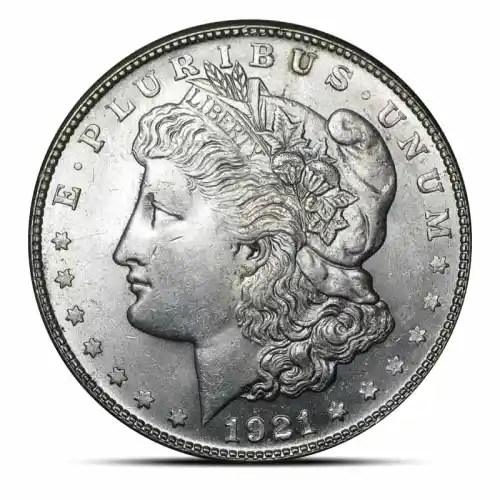
The obverse features Lady Liberty in left profile, wearing a Phrygian cap with "LIBERTY" inscribed across her hair band, surrounded by "E Pluribus Unum," the date, and thirteen stars representing the original colonies. The design was created by U.S. Mint engraver George T. Morgan, who used Philadelphia teacher Anna Willess Williams as his model for Liberty's portrait. The reverse displays the heraldic bald eagle clutching an olive branch and arrows, surrounded by "United States of America," "One Dollar," and "In God We Trust."
The Morgan Silver Dollar was first struck in 1878 following passage of the Bland-Allison Act, then halted in 1904 when the silver reserves purchased under the Sherman Silver Purchase Act were exhausted. The 1921 revival was a one-year reintroduction before the Peace Dollar replaced the Morgan design later that same year. This makes the 1921-S the closing chapter of the original Morgan series at the San Francisco Mint, giving it long-term collector appeal beyond its silver melt value.
At BOLD Precious Metals, we only stock products we are willing to buy back ourselves. Morgan Silver Dollars in BU condition carry numismatic premiums that hold up reliably in the secondary market, making them one of the most stable U.S. silver coin investments. Pay by check, bank wire, or cryptocurrency and save 2-6% compared to credit card pricing.
The 1921-S has a story most casual buyers do not know: it is the final San Francisco Mint Morgan ever struck. That single fact makes it one of the more meaningful Morgans you can hold, even though the high mintage keeps the price accessible compared to key dates like the 1893-S. For collectors completing a Morgan date set or anyone who wants a tangible piece of the silver-dollar era at a fair price, this coin is one I recommend without hesitation.
— Ryan Cochran, BOLD Precious Metals
The 1921-S Morgan Silver Dollar in Brilliant Uncirculated condition is the final San Francisco Mint issue of America's most beloved silver coin series. After the original Morgan Dollar program ended in 1904, the design returned for a single revival year in 1921 before being permanently replaced by the Peace Dollar. The "S" mintmark, located just above the denomination on the reverse, identifies the 21,695,000 coins struck in San Francisco that year.
The obverse features Lady Liberty in left profile, wearing a Phrygian cap with "LIBERTY" inscribed across her hair band, surrounded by "E Pluribus Unum," the date, and thirteen stars representing the original colonies. The design was created by U.S. Mint engraver George T. Morgan, who used Philadelphia teacher Anna Willess Williams as his model for Liberty's portrait. The reverse displays the heraldic bald eagle clutching an olive branch and arrows, surrounded by "United States of America," "One Dollar," and "In God We Trust."
The Morgan Silver Dollar was first struck in 1878 following passage of the Bland-Allison Act, then halted in 1904 when the silver reserves purchased under the Sherman Silver Purchase Act were exhausted. The 1921 revival was a one-year reintroduction before the Peace Dollar replaced the Morgan design later that same year. This makes the 1921-S the closing chapter of the original Morgan series at the San Francisco Mint, giving it long-term collector appeal beyond its silver melt value.
At BOLD Precious Metals, we only stock products we are willing to buy back ourselves. Morgan Silver Dollars in BU condition carry numismatic premiums that hold up reliably in the secondary market, making them one of the most stable U.S. silver coin investments. Pay by check, bank wire, or cryptocurrency and save 2-6% compared to credit card pricing.
The 1921-S has a story most casual buyers do not know: it is the final San Francisco Mint Morgan ever struck. That single fact makes it one of the more meaningful Morgans you can hold, even though the high mintage keeps the price accessible compared to key dates like the 1893-S. For collectors completing a Morgan date set or anyone who wants a tangible piece of the silver-dollar era at a fair price, this coin is one I recommend without hesitation.
— Ryan Cochran, BOLD Precious Metals


Affiliations


Copyright BOLD Precious Metals 2026