

Share
| Quantity | Cash/Check | Credit Card | Paypal/Pay |
|---|---|---|---|
| 1 - 9 | $73.70 | $76.80 | $77.75 |
| 10 - 19 | $73.40 | $76.48 | $77.44 |
| 20 or more | $73.05 | $76.12 | $77.07 |
Share
The Pre-1921 Morgan Silver Dollar is one of the most iconic and widely collected coins in American numismatic history — struck by the United States Mint between 1878 and 1904 at up to five different mint facilities across the country. Each coin contains 0.7734 troy ounces of 90% fine silver, with 10% copper for durability, weighs 26.73 grams, and measures 38.1mm in diameter with a reeded edge.
These coins are offered in Brilliant Uncirculated (BU) condition — the highest grade available for vintage business-strike coins that were never placed into general circulation. Dates and mint marks are our choice from the 1878–1904 production era. Buyers will receive a genuine pre-1921 issue rather than the vastly more common 1921 revival strikes.
The Morgan Silver Dollar is the most actively collected coin series in American numismatic history — a distinction whose continued popularity has sustained demand and price premiums for over a century. A pre-1921 BU example is a coin that has survived more than 140 years of American history, including wars, economic depressions, and multiple government melting programs that destroyed hundreds of millions of its counterparts.
Many buyers encounter both pre-1921 and 1921 Morgan Dollars on the market. Understanding the difference is essential.
The 1921 Morgan Dollar was a single-year revival, struck under political pressure after the Pittman Act ordered millions of stored silver dollars melted during World War I. To replace the melted coins, the U.S. Mint reopened Morgan Dollar production in 1921 — striking over 86 million coins at three mint facilities in Philadelphia, San Francisco, and Denver in a single year using freshly cut dies. This made the 1921 Morgan the most common date in the entire series. Its high mintage, combined with the fact that most 1921 coins went directly into Treasury storage without circulating, means survival rates are exceptionally high.
Pre-1921 Morgan Dollars tell a different story. Many dates had far lower original mintages — particularly at the Carson City and New Orleans mints. The Pittman Act of 1918 authorized the melting of up to 350 million stored silver dollars, and 230,232,722 were actually melted — dramatically reducing the surviving populations of many pre-1921 dates that had seemed common. Further melting occurred under the Silver Act of 1942 and again during the silver price surge of the 1980s. Many survivors carry the characteristics of genuine pre-circulation storage: bag marks from original mint bags, but no wear from hand-to-hand use.
The result is that pre-1921 BU Morgan Dollars represent genuinely scarcer historical artifacts than their 1921 counterparts — with more interesting date and mint mark variety, and greater potential for numismatic premium above raw silver melt value.
The Morgan Dollar exists because of one of the most fiercely contested political battles in nineteenth-century American history: the silver controversy.
Following the Civil War, the U.S. government adopted a de facto gold standard — effectively demonetizing silver through the Coinage Act of 1873, a measure so inflammatory among silver-mining interests and Western agricultural communities that it became known as the "Crime of 1873." Silver mine owners in Nevada, Colorado, and the Mountain West were producing massive quantities of silver from newly discovered deposits and needed a guaranteed market. Farmers and debtors wanted an expanded money supply to ease deflation. Gold-standard advocates on Wall Street and in Washington wanted fiscal conservatism.
The compromise was the Bland-Allison Act of February 1878, written by Representative Richard P. Bland and amended by Senator William B. Allison. The Act restored silver as legal tender, required the U.S. Treasury to purchase between $2 million and $4 million worth of silver bullion per month, and directed that purchased silver be coined into silver dollars.
With a mandate and silver in hand, the U.S. Mint needed a new dollar design. Mint Director Henry R. Linderman commissioned George T. Morgan — an English-born engraver recently recruited from the Royal Mint in London — to create it. The first Morgan Dollars were struck on March 11, 1878, and an American numismatic legend was born.
George Thomas Morgan was born in Birmingham, England, in 1845 and trained as an engraver at the Royal Mint in London. Recruited by Mint Director Henry R. Linderman in 1876 to serve as Assistant Engraver at the U.S. Mint in Philadelphia, Morgan brought exceptional technical skill and artistic sensibility to American coinage at a critical moment in its history.
Morgan would eventually rise to become Chief Engraver of the United States Mint — serving from 1917 until his death in 1925 — but his legacy rests above all on the silver dollar that bears his name. He designed both the obverse and reverse in 1877–1878, refining the composition through a series of pattern coins before the final design was adopted.
The obverse depicts Lady Liberty in left-profile relief — and her design represented a deliberate departure from the classical tradition of American coinage. Earlier Liberty figures drew on Greek and Roman statuary: idealized, ancient, and remote. Morgan wanted something different.
Working with his friend, the celebrated Philadelphia artist Thomas Eakins — whose own work was then revolutionizing American realism — Morgan sought a living American woman to model for Liberty. Eakins suggested Anna Willess Williams, a nineteen-year-old Philadelphia schoolteacher who had posed for several of his paintings.
Williams was reluctant. After persuasion from Eakins and her friends, she agreed to sit for five modelling sessions with Morgan in November 1876. Morgan was immediately struck by what he described as "the most perfect profile he had seen in England or America." Williams made her participation conditional on anonymity — but the secret was quickly revealed after the coin was released.
She was unprepared for the fame that followed: thousands of letters, visitors at her home and school, and relentless public attention. She later dismissed the modelling work as "an incident of my youth" she would rather forget, and spent her career as an educator until her retirement in 1924. She died in 1926, at age sixty-eight — her face having appeared on hundreds of millions of silver dollars for nearly fifty years.
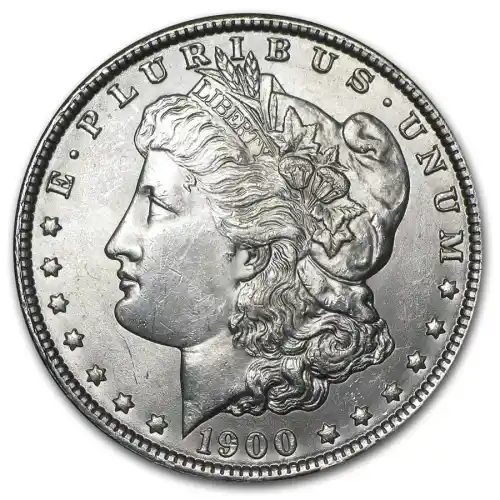
Liberty's distinctive features on the Morgan Dollar include the Phrygian cap — the ancient symbol of freedom worn by freed Roman slaves — adorned with wheat and cotton rather than the classical laurel wreath of earlier coins, a uniquely American addition honoring the country's agricultural identity. Thirteen stars ring the obverse rim, representing the original colonies. "LIBERTY" appears on the diadem above the cap, and the designer's monogram "M" sits at the neck truncation.
This was the first U.S. coin to depict Lady Liberty with an authentically American appearance — rooted in the real face of an American woman, adorned with symbols of American agriculture and geography rather than the idealized classicism of the ancient world.
The reverse depicts the heraldic American bald eagle in a powerful, precisely rendered composition that became one of the most recognized coin reverses in world numismatics.
The eagle spreads its wings in a posture of commanding authority, clutching an olive branch — representing peace — in the right talon and a bundle of arrows — representing war and defense — in the left: the same dual symbolism found on the Great Seal of the United States. It perches on a rocky crag above a mountain pine sapling — a specifically American natural symbol Morgan added to root the design in the American landscape. "UNITED STATES OF AMERICA" and "ONE DOLLAR" surround the composition; "E PLURIBUS UNUM" appears on a ribbon in the eagle's beak.
The eagle's feathers are rendered with extraordinary detail — a product of Morgan's technical mastery and one of the reasons historians and collectors have consistently ranked the Morgan Dollar among the finest coin designs in American history.
| Mint | Mint Mark | Years Active for Morgan Dollar | Notes |
|---|---|---|---|
| Philadelphia | None | 1878–1904 | Largest producer; no mint mark on coin |
| Carson City, NV | CC | 1878–1885, 1889–1893 | Most prized by collectors; built to process Comstock Lode silver |
| New Orleans, LA | O | 1879–1904 | Closed 1909; significant melting losses from Pittman Act |
| San Francisco, CA | S | 1878–1904 | High quality strikes; generally well-struck |
| Denver, CO | D | 1921 only | Did NOT produce pre-1921 Morgan Dollars |
For buyers of this random-date listing: the coin you receive may carry any of the Philadelphia (none), Carson City (CC), New Orleans (O), or San Francisco (S) mint marks...
| Date | Mint | Notes |
|---|---|---|
| 1893-S | San Francisco | The single rarest Morgan Dollar; only 100,000 minted; MS-65 sold for $735,000 in 2018 |
| 1889-CC | Carson City | Extremely scarce in any grade; most survivors are circulated |
| 1879-CC | Carson City | Scarce in BU; very early CC issue |
| 1892-S | San Francisco | Low survival in BU |
| 1895 | Philadelphia | Proof-only year; no business strike coins known to survive |
| 1883-S | San Francisco | Scarce in higher grades |
| 1884-S | San Francisco | Scarce in BU |
| 1886-O | New Orleans | High original mintage but most melted under Pittman Act |
Each coin contains 0.7734 troy ounces of 90% fine silver — the silver content expressed as actual silver weight, or ASW...
The Morgan Dollar series is the most actively collected U.S. coin series in history...
These coins were struck during the American Gilded Age — an era of rapid industrialization...
BOLD Precious Metals has served over 100,000 investors and collectors with competitive pricing, A+ BBB accreditation, and fully insured shipping on every order.
📧 support@boldpreciousmetals.com 📞 1(866) 454-BOLD
For bulk orders, roll purchases, or inquiries about specific dates and mint marks, contact our team directly.
The Pre-1921 Morgan Silver Dollar is one of the most iconic and widely collected coins in American numismatic history — struck by the United States Mint between 1878 and 1904 at up to five different mint facilities across the country. Each coin contains 0.7734 troy ounces of 90% fine silver, with 10% copper for durability, weighs 26.73 grams, and measures 38.1mm in diameter with a reeded edge.
These coins are offered in Brilliant Uncirculated (BU) condition — the highest grade available for vintage business-strike coins that were never placed into general circulation. Dates and mint marks are our choice from the 1878–1904 production era. Buyers will receive a genuine pre-1921 issue rather than the vastly more common 1921 revival strikes.
The Morgan Silver Dollar is the most actively collected coin series in American numismatic history — a distinction whose continued popularity has sustained demand and price premiums for over a century. A pre-1921 BU example is a coin that has survived more than 140 years of American history, including wars, economic depressions, and multiple government melting programs that destroyed hundreds of millions of its counterparts.
Many buyers encounter both pre-1921 and 1921 Morgan Dollars on the market. Understanding the difference is essential.
The 1921 Morgan Dollar was a single-year revival, struck under political pressure after the Pittman Act ordered millions of stored silver dollars melted during World War I. To replace the melted coins, the U.S. Mint reopened Morgan Dollar production in 1921 — striking over 86 million coins at three mint facilities in Philadelphia, San Francisco, and Denver in a single year using freshly cut dies. This made the 1921 Morgan the most common date in the entire series. Its high mintage, combined with the fact that most 1921 coins went directly into Treasury storage without circulating, means survival rates are exceptionally high.
Pre-1921 Morgan Dollars tell a different story. Many dates had far lower original mintages — particularly at the Carson City and New Orleans mints. The Pittman Act of 1918 authorized the melting of up to 350 million stored silver dollars, and 230,232,722 were actually melted — dramatically reducing the surviving populations of many pre-1921 dates that had seemed common. Further melting occurred under the Silver Act of 1942 and again during the silver price surge of the 1980s. Many survivors carry the characteristics of genuine pre-circulation storage: bag marks from original mint bags, but no wear from hand-to-hand use.
The result is that pre-1921 BU Morgan Dollars represent genuinely scarcer historical artifacts than their 1921 counterparts — with more interesting date and mint mark variety, and greater potential for numismatic premium above raw silver melt value.
The Morgan Dollar exists because of one of the most fiercely contested political battles in nineteenth-century American history: the silver controversy.
Following the Civil War, the U.S. government adopted a de facto gold standard — effectively demonetizing silver through the Coinage Act of 1873, a measure so inflammatory among silver-mining interests and Western agricultural communities that it became known as the "Crime of 1873." Silver mine owners in Nevada, Colorado, and the Mountain West were producing massive quantities of silver from newly discovered deposits and needed a guaranteed market. Farmers and debtors wanted an expanded money supply to ease deflation. Gold-standard advocates on Wall Street and in Washington wanted fiscal conservatism.
The compromise was the Bland-Allison Act of February 1878, written by Representative Richard P. Bland and amended by Senator William B. Allison. The Act restored silver as legal tender, required the U.S. Treasury to purchase between $2 million and $4 million worth of silver bullion per month, and directed that purchased silver be coined into silver dollars.
With a mandate and silver in hand, the U.S. Mint needed a new dollar design. Mint Director Henry R. Linderman commissioned George T. Morgan — an English-born engraver recently recruited from the Royal Mint in London — to create it. The first Morgan Dollars were struck on March 11, 1878, and an American numismatic legend was born.
George Thomas Morgan was born in Birmingham, England, in 1845 and trained as an engraver at the Royal Mint in London. Recruited by Mint Director Henry R. Linderman in 1876 to serve as Assistant Engraver at the U.S. Mint in Philadelphia, Morgan brought exceptional technical skill and artistic sensibility to American coinage at a critical moment in its history.
Morgan would eventually rise to become Chief Engraver of the United States Mint — serving from 1917 until his death in 1925 — but his legacy rests above all on the silver dollar that bears his name. He designed both the obverse and reverse in 1877–1878, refining the composition through a series of pattern coins before the final design was adopted.
The obverse depicts Lady Liberty in left-profile relief — and her design represented a deliberate departure from the classical tradition of American coinage. Earlier Liberty figures drew on Greek and Roman statuary: idealized, ancient, and remote. Morgan wanted something different.
Working with his friend, the celebrated Philadelphia artist Thomas Eakins — whose own work was then revolutionizing American realism — Morgan sought a living American woman to model for Liberty. Eakins suggested Anna Willess Williams, a nineteen-year-old Philadelphia schoolteacher who had posed for several of his paintings.
Williams was reluctant. After persuasion from Eakins and her friends, she agreed to sit for five modelling sessions with Morgan in November 1876. Morgan was immediately struck by what he described as "the most perfect profile he had seen in England or America." Williams made her participation conditional on anonymity — but the secret was quickly revealed after the coin was released.
She was unprepared for the fame that followed: thousands of letters, visitors at her home and school, and relentless public attention. She later dismissed the modelling work as "an incident of my youth" she would rather forget, and spent her career as an educator until her retirement in 1924. She died in 1926, at age sixty-eight — her face having appeared on hundreds of millions of silver dollars for nearly fifty years.
Liberty's distinctive features on the Morgan Dollar include the Phrygian cap — the ancient symbol of freedom worn by freed Roman slaves — adorned with wheat and cotton rather than the classical laurel wreath of earlier coins, a uniquely American addition honoring the country's agricultural identity. Thirteen stars ring the obverse rim, representing the original colonies. "LIBERTY" appears on the diadem above the cap, and the designer's monogram "M" sits at the neck truncation.
This was the first U.S. coin to depict Lady Liberty with an authentically American appearance — rooted in the real face of an American woman, adorned with symbols of American agriculture and geography rather than the idealized classicism of the ancient world.
The reverse depicts the heraldic American bald eagle in a powerful, precisely rendered composition that became one of the most recognized coin reverses in world numismatics.
The eagle spreads its wings in a posture of commanding authority, clutching an olive branch — representing peace — in the right talon and a bundle of arrows — representing war and defense — in the left: the same dual symbolism found on the Great Seal of the United States. It perches on a rocky crag above a mountain pine sapling — a specifically American natural symbol Morgan added to root the design in the American landscape. "UNITED STATES OF AMERICA" and "ONE DOLLAR" surround the composition; "E PLURIBUS UNUM" appears on a ribbon in the eagle's beak.
The eagle's feathers are rendered with extraordinary detail — a product of Morgan's technical mastery and one of the reasons historians and collectors have consistently ranked the Morgan Dollar among the finest coin designs in American history.
| Mint | Mint Mark | Years Active for Morgan Dollar | Notes |
|---|---|---|---|
| Philadelphia | None | 1878–1904 | Largest producer; no mint mark on coin |
| Carson City, NV | CC | 1878–1885, 1889–1893 | Most prized by collectors; built to process Comstock Lode silver |
| New Orleans, LA | O | 1879–1904 | Closed 1909; significant melting losses from Pittman Act |
| San Francisco, CA | S | 1878–1904 | High quality strikes; generally well-struck |
| Denver, CO | D | 1921 only | Did NOT produce pre-1921 Morgan Dollars |
For buyers of this random-date listing: the coin you receive may carry any of the Philadelphia (none), Carson City (CC), New Orleans (O), or San Francisco (S) mint marks...
| Date | Mint | Notes |
|---|---|---|
| 1893-S | San Francisco | The single rarest Morgan Dollar; only 100,000 minted; MS-65 sold for $735,000 in 2018 |
| 1889-CC | Carson City | Extremely scarce in any grade; most survivors are circulated |
| 1879-CC | Carson City | Scarce in BU; very early CC issue |
| 1892-S | San Francisco | Low survival in BU |
| 1895 | Philadelphia | Proof-only year; no business strike coins known to survive |
| 1883-S | San Francisco | Scarce in higher grades |
| 1884-S | San Francisco | Scarce in BU |
| 1886-O | New Orleans | High original mintage but most melted under Pittman Act |
Each coin contains 0.7734 troy ounces of 90% fine silver — the silver content expressed as actual silver weight, or ASW...
The Morgan Dollar series is the most actively collected U.S. coin series in history...
These coins were struck during the American Gilded Age — an era of rapid industrialization...
BOLD Precious Metals has served over 100,000 investors and collectors with competitive pricing, A+ BBB accreditation, and fully insured shipping on every order.
📧 support@boldpreciousmetals.com 📞 1(866) 454-BOLD
For bulk orders, roll purchases, or inquiries about specific dates and mint marks, contact our team directly.


Affiliations


Copyright BOLD Precious Metals 2026