

Share
| Quantity | Cash/Check | Credit Card | Paypal/Pay |
|---|---|---|---|
| Any Quantity | $639.70 | $666.57 | $674.88 |
Share
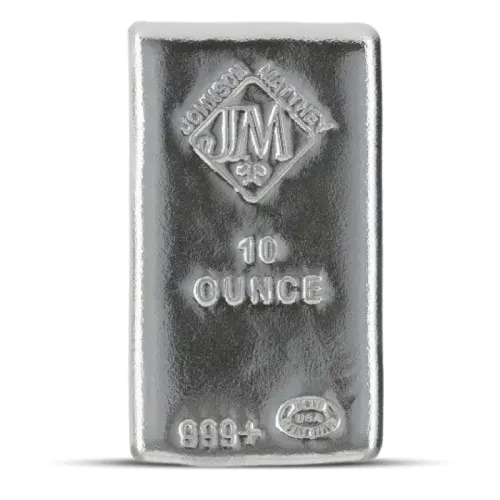
The 10 oz Johnson Matthey Silver Bar is a cast bar that is formed by pouring molten .999 fine silver into a mold and manually stamping it with a wavy pattern, as opposed to the sharp-edged, smooth face of a machine-pressed bar.Bars such as this are from previous Johnson Matthey minting runs and now sell as "secondary market" silver, with the century-plus reputation of the refiner and at a premium that is generally lower than for newly minted Johnson Matthey bars.
Obverse
The Johnson Matthey logo, along with purity and weight markings and an individual serial number, is all hand-stamped into the cast surface of the bar. The wavy, slightly irregular texture around the stamping is an inherent part of the casting process and should not be considered defective.
Reverse
A repeating pattern of the Johnson Matthey logo appears across the reverse, consistent with the markings found on Johnson Matthey bar formats. The Johnson Matthey bar markings are quoted for reference only against the quotes in SD Bullion and Provident Metals listings.
The 10 oz silver bars are Johnson Matthey's cast bars, and the Official Assayer/Refiner label to the Bank of England has been in use since 1852 when Johnson Matthey started casting bars in its active days as an institutional bullion producer. The usual method for making bars of this period was by casting, in which the silver was melted and poured by hand into a bar mold and marked with the company's marks. This method was slower and more individualistic than the current high-speed pressed bar minting. Eventually, Johnson Matthey withdrew from producing bullion for retail sale, so that each cast bar in circulation is a piece from the earlier production. The true, honest old-age, hand-cast look and Johnson Matthey's history as a producer of bullion bars are why these bars often sell for a collector premium over those of active private mints.
The 10 oz Johnson Matthey Silver Bar is a cast bar that is formed by pouring molten .999 fine silver into a mold and manually stamping it with a wavy pattern, as opposed to the sharp-edged, smooth face of a machine-pressed bar.Bars such as this are from previous Johnson Matthey minting runs and now sell as "secondary market" silver, with the century-plus reputation of the refiner and at a premium that is generally lower than for newly minted Johnson Matthey bars.
Obverse
The Johnson Matthey logo, along with purity and weight markings and an individual serial number, is all hand-stamped into the cast surface of the bar. The wavy, slightly irregular texture around the stamping is an inherent part of the casting process and should not be considered defective.
Reverse
A repeating pattern of the Johnson Matthey logo appears across the reverse, consistent with the markings found on Johnson Matthey bar formats. The Johnson Matthey bar markings are quoted for reference only against the quotes in SD Bullion and Provident Metals listings.
The 10 oz silver bars are Johnson Matthey's cast bars, and the Official Assayer/Refiner label to the Bank of England has been in use since 1852 when Johnson Matthey started casting bars in its active days as an institutional bullion producer. The usual method for making bars of this period was by casting, in which the silver was melted and poured by hand into a bar mold and marked with the company's marks. This method was slower and more individualistic than the current high-speed pressed bar minting. Eventually, Johnson Matthey withdrew from producing bullion for retail sale, so that each cast bar in circulation is a piece from the earlier production. The true, honest old-age, hand-cast look and Johnson Matthey's history as a producer of bullion bars are why these bars often sell for a collector premium over those of active private mints.


Affiliations


Copyright BOLD Precious Metals 2026