BOLD Precious Metals
If you've been following the precious metals market, recent price movements may seem confusing. U.S. inflation remains elevated, and gold and silver are widely viewed as traditional inflation hedges. Yet both metals have been declining for weeks.
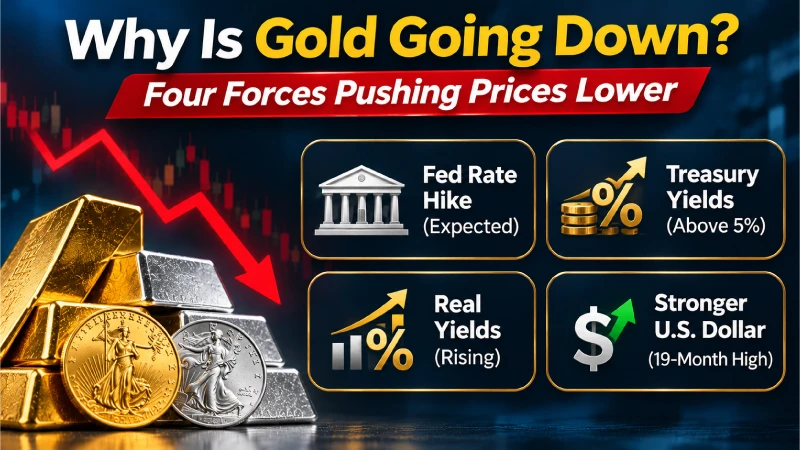
So, why is gold going down when inflation is rising? The main reason is changing interest-rate expectations. Financial markets increasingly expect the Federal Reserve to raise rates at its December 8–9 meeting. Higher interest rates and bond yields can make physical gold and silver less attractive in the short term because these metals don't pay interest or dividends.
Here's a closer look at recent prices, the four economic factors behind the decline, and what they could mean for bullion buyers.
Both metals have experienced sustained selling pressure over the past three months.
Weeks of decline out of the last twelve.
Weeks of decline out of the last twelve.
Core CPI rose 0.3% over the same month.
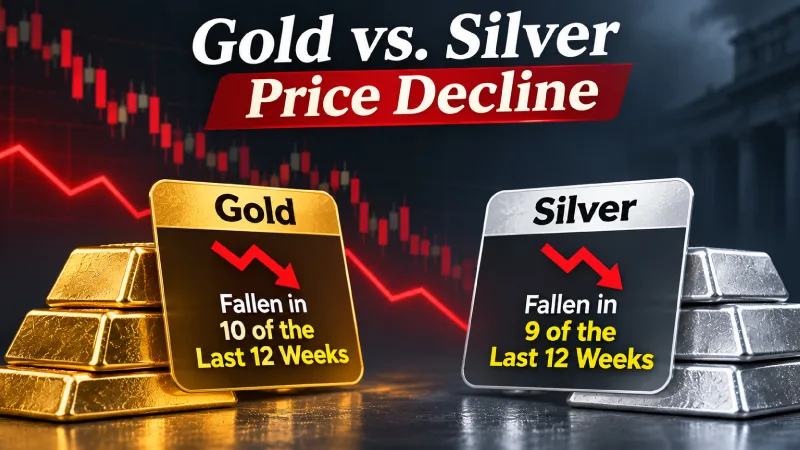
According to BullionVault, this is gold's worst multi-week losing stretch since spring 1989. London benchmark gold closed the week of November 13 near $3,890 per troy ounce, down 3.5% for the week.
Spot silver dropped below $48 per troy ounce for the first time in a year, dipping below $47.50 in mid-November. It is now more than 50% below its record high above $120 per ounce, reached around the start of 2026.
According to the U.S. Bureau of Labor Statistics (BLS), the Consumer Price Index (CPI) rose 0.4% in October. Core CPI, which excludes food and energy, increased 0.3%. Meanwhile, core producer prices rose 5.0% from a year earlier, their fastest annual pace since early 2023.
For everyday buyers, falling metal prices alongside rising inflation can seem contradictory. The explanation becomes clearer when you look at how inflation affects bond yields and Federal Reserve expectations.
Gold and silver respond not only to inflation but also to expectations about Federal Reserve policy. Four key factors are contributing to the recent decline.
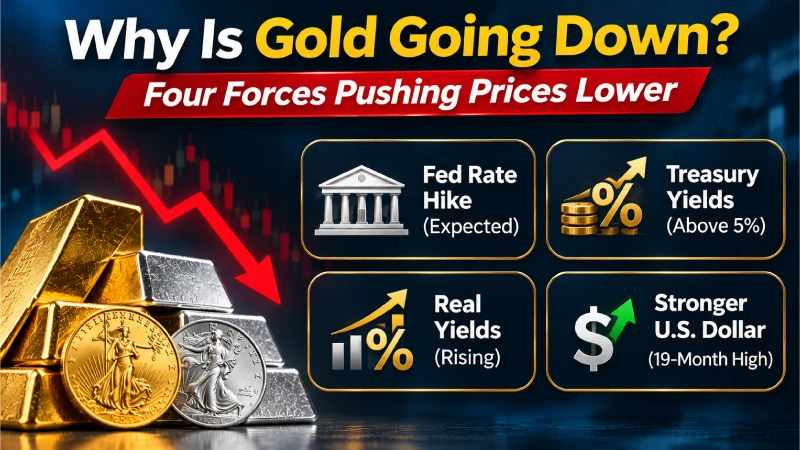
Persistent inflation has increased expectations of another Fed rate hike. Following October's hotter-than-expected CPI report and hawkish comments from policymakers, including discussion of a possible half-point increase, futures markets are pricing in overwhelming odds of a rate hike at the Federal Open Market Committee (FOMC) meeting on December 8–9, 2026.
Markets often react to changing rate expectations before the Fed makes an official announcement. Even the possibility of higher rates can put pressure on precious metals.
The 10-year U.S. Treasury yield climbed to approximately 5.13% during the week ending November 13, its biggest weekly increase since April 2025.
Opportunity cost is the return you give up by choosing one asset over another. Unlike Treasury bonds, physical bullion pays no interest or dividends. As yields rise, some institutional investors may shift toward interest-bearing assets.
Real yields measure bond returns after accounting for expected inflation. TIPS are U.S. government bonds whose principal adjusts with inflation.
Historically, rising real yields have often pressured gold because investors can earn inflation-adjusted returns from government debt. This helps explain why gold can decline even when inflation remains elevated.
Higher interest rates can attract foreign investment into U.S. assets, increasing demand for the dollar. The U.S. Dollar Index (DXY), which tracks the dollar against a basket of major currencies, climbed above 103, reaching its highest level in 19 months.
Since gold and silver are priced internationally in U.S. dollars, a stronger dollar makes bullion more expensive for buyers using other currencies, including euros, yen, and rupees. This can weigh on international demand.
Historically, many investors have held physical gold to help preserve purchasing power over the long term. However, over shorter periods, interest-rate expectations, real yields, and dollar movements can influence prices more than individual monthly inflation reports.
Yes. Gold's current decline of 10 out of 12 weeks resembles losing streaks in 1996, 1999, 2014, and 2018, according to BullionVault. Only spring 1989 saw a longer decline.
In 2014 and 2018, a stronger U.S. dollar and tighter Fed policy pressured gold for extended periods. While past performance doesn't predict future results, these examples show that sharp pullbacks are part of historical precious metals cycles.
Silver's decline has been steeper, falling more than half from its New Year peak above $120. Its dual role as a precious and industrial metal, used in solar panels, electric vehicles, and electronics, makes its price sensitive to both investment activity and industrial demand.
Several developments could influence precious metals prices through the remainder of 2026 and into early 2027:
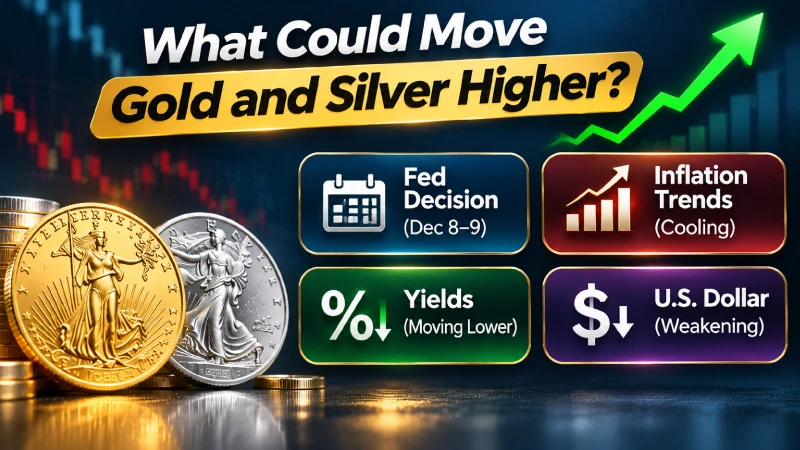
Markets will watch Chair Kevin Warsh's press conference and the Fed's updated 2027 economic projections. A less aggressive outlook could ease pressure on metals.
Cooler CPI or Producer Price Index (PPI) readings could give the Fed room to pause rate increases. Another upside surprise could keep yields elevated.
Falling Treasury yields or a weaker dollar could support gold and silver, while continued strength may add pressure.
The federal government recorded an October budget deficit exceeding $400 billion, according to U.S. Treasury figures. Growing national debt remains one reason some long-term savers hold physical gold alongside traditional financial assets.
Analysts remain divided.
Canada's BMO has warned that higher silver prices could encourage solar manufacturers to reduce silver use, potentially contributing to a market surplus by 2030.
The Silver Institute, in its Interim Market Review produced by Metals Focus, projects a sixth consecutive annual market deficit in 2026, even as total demand is expected to decline roughly 5% due to softer jewelry and retail coin purchases.
These competing views highlight the uncertainty surrounding silver's outlook. Supply constraints may provide support, while weaker demand and changes in industrial consumption could create additional pressure.
Rather than reacting to daily price movements, physical bullion buyers may find it useful to focus on a few practical considerations:
Many bullion owners hold gold and silver for long-term wealth preservation or portfolio diversification over 5 to 10+ years, rather than short-term trading.
Some buyers divide their budgets into smaller, regular purchases instead of trying to identify the exact market bottom. This spreads purchases across different price levels but doesn't eliminate market risk.
Dealer premiums are the additional costs above the spot price for manufacturing, distribution, and other expenses. Standard bullion bars, rounds, and silver near-spot products can offer lower premiums than certain collectible products.
Physical metals can experience extended volatility. Avoid committing money you may need for everyday expenses or unexpected costs.
Review a dealer's reputation, transparent pricing, shipping and insurance policies, and customer feedback.
At BOLD Precious Metals, our goal is to provide clear market information and transparent product details so customers can make informed choices at their own pace.
Gold is declining mainly because markets expect the Federal Reserve to raise interest rates at its December 8–9, 2026 meeting following October's hotter-than-expected inflation report. Higher Treasury yields, rising real yields, and a stronger U.S. dollar have also put pressure on precious metals.
Historically, many investors have used physical gold to help preserve purchasing power over longer periods, such as five to ten years or more. Over shorter periods, gold prices can respond more strongly to real interest rates, Federal Reserve policy, and U.S. dollar movements than to monthly inflation reports.
Silver has a smaller market than gold and serves as both a precious metal and an industrial commodity used in solar energy and electronics. Its industrial exposure makes it sensitive to changes in economic activity, while its larger price swings can contribute to sharper pullbacks.
No one can consistently identify the exact bottom of a commodity market. Some bullion buyers use dollar-cost averaging to spread purchases over time rather than trying to predict a particular price level. Consider your personal financial circumstances and consult a licensed financial advisor before making major allocation decisions.
Potential catalysts include a less aggressive Federal Reserve outlook in December, cooler inflation readings, lower Treasury yields, or a weaker U.S. dollar. However, commodity markets remain unpredictable, and none of these developments guarantees a price recovery.
Disclaimer: This article is for educational and informational purposes only and does not constitute financial, investment, legal, or tax advice. Precious metals prices can be volatile, and past performance does not guarantee future results. Always conduct your own research and consult a licensed financial professional before making investment decisions.
If you've been following the precious metals market, recent price movements may seem confusing. U.S. inflation remains elevated, and gold and silver are widely viewed as traditional inflation hedges. Yet both metals have been declining for weeks.
So, why is gold going down when inflation is rising? The main reason is changing interest-rate expectations. Financial markets increasingly expect the Federal Reserve to raise rates at its December 8–9 meeting. Higher interest rates and bond yields can make physical gold and silver less attractive in the short term because these metals don't pay interest or dividends.
Here's a closer look at recent prices, the four economic factors behind the decline, and what they could mean for bullion buyers.
Both metals have experienced sustained selling pressure over the past three months.


Affiliations








Copyright BOLD Precious Metals 2026