Silver has managed to appeal to investors because of its two-fold functionality, as an industrial metal and a medium of exchange. Silver bullion products have been used by many investors to diversify their portfolios.
As the global economic environment becomes more unpredictable, industrial demand rises, and monetary policies shift, many investors are asking an important question:
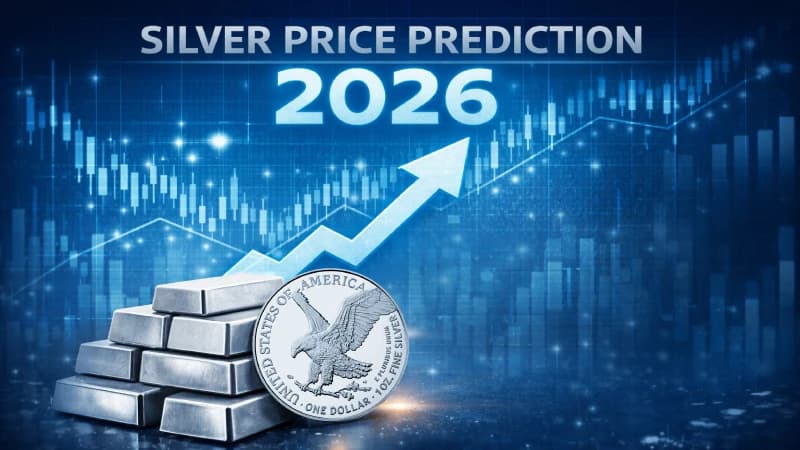
So, what does the silver price prediction 2026 look like?
Even though predictions don’t necessarily give precise numbers, you can develop a conclusion with detailed market analysis. This market analysis will include economic cycles, supply and demand trends, and past market trends.
We will discuss what might influence the prices of silver in 2026.
Silver has been very volatile in recent years. To a large extent, price movements have been affected by:
As the market evolves, the silver market outlook 2026 is expected to be shifting out of aggressive monetary tightening to the chances of stabilizing, a process historically favoring investment in precious metals.
Market insights for silver price prediction 2026 or any market related analysis can only be trusted from global institutions and precious metal organizations like the Silver Institute. Solar panels, electronics, and electric vehicles (EVs) have been on the forefront of industrial demand for silver that is ensuring its long-term market growth. Along with this, macroeconomic factors like inflation and currency trends tracked by the International Monetary Fund and World Bank are also equally influential. This combination of industrial demand and store of value is impeccably highlighted by financial institutions like JPMorgan Chase. With the cumulative exposure to sustainable energy industry and investment interest, the silver prices could see a possible bullish run in 2026.
Silver generally performs poorly when rates are on a steep increase and when the rates hit a zenith or an inverse zenith.
Silver will experience a new investment demand in case of global central bank sluggishness in tightening in 2026. When safe-haven strategies are considered, investors tend to compare it with gold bullion.
High silver prices are generally supported by lower real interest rates.
Although inflation may have subsided since its peak, structural inflation pressures (energy, labor, supply chain changes) may remain.
Silver normally works well in situations where:
A weaker environment in the dollar would lead to an upward price pressure.
Silver is essential in:
One of the strongest structural bullish drivers of silver is a global move towards renewable energy.
Solar production may keep growing at a rapid pace through 2026, which may greatly restrict the supply of industrial demand. Silver bars are usually amassed by long-term investors when consolidation is taking place.
The production of silver has not increased at the same rate as industrial use. A large number of silver mines are co-products of other metals (such as copper and zinc), i.e. an increase in supply requires expansion in the economics of the wider mining.
When supply is limited and demand increases, silver prices are likely to rise, benefiting investors who hold physical silver bullion.
While the silver price prediction 2026 is for the coming year, historical data is equally important. Historically, silver:
In the possibility of a larger and more accessible commodity upcycle occurring, silver could be negatively impacted considering its smaller market size and more volatility in the market.
Below is a long-term silver price forecast 2026 to 2030 based on industrial demand, inflation trends, and historical price cycles. With the silver price analysis, silver market trends, and historical data, the silver prices (with reasoning) can be forecasted as follows:
| Year | Expected Price Range (USD per oz) | Key Market Drivers |
|---|---|---|
| 2026 | $50 – $70 | Interest rate changes, inflation trends, rising solar and EV demand |
| 2027 | $55 – $75 | Continued renewable energy growth and increasing industrial demand for silver |
| 2028 | $60 – $85 | Potential supply shortages and stronger investment demand |
| 2029 | $65 – $95 | Expansion of green technology and global infrastructure projects |
| 2030 | $70 – $110 | Major energy transition demand, long-term inflation hedge demand |
With the above price forecast, the silver investment 2026 criteria would be dependent on various factors. These factors also align with the explanation that derives the numbers above. Here is the explanation of the forecast and with constitutes to the prices:
Growth in industrial demand for Silver: Silver finds extensive applications in solar panels, electric vehicles, and electronics, and its use may rise by a significant margin by 2030.
Supply constraints: Production of global silver mining decreases gradually relative to the demand and might impact on supply in the long run.
Investment demand: Uncertainty of the economy and inflation can push investors towards precious metals such as silver.
Energy transition: One of the most potent long-term silver price drivers is the adoption of renewable energy.
It is the opinion of many analysts that silver might see a gradual increase in price over the next 2026-2030 because of the expanding use of clean energy technologies and the ongoing demand of precious metals by investors.
Silver however is more volatile than gold and this implies that even in a long-term bullish trend short-term variations are to be expected.
One question that lives rent-free among investors is what is the silver price forecast 2026? There are chances that an upward movement will occur when:
Nevertheless, investors would want to be surprised by fluctuations and not steady progress. This could be a cumulative result of the above factors like decreasing interest rates and silver prices increase.
Silver does not travel in straight lines very often - but long-term patience has always been rewarded historically.
Silver offers:
Liquidity and resale value makes many investors want to be associated with globally recognized coins like American Silver Eagle coins.
It may suit investors who:
Disciplined allocation and risk management are still vital. Selling your silver bullion when rebalancing the portfolio should also be known to the investors.
The silver market forecast of 2026 is that the price would fall within the range of $50-70 per ounce, provided that the interest rate changes, inflationary and industrial demand, and the economic conditions in the world are all put into account. The increase in demand in the renewable energy markets such as the solar panels could also favor the high silver prices.
There is a likelihood of a rise in silver prices in 2026 provided that the interest rates are low, inflation still persists and industrial growth is still high. The demand by other industries like solar energy, electric vehicles, and electronics would continue to make significant contributions to the long-term growth of the price of silver.
Silver price predictions depend on a number of factors, such as:
Central bank interest rate policies.
Currency fluctuations and inflation.
Silver industrial demand.
International business risk.
Limitations to supply in the mining of silver.
All these combined will determine the general future perspective of silver prices.
Silver can be a good investment in portfolio diversification since it is both an industrial need and a precious metal. Silver is usually used by investors in times of economic uncertainty or inflation as a way against depreciated currencies.
The industrial market is a significant player in the silver market since silver finds extensive applications in solar panels, electric cars, electronics and medical technologies. Due to the increase in the use of renewable energy around the world, the demand for silver in manufacturing may further go up.
The positive structural demand of both renewable energy and industries makes Silver a supported commodity in 2026. Meanwhile, macroeconomic variables like interest rates and silver price inflation will have a significant effect on the short-term price movement.
There is no prediction that will guarantee certain values, but the overall arrangement indicates that silver will continue to be a strategically crucial asset in a diversified portfolio.
Investors should monitor:
To investors looking to construct or add to their allocation, there is an option to look at silver bullion products available in the market as a direct way of being exposed to market trends in the coming 2026.
The distinctive nature of the relationship between the industrial use of silver and the investment demand of the precious metal predetermines the fact that 2026 can be a crucial year in the life of the price.


Affiliations











Copyright BOLD Precious Metals 2026