

Share
| Quantity | Cash/Check | Credit Card | Paypal/Pay |
|---|---|---|---|
| Any Quantity | $4,334.70 | $4,516.76 | $4,573.11 |
Share
The Austrian Gold Philharmonic is the most decorated sovereign gold bullion coin in European history and one of the best-selling gold coins in the world, having won the World Gold Council's world's best-selling gold coin award in 1992, 1995, 1996, and 2000, and Europe's best-selling gold bullion coin award each year since 1989. The .9999 purity, the design's reputation as a 35 year winning design based on one of the world's greatest cultural institutions, a close relationship with the sovereign government of Austria, and a consistent output of 1 oz gold coins year after year have paved the way for the Philharmonic to establish itself as one of the most liquid secondary market gold coin liquidity pools in the world.
The Austrian Gold Philharmonic was first released on 10th October 1989 in two denominations, one-ounce and one-quarter ounce. The coin is 2 mm thick, reeded, and 37mm across. Since this time, it has grown to include 1/2 oz, 1/10 oz and 1/25 oz gold coins, and has even been released in silver (2008) and platinum (2016) versions, but the 1 oz gold coin has always been the heart of the program and the premier product of the Austrian Mint. JM Bullion
This is a listing for a Random Date coin; the year of a coin received may differ depending upon BOLD's inventory. The dates are authentic philharmonic Brilliant Uncirculated pieces struck by the Münze Österreich. Since 1989, the design has remained the same (apart from the minor change noted below), thus making all years look exactly the same. For a particular year, please refer to BOLD's dated Philharmonic listings.
BOLD Precious Metals is an authorized dealer of the Münze Österreich products. Each coin is shipped Brilliant Uncirculated in a protective plastic flip.
The Vienna Philharmonic coin is special in one particular aspect: It doesn't feature any image of a head of state or monarch. On the first side, there are objects, one great architectural instrument of music, and on the other side, there is a collection of orchestral instruments. It is the only large European gold bullion coin that was not based on royal heritage but was inspired by cultural identity.
The front shows the magnificent pipe organ of the Musikverein's concert hall, the Goldener Saal—the Golden Hall—of Vienna's Musikverein, which opened its doors in 1870 and has since been the home of the Vienna Philharmonic Orchestra. The Golden Hall of the Musikverein is one of the acoustically best concert halls in the world, and the instrument at the center of the music is one of the most ostentatious pipe organs in European concert hall music: gilded pipes ascend between carved caryatids, and the ceiling is covered with an incredible coffered gold.
The words "REPUBLIK ÖSTERREICH," the official name of the country, are written above the organ. The design depicts the organ, and under it, the coin bears the inscription "1 UNZE GOLD 999.9" and the date of mintage. The bottom side of the coin has the denomination "100 EURO." Coins from before 2002 have “2,000 SCHILLING” as the new denomination, instead of “100 EURO," as this was the currency change for Austria that took place when the euro was introduced.
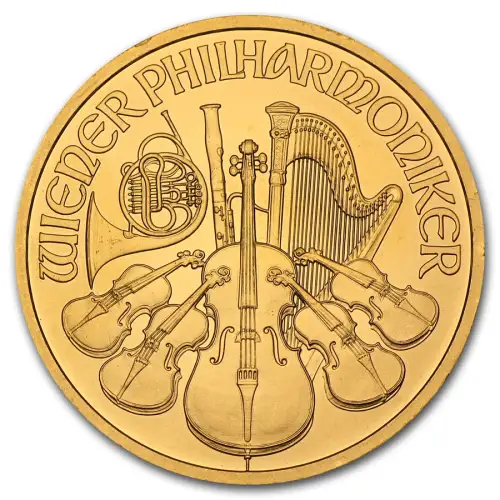
At the back is a group of instruments in two rows: the violins, harp, Vienna horn, and bassoon in the top line, and the cello in the bottom line. The legend "WIENER PHILHARMONIKER" (Vienna Philharmonic) appears above the instruments.
It is the cello that is the focal point of the reverse; the scroll and the curved body are captured in their dimensionality as the four nines gold and fine die craftsmanship enable them to appear in this manner. On the right side of the work, behind the harp, the Vienna horn—the natural horn with a valve—is to be found, as it is most associated with the Vienna Philharmonic's signature sound. Thomas Pesendorfer's arrangement allows each instrument to be heard and appreciated for its individual worth and also affords the visual interest of the arrangement, directing the listener's attention from the main instrument, the cello, out towards the other instruments.
Pesendorfer's original design has been modified in just one way—the inclusion of a raised rim for easier stacking—known as an edge rod. This is an actual modification that was made to make it easier to handle and store the artwork without changing the art itself. All other obverse and reverse features match the 1989 original, which no other major sovereign gold bullion coin program of its maturity can match.
Founded in an era before the modern era of big business, the Austrian Mint (Münze Österreich AG) has a history that is unique among the world's precious metals mints.
The story of the Austrian Mint began in 1194 when Duke Leopold V of Austria was given 12 tonnes of silver to ransom his own captured King Richard the Lionheart of England, who had been taken prisoner near Vienna on his way back from a Crusade. Leopold decided to mint this silver into coins, which started Vienna's minting operations. The Austrian Mint uses 1194 as a historical starting date as well (in 1994 they celebrated 800 years).
In 1989, the Vienna state mint was converted to a public company known as Münze Österreich AG (Austrian Mint AG), and at the same time the state mint was established as a full subsidiary of the Oesterreichische Nationalbank, Austria's central bank. The whole structure is wholly owned by the state and is backed by the central bank, and this makes the Philharmonic coins more ‘sovereign' than the coins made by private mints. An Austrian Gold Philharmonic is not made by a private manufacturer but by the Republic of Austria and its central banking system.
Austria's euro currency coins for circulation are produced by the Austrian Mint in Vienna, as are bullion and commemorative coins. The Philharmonic series is the flagship bullion program of the mint.
Record: World Best-Selling Gold Coin is the Philharmonic's latest album.
In 1989, the Austrian Mint was transferred to Austria's National Bank, which requested that the engraving department create a 1 oz gold coin in the highest gold purity, .9999 or 99.99%. The design process was personally carried out by Chief Engraver Thomas Pesendorfer. As he was developing some concepts for the design in an internal national bank competition, Pesendorfer asked an official of the orchestra for a discussion on the design, but he was initially met with a skeptical receptionist. Eventually, the correct individual heard of his interest, and the remainder of the story is history.
The Gold Philharmonic was introduced to the market on 10 Oct 1989. The 1 oz was issued in the highest denomination of any gold bullion coin in the world at the time, 2,000 schillings, or Austrian gulden, which was the standard denomination of the country's gold coins.
The popularity of the Vienna Philharmonic was soon on the rise: the coin was in 1990 the most popular in Europe and the second most popular in the world. It was the best-selling gold coin in the world, as determined by the World Gold Council in 1992, 1995, 1996 and 2000. The 14 million Vienna Philharmonic coins sold since their launch in October 1989 have weighed just over 329 tonnes of gold in total.
Since 1989, more than 17 million coins have been issued all over the world. Austrian Mint data shows the Philharmonic is the most wanted gold coin in Europe and Japan.
This listing represents 1 oz Gold Philharmonics from a random year of issue, and the exact year of issue is not guaranteed and cannot be predicted in advance, as it is chosen from BOLD's available inventory at the time the listing is made.
The design is consistent throughout all years—Pesendorfer's 1989 original art never changed. A 1991 coin and a 2024 coin look the same, except for the inscription they have on the obverse depicting the year. From an artistic and design perspective, there is no reason to prefer one year over another if viewed from a pure investment perspective.
Those coins that were minted before 2002 have a face value of "2,000 SCHILLINGS" instead of "100 EURO"—they are the schilling-era Philharmonics that were produced prior to the introduction of the euro in Austria. The gold content, state of purity, and size are the same as all subsequent coins. A few collectors appreciate the schilling-era coins as a historical footnote. The investment value of the piece is the amount of metal that it contains and is not dependent on the date of the piece.
Whether you're creating a year-set collection, filling a gap in a set, or just want to add a newer year-set coin, BOLD's dated Philharmonic listings can give you that peace of mind. The random date option is great for those who want to find the pure gold content in their coins at the lowest coin premium.
The 1 oz Austrian Gold Philharmonic is compliant with all IRS rules and regulations for holding within a Self-Directed Precious Metals IRA. It is .9999 fine gold, which is one whole purity grade higher than the minimum amount the IRS considers gold to be .995 fine. It is a legal tender European coin that has been manufactured by a mint that is owned by a central bank; therefore, it is accepted by virtually all Self-Directed IRA custodians that deal in gold. Please check the acceptance of specific products with your custodian prior to buying.
The Austrian Gold Philharmonic is the most decorated sovereign gold bullion coin in European history and one of the best-selling gold coins in the world, having won the World Gold Council's world's best-selling gold coin award in 1992, 1995, 1996, and 2000, and Europe's best-selling gold bullion coin award each year since 1989. The .9999 purity, the design's reputation as a 35 year winning design based on one of the world's greatest cultural institutions, a close relationship with the sovereign government of Austria, and a consistent output of 1 oz gold coins year after year have paved the way for the Philharmonic to establish itself as one of the most liquid secondary market gold coin liquidity pools in the world.
The Austrian Gold Philharmonic was first released on 10th October 1989 in two denominations, one-ounce and one-quarter ounce. The coin is 2 mm thick, reeded, and 37mm across. Since this time, it has grown to include 1/2 oz, 1/10 oz and 1/25 oz gold coins, and has even been released in silver (2008) and platinum (2016) versions, but the 1 oz gold coin has always been the heart of the program and the premier product of the Austrian Mint. JM Bullion
This is a listing for a Random Date coin; the year of a coin received may differ depending upon BOLD's inventory. The dates are authentic philharmonic Brilliant Uncirculated pieces struck by the Münze Österreich. Since 1989, the design has remained the same (apart from the minor change noted below), thus making all years look exactly the same. For a particular year, please refer to BOLD's dated Philharmonic listings.
BOLD Precious Metals is an authorized dealer of the Münze Österreich products. Each coin is shipped Brilliant Uncirculated in a protective plastic flip.
The Vienna Philharmonic coin is special in one particular aspect: It doesn't feature any image of a head of state or monarch. On the first side, there are objects, one great architectural instrument of music, and on the other side, there is a collection of orchestral instruments. It is the only large European gold bullion coin that was not based on royal heritage but was inspired by cultural identity.
The front shows the magnificent pipe organ of the Musikverein's concert hall, the Goldener Saal—the Golden Hall—of Vienna's Musikverein, which opened its doors in 1870 and has since been the home of the Vienna Philharmonic Orchestra. The Golden Hall of the Musikverein is one of the acoustically best concert halls in the world, and the instrument at the center of the music is one of the most ostentatious pipe organs in European concert hall music: gilded pipes ascend between carved caryatids, and the ceiling is covered with an incredible coffered gold.
The words "REPUBLIK ÖSTERREICH," the official name of the country, are written above the organ. The design depicts the organ, and under it, the coin bears the inscription "1 UNZE GOLD 999.9" and the date of mintage. The bottom side of the coin has the denomination "100 EURO." Coins from before 2002 have “2,000 SCHILLING” as the new denomination, instead of “100 EURO," as this was the currency change for Austria that took place when the euro was introduced.
At the back is a group of instruments in two rows: the violins, harp, Vienna horn, and bassoon in the top line, and the cello in the bottom line. The legend "WIENER PHILHARMONIKER" (Vienna Philharmonic) appears above the instruments.
It is the cello that is the focal point of the reverse; the scroll and the curved body are captured in their dimensionality as the four nines gold and fine die craftsmanship enable them to appear in this manner. On the right side of the work, behind the harp, the Vienna horn—the natural horn with a valve—is to be found, as it is most associated with the Vienna Philharmonic's signature sound. Thomas Pesendorfer's arrangement allows each instrument to be heard and appreciated for its individual worth and also affords the visual interest of the arrangement, directing the listener's attention from the main instrument, the cello, out towards the other instruments.
Pesendorfer's original design has been modified in just one way—the inclusion of a raised rim for easier stacking—known as an edge rod. This is an actual modification that was made to make it easier to handle and store the artwork without changing the art itself. All other obverse and reverse features match the 1989 original, which no other major sovereign gold bullion coin program of its maturity can match.
Founded in an era before the modern era of big business, the Austrian Mint (Münze Österreich AG) has a history that is unique among the world's precious metals mints.
The story of the Austrian Mint began in 1194 when Duke Leopold V of Austria was given 12 tonnes of silver to ransom his own captured King Richard the Lionheart of England, who had been taken prisoner near Vienna on his way back from a Crusade. Leopold decided to mint this silver into coins, which started Vienna's minting operations. The Austrian Mint uses 1194 as a historical starting date as well (in 1994 they celebrated 800 years).
In 1989, the Vienna state mint was converted to a public company known as Münze Österreich AG (Austrian Mint AG), and at the same time the state mint was established as a full subsidiary of the Oesterreichische Nationalbank, Austria's central bank. The whole structure is wholly owned by the state and is backed by the central bank, and this makes the Philharmonic coins more ‘sovereign' than the coins made by private mints. An Austrian Gold Philharmonic is not made by a private manufacturer but by the Republic of Austria and its central banking system.
Austria's euro currency coins for circulation are produced by the Austrian Mint in Vienna, as are bullion and commemorative coins. The Philharmonic series is the flagship bullion program of the mint.
Record: World Best-Selling Gold Coin is the Philharmonic's latest album.
In 1989, the Austrian Mint was transferred to Austria's National Bank, which requested that the engraving department create a 1 oz gold coin in the highest gold purity, .9999 or 99.99%. The design process was personally carried out by Chief Engraver Thomas Pesendorfer. As he was developing some concepts for the design in an internal national bank competition, Pesendorfer asked an official of the orchestra for a discussion on the design, but he was initially met with a skeptical receptionist. Eventually, the correct individual heard of his interest, and the remainder of the story is history.
The Gold Philharmonic was introduced to the market on 10 Oct 1989. The 1 oz was issued in the highest denomination of any gold bullion coin in the world at the time, 2,000 schillings, or Austrian gulden, which was the standard denomination of the country's gold coins.
The popularity of the Vienna Philharmonic was soon on the rise: the coin was in 1990 the most popular in Europe and the second most popular in the world. It was the best-selling gold coin in the world, as determined by the World Gold Council in 1992, 1995, 1996 and 2000. The 14 million Vienna Philharmonic coins sold since their launch in October 1989 have weighed just over 329 tonnes of gold in total.
Since 1989, more than 17 million coins have been issued all over the world. Austrian Mint data shows the Philharmonic is the most wanted gold coin in Europe and Japan.
This listing represents 1 oz Gold Philharmonics from a random year of issue, and the exact year of issue is not guaranteed and cannot be predicted in advance, as it is chosen from BOLD's available inventory at the time the listing is made.
The design is consistent throughout all years—Pesendorfer's 1989 original art never changed. A 1991 coin and a 2024 coin look the same, except for the inscription they have on the obverse depicting the year. From an artistic and design perspective, there is no reason to prefer one year over another if viewed from a pure investment perspective.
Those coins that were minted before 2002 have a face value of "2,000 SCHILLINGS" instead of "100 EURO"—they are the schilling-era Philharmonics that were produced prior to the introduction of the euro in Austria. The gold content, state of purity, and size are the same as all subsequent coins. A few collectors appreciate the schilling-era coins as a historical footnote. The investment value of the piece is the amount of metal that it contains and is not dependent on the date of the piece.
Whether you're creating a year-set collection, filling a gap in a set, or just want to add a newer year-set coin, BOLD's dated Philharmonic listings can give you that peace of mind. The random date option is great for those who want to find the pure gold content in their coins at the lowest coin premium.
The 1 oz Austrian Gold Philharmonic is compliant with all IRS rules and regulations for holding within a Self-Directed Precious Metals IRA. It is .9999 fine gold, which is one whole purity grade higher than the minimum amount the IRS considers gold to be .995 fine. It is a legal tender European coin that has been manufactured by a mint that is owned by a central bank; therefore, it is accepted by virtually all Self-Directed IRA custodians that deal in gold. Please check the acceptance of specific products with your custodian prior to buying.


Affiliations


Copyright BOLD Precious Metals 2026