

Share
| Quantity | Cash/Check | Credit Card | Paypal/Pay |
|---|---|---|---|
| Any Quantity | $334.78 | $348.84 | $353.19 |
Share
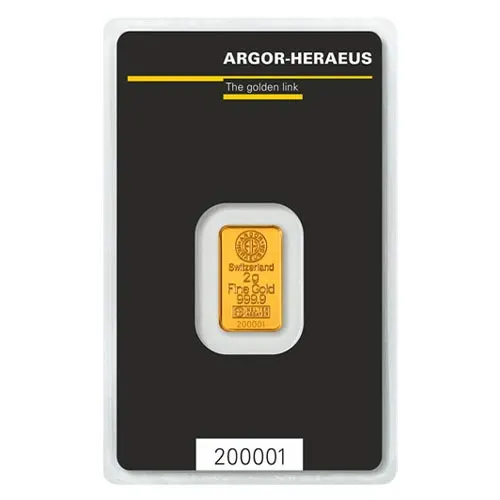
It is the smallest gold bar in one of the world's most reputable Swiss refineries' iconic gold bar series: the Argor-Heraeus 2 Gram Gold Bar, a 2-gm gold bar of .9999 fineness sealed in the transparent blister assay card with a certified assayer's signature and a unique serial number matched to the bar's documentation.
Since 1951, Argor-Heraeus has been playing a leading role in the precious metals industry from Switzerland's heart. Already in the 1960s, the company was able to achieve four-nine (999.9‰) gold fineness, an outstanding feat for that time when the vast majority of the gold in use was of 999.5‰ or less, symbolizing technological leadership and refinement.
This bar offers the true experience of Swiss gold ownership with the lowest absolute dollar price point in the line of Argor-Heraeus's minted bars. For new gold investors, it is the obvious and logical first investment in gold; for the cost-averagers, a logical step-up; and for the thoughtful and credible gold givers, one of the most practical and convincing choices of a gold gift, it is compact; it is professionally authenticated; and it carries with it the institutional weight now more than 70 years strong that has been established by the world's leading gold refinery.
All of Argor-Heraeus bars purchased by BOLD Precious Metals are obtained via the official distributors. All bars are sent in the original blister assay card, unopened.
All the markings that you will see on these items will be on the obverse field of the 2 Gram Argor-Heraeus Gold Bar. The design field has the Argor-Heraeus logo at the top, which consists of a circle with the company initials in the center and the company name "ARGOR HERAEUS SA" written in a circle around the center. Other notations include weight, content, and purity of the bar.
Vertically on the obverse of the medal: ARGOR HERAEUS SA logo, SWITZERLAND, 2G (value of the medal), FINE GOLD, 9999, (assayer's mark), unique serial number. The design is clean, purposeful, and vertical—it is all designed to provide the authentication function and not for aesthetic purposes. This clarity is a key aspect of why Argor-Heraeus minted bars are immediately recognized by the dealer and investment market.
The blank face is on the back of the 2 Gram Argor-Heraeus Gold Bar. This is not a mistake and is considered a design idea that makes this Classic Minted series different from the KineBar series. The art on the reverse is the product, not the embellishment, and that's what the blank reverse conveys with its investment-first philosophy. It also clearly differentiates this bar from the 2 Gram KineBar (also listed on BOLD) with a proprietary holographic security feature on the back.
Argor-Heraeus classic minted ingots come in sealed assay blister packs. The transparent blister pack features a capsule space to house the bar and has an assay card around the capsule within the display. The signature of a certified assayer and the weight, purity, metal content, and serial number of the bar are all recorded on this assay card. The front of the assay card features the name Argor-Heraeus and their slogan, "The Golden Link," the re-refinery's self-proclaimed position in the value chain of precious metals. The reverse of the assay card contains the weight, fineness, metal content, a small Swiss flag (the country of issue indicator), and a signature of the certified assayer who verified the bar independently after its production.
Emilio Weiss and Elvio Zoppi got the idea from the Italian words "argento" (silver) and "oro" (gold) and established ARGOR SA in 1951, the first precious metals foundry in Ticino, the southernmost canton of Switzerland, right along Italy's border. The name Argor is itself double-coded, with the precious metals of silver and gold.
The company soon became a gold refining powerhouse with a capacity to process 440kg of gold a day. With the development of assays, acceptance, smelting, and mechanics in the 1960s, the company gained control of (999.9‰) gold fineness, an extraordinary feat, as gold was only 999.5‰ or less at that time. This early achievement of 4 nines purity marked the beginning of an industry leadership position for Argor-Heraeus many decades before it became an industry standard.
In 1960, the Union Bank of Switzerland (UBS) took over an 80% stake in Argor SA, and in 1973, it acquired the remaining stake. In 1986, UBS sold the 25% stake to Heraeus and thus created a joint venture company (Argor-Heraeus SA) for the operation of the refinery, which was relocated to Mendrisio.
Since 1961, Argor-Heraeus wholesale gold bars have been recognized as LBMA Good Delivery and silver bars since 1961. Wholesale market platinum and palladium bars offered by the refinery are also considered as ‘good delivery' bars to the London Platinum and Palladium Market (LPPM). Argor-Heraeus good delivery bars are also accepted for delivery for TOCOM's gold futures contracts and COMEX gold futures contracts.
Kinebar technology is an invention by Argor-Heraeus and UBS, which was developed in 1993 and consists of a holographic Kinegram element printed on the back of their classic minted gold ingots. With its Kinebars, Argor-Heraeus is still the only refiner worldwide. The technology of Kinebar was presented for the first time in 1993 and made Argor-Heraeus a pioneer in the field of anti-counterfeiting for precious metals in the physical state, which is the technology used by the security systems in passports and banknotes in the whole world.
All other shareholders were sold to Heraeus in April 2017, with the result that Heraeus became a 100 percent shareholder in the refinery. Nowadays, Argor-Heraeus is a wholly owned company of Heraeus Precious Metals, a German global business. It now employs more than 600 people in its main locations in Mendrisio (Switzerland), Hong Kong, Pforzheim (Germany) and Cavenago di Brianza (Italy) and processes and transforms precious metals for customers in more than 50 countries around the world.
Apart from their investment products, Argor-Heraeus is also a leading supplier of precious metals to the luxury industry, such as the world's finest watchmakers and jewelers. The same refinery supplies precious metals for Rolex, Patek Philippe, and other hallmarks of Swiss horology for the investors. Argor-Heraeus has a dual industrial and investment clientele, which makes the purity standards of Argor-Heraeus products verifiable by industries where the deviation from specification of the final product is not accepted.
The Classic Minted vs. KineBar are both types of 2 gram Argor-Heraeus bars, but they are different. There are two types of Argor-Heraeus bars: Classic Minted and KineBar.
BOLD is a gold bar manufacturer that produces two different gold bars of 2 grams each with a gold purity of 24 karats made by Argor-Heraeus. It is crucial to know the distinction so that the correct product may be purchased.
The basic Argor-Heraeus minted ingot. Clean with the AH logo, weight, purity, ESSAYEUR FONDER, and unique serial number. Blank reverse. Closed in blister assay card with certified assayer's signature. Authentic investment-grade bar from one of the world's most highly regarded refineries. No additional premium for security technology. For investors and gift purchasers who want to enjoy the complete institutional level of Argor-Heraeus in the 2-gram denomination at a minimum price.
The .9999 gold, obverse marks, and serial number are the same, but the reverse has a proprietary holographic security element embossed. Kinebar technology was developed by Argor-Heraeus and UBS in 1993. The hologram, or Kinegram, is applied to the surface of the substrate on the back and provides several color changes and visual textures as the bar is moved at various angles. Argor-Heraeus is the sole refinery in the world to manufacture Kinebars. The KineBar is slightly more expensive than the Classic bar. This is more valuable for those who purchase a gold bar as a gift and desire the maximum amount of visual effect, or for investors who are specifically looking for the added anti-counterfeiting security of the world's only holographic gold bar format. The Classic bar is the superior option for investing in an affordable manner.
BOLD Precious Metals has a buy-back program that is transparent. The LBMA Good Delivery accreditation since 1961, COMEX acceptance since 1972, and the hallmark of one of the five LBMA referee refineries make Argor-Heraeus bars one of the easiest gold products to sell for full market value to dealers all over the world. Sealed bars, which come in original assay card packaging, are offered the best buyback prices.
It is the smallest gold bar in one of the world's most reputable Swiss refineries' iconic gold bar series: the Argor-Heraeus 2 Gram Gold Bar, a 2-gm gold bar of .9999 fineness sealed in the transparent blister assay card with a certified assayer's signature and a unique serial number matched to the bar's documentation.
Since 1951, Argor-Heraeus has been playing a leading role in the precious metals industry from Switzerland's heart. Already in the 1960s, the company was able to achieve four-nine (999.9‰) gold fineness, an outstanding feat for that time when the vast majority of the gold in use was of 999.5‰ or less, symbolizing technological leadership and refinement.
This bar offers the true experience of Swiss gold ownership with the lowest absolute dollar price point in the line of Argor-Heraeus's minted bars. For new gold investors, it is the obvious and logical first investment in gold; for the cost-averagers, a logical step-up; and for the thoughtful and credible gold givers, one of the most practical and convincing choices of a gold gift, it is compact; it is professionally authenticated; and it carries with it the institutional weight now more than 70 years strong that has been established by the world's leading gold refinery.
All of Argor-Heraeus bars purchased by BOLD Precious Metals are obtained via the official distributors. All bars are sent in the original blister assay card, unopened.
All the markings that you will see on these items will be on the obverse field of the 2 Gram Argor-Heraeus Gold Bar. The design field has the Argor-Heraeus logo at the top, which consists of a circle with the company initials in the center and the company name "ARGOR HERAEUS SA" written in a circle around the center. Other notations include weight, content, and purity of the bar.
Vertically on the obverse of the medal: ARGOR HERAEUS SA logo, SWITZERLAND, 2G (value of the medal), FINE GOLD, 9999, (assayer's mark), unique serial number. The design is clean, purposeful, and vertical—it is all designed to provide the authentication function and not for aesthetic purposes. This clarity is a key aspect of why Argor-Heraeus minted bars are immediately recognized by the dealer and investment market.
The blank face is on the back of the 2 Gram Argor-Heraeus Gold Bar. This is not a mistake and is considered a design idea that makes this Classic Minted series different from the KineBar series. The art on the reverse is the product, not the embellishment, and that's what the blank reverse conveys with its investment-first philosophy. It also clearly differentiates this bar from the 2 Gram KineBar (also listed on BOLD) with a proprietary holographic security feature on the back.
Argor-Heraeus classic minted ingots come in sealed assay blister packs. The transparent blister pack features a capsule space to house the bar and has an assay card around the capsule within the display. The signature of a certified assayer and the weight, purity, metal content, and serial number of the bar are all recorded on this assay card. The front of the assay card features the name Argor-Heraeus and their slogan, "The Golden Link," the re-refinery's self-proclaimed position in the value chain of precious metals. The reverse of the assay card contains the weight, fineness, metal content, a small Swiss flag (the country of issue indicator), and a signature of the certified assayer who verified the bar independently after its production.
Emilio Weiss and Elvio Zoppi got the idea from the Italian words "argento" (silver) and "oro" (gold) and established ARGOR SA in 1951, the first precious metals foundry in Ticino, the southernmost canton of Switzerland, right along Italy's border. The name Argor is itself double-coded, with the precious metals of silver and gold.
The company soon became a gold refining powerhouse with a capacity to process 440kg of gold a day. With the development of assays, acceptance, smelting, and mechanics in the 1960s, the company gained control of (999.9‰) gold fineness, an extraordinary feat, as gold was only 999.5‰ or less at that time. This early achievement of 4 nines purity marked the beginning of an industry leadership position for Argor-Heraeus many decades before it became an industry standard.
In 1960, the Union Bank of Switzerland (UBS) took over an 80% stake in Argor SA, and in 1973, it acquired the remaining stake. In 1986, UBS sold the 25% stake to Heraeus and thus created a joint venture company (Argor-Heraeus SA) for the operation of the refinery, which was relocated to Mendrisio.
Since 1961, Argor-Heraeus wholesale gold bars have been recognized as LBMA Good Delivery and silver bars since 1961. Wholesale market platinum and palladium bars offered by the refinery are also considered as ‘good delivery' bars to the London Platinum and Palladium Market (LPPM). Argor-Heraeus good delivery bars are also accepted for delivery for TOCOM's gold futures contracts and COMEX gold futures contracts.
Kinebar technology is an invention by Argor-Heraeus and UBS, which was developed in 1993 and consists of a holographic Kinegram element printed on the back of their classic minted gold ingots. With its Kinebars, Argor-Heraeus is still the only refiner worldwide. The technology of Kinebar was presented for the first time in 1993 and made Argor-Heraeus a pioneer in the field of anti-counterfeiting for precious metals in the physical state, which is the technology used by the security systems in passports and banknotes in the whole world.
All other shareholders were sold to Heraeus in April 2017, with the result that Heraeus became a 100 percent shareholder in the refinery. Nowadays, Argor-Heraeus is a wholly owned company of Heraeus Precious Metals, a German global business. It now employs more than 600 people in its main locations in Mendrisio (Switzerland), Hong Kong, Pforzheim (Germany) and Cavenago di Brianza (Italy) and processes and transforms precious metals for customers in more than 50 countries around the world.
Apart from their investment products, Argor-Heraeus is also a leading supplier of precious metals to the luxury industry, such as the world's finest watchmakers and jewelers. The same refinery supplies precious metals for Rolex, Patek Philippe, and other hallmarks of Swiss horology for the investors. Argor-Heraeus has a dual industrial and investment clientele, which makes the purity standards of Argor-Heraeus products verifiable by industries where the deviation from specification of the final product is not accepted.
The Classic Minted vs. KineBar are both types of 2 gram Argor-Heraeus bars, but they are different. There are two types of Argor-Heraeus bars: Classic Minted and KineBar.
BOLD is a gold bar manufacturer that produces two different gold bars of 2 grams each with a gold purity of 24 karats made by Argor-Heraeus. It is crucial to know the distinction so that the correct product may be purchased.
The basic Argor-Heraeus minted ingot. Clean with the AH logo, weight, purity, ESSAYEUR FONDER, and unique serial number. Blank reverse. Closed in blister assay card with certified assayer's signature. Authentic investment-grade bar from one of the world's most highly regarded refineries. No additional premium for security technology. For investors and gift purchasers who want to enjoy the complete institutional level of Argor-Heraeus in the 2-gram denomination at a minimum price.
The .9999 gold, obverse marks, and serial number are the same, but the reverse has a proprietary holographic security element embossed. Kinebar technology was developed by Argor-Heraeus and UBS in 1993. The hologram, or Kinegram, is applied to the surface of the substrate on the back and provides several color changes and visual textures as the bar is moved at various angles. Argor-Heraeus is the sole refinery in the world to manufacture Kinebars. The KineBar is slightly more expensive than the Classic bar. This is more valuable for those who purchase a gold bar as a gift and desire the maximum amount of visual effect, or for investors who are specifically looking for the added anti-counterfeiting security of the world's only holographic gold bar format. The Classic bar is the superior option for investing in an affordable manner.
BOLD Precious Metals has a buy-back program that is transparent. The LBMA Good Delivery accreditation since 1961, COMEX acceptance since 1972, and the hallmark of one of the five LBMA referee refineries make Argor-Heraeus bars one of the easiest gold products to sell for full market value to dealers all over the world. Sealed bars, which come in original assay card packaging, are offered the best buyback prices.


Affiliations


Copyright BOLD Precious Metals 2026