

Share
| Quantity | Cash/Check | Credit Card | Paypal/Pay |
|---|---|---|---|
| 1 - 19 | $131.92 | $137.46 | $139.18 |
| 20 - 99 | $130.92 | $136.42 | $138.12 |
| 100 or more | $129.92 | $135.38 | $137.07 |
Share
One of the most historically significant private-mint Indian silver rounds ever issued in the United States is the 2 oz Golden State Mint Incuse Indian Silver Round.
This round is minted from .999 fine silver and honors one of the rarest and most artistically unusual designs in U.S. numismatic history, the incuse relief style of sculptor Bela Lyon Pratt on the 1908 to 1929 gold $2.50 and $5 Half Eagle.
To date, the incuse technique (sunken below the flat surface of the coin, rather than raised above) is the only sunken-relief design used on circulating U.S. coinage. This round represents that one-of-a-kind American design style at a bullion price point for 2 oz of .999 fine silver.
The Obverse Profile — The Incuse Indian Chief
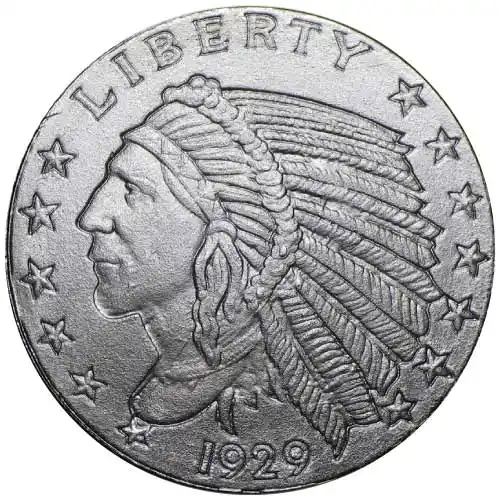
On the obverse is a profile portrait of a Native American chief in full traditional headdress, surrounded by 13 stars (one for each of the original colonies) with "LIBERTY" above and the date "1929" below.
The unique characteristic is the incuse technique in which the portrait is partially recessed into the flat surface, instead of raised above it as in normal round, raised-relief silver bullion designs, which creates a distinct impression of light reflected from the work at all angles and a subtle shadow and depth that no other silver bullion design offers.
Note: At present, transition rounds may come with or without the "1929" designation. BOLD will send what Golden State Mint is currently offering.
The Reverse Profile — The Standing American Eagle
On the reverse, an American Eagle is depicted in profile, standing high and proud with its wings folded, head held high, and displaying strength and sovereignty.
On the left reads "IN GOD WE TRUST," on the right "E PLURIBUS UNUM" (from one many), on the top rim "2 TROY OZ .999 FINE SILVER," and on the bottom rim "GOLDEN STATE MINT."
The incuse that is used on this round is derived from the most daring moment in the design of U.S. coins. The incuse Indian Head design was used on the $2.50 Quarter Eagle and $5 Half Eagle gold coins, the only U.S. gold coins ever struck with sunken relief, in 1908, when the designer was sculptor Bela Lyon Pratt, a student of the legendary Augustus Saint-Gaudens.
The idea was inspired by the relief art at the Boston Museum of Fine Arts, by William Sturgis Bigelow, a close friend of President Theodore Roosevelt of Boston, Massachusetts. Roosevelt was a big supporter of Saint-Gaudens' reworking of the double eagle and eagle and authorized the U.S. Mint to do so.
It generated some controversy when it was first released. Those who opposed the sunken surfaces said that dirt and germs would be trapped there. However, the coins continued to circulate in abundance from 1908 until 1929, and in the years that followed, collectors have viewed Pratt's incuse Indian as one of the most artistically original in American numismatic history.
The year '1929' on this round is a direct reference to the last year of the original production run.
Golden State Mint is an American, private mint that has been family-owned since it was founded in 1974 by Jim Pavlakos and is now run by his son, Andrew Pavlakos.
GSM's 50+ years of production is a testament to one of the most trusted names on U.S. private-sector bullion production, distinguished by its tight tolerances, consistent purity, and well-known hallmarks that make the market's secondary trading much easier.
One of the most historically significant private-mint Indian silver rounds ever issued in the United States is the 2 oz Golden State Mint Incuse Indian Silver Round.
This round is minted from .999 fine silver and honors one of the rarest and most artistically unusual designs in U.S. numismatic history, the incuse relief style of sculptor Bela Lyon Pratt on the 1908 to 1929 gold $2.50 and $5 Half Eagle.
To date, the incuse technique (sunken below the flat surface of the coin, rather than raised above) is the only sunken-relief design used on circulating U.S. coinage. This round represents that one-of-a-kind American design style at a bullion price point for 2 oz of .999 fine silver.
The Obverse Profile — The Incuse Indian Chief
On the obverse is a profile portrait of a Native American chief in full traditional headdress, surrounded by 13 stars (one for each of the original colonies) with "LIBERTY" above and the date "1929" below.
The unique characteristic is the incuse technique in which the portrait is partially recessed into the flat surface, instead of raised above it as in normal round, raised-relief silver bullion designs, which creates a distinct impression of light reflected from the work at all angles and a subtle shadow and depth that no other silver bullion design offers.
Note: At present, transition rounds may come with or without the "1929" designation. BOLD will send what Golden State Mint is currently offering.
The Reverse Profile — The Standing American Eagle
On the reverse, an American Eagle is depicted in profile, standing high and proud with its wings folded, head held high, and displaying strength and sovereignty.
On the left reads "IN GOD WE TRUST," on the right "E PLURIBUS UNUM" (from one many), on the top rim "2 TROY OZ .999 FINE SILVER," and on the bottom rim "GOLDEN STATE MINT."
The incuse that is used on this round is derived from the most daring moment in the design of U.S. coins. The incuse Indian Head design was used on the $2.50 Quarter Eagle and $5 Half Eagle gold coins, the only U.S. gold coins ever struck with sunken relief, in 1908, when the designer was sculptor Bela Lyon Pratt, a student of the legendary Augustus Saint-Gaudens.
The idea was inspired by the relief art at the Boston Museum of Fine Arts, by William Sturgis Bigelow, a close friend of President Theodore Roosevelt of Boston, Massachusetts. Roosevelt was a big supporter of Saint-Gaudens' reworking of the double eagle and eagle and authorized the U.S. Mint to do so.
It generated some controversy when it was first released. Those who opposed the sunken surfaces said that dirt and germs would be trapped there. However, the coins continued to circulate in abundance from 1908 until 1929, and in the years that followed, collectors have viewed Pratt's incuse Indian as one of the most artistically original in American numismatic history.
The year '1929' on this round is a direct reference to the last year of the original production run.
Golden State Mint is an American, private mint that has been family-owned since it was founded in 1974 by Jim Pavlakos and is now run by his son, Andrew Pavlakos.
GSM's 50+ years of production is a testament to one of the most trusted names on U.S. private-sector bullion production, distinguished by its tight tolerances, consistent purity, and well-known hallmarks that make the market's secondary trading much easier.


Affiliations


Copyright BOLD Precious Metals 2026