

Share
| Quantity | Cash/Check | Credit Card | Paypal/Pay |
|---|---|---|---|
| 1 - 4 | $629.60 | $656.04 | $664.23 |
| 5 or more | $627.10 | $653.44 | $661.59 |
Share
The 10 oz Walking Liberty Silver Bar features one of the most famous designs in American numismatic history: Adolph A. Weinman's Walking Liberty design, which has been featured on official United States coinage since 1916 and on the American Silver Eagle since its launch in 1986. The bars are .999 fine silver, each weighing 10 troy ounces, and are minted by the Highland Mint (a certified USA company in Florida) and have a plastic sleeve that seals each bar.This bar has been .999 pure and is eligible for an IRA at one of the lowest premiums for 10 oz silver bars.
Obverse — Walking Liberty
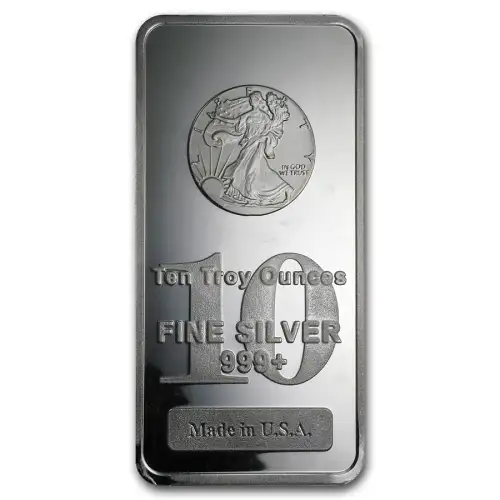
The Walking Liberty figure is carved in fine relief and stands on the polished face of the obverse of the bar. The lady stands on her feet and leaps forward and to the left, toward a rising sun, showing clear purpose, optimism and forward momentum. She is wearing a flowing gown and the U.S. flag as a cape and holds oak and laurel branches (strength and peace) in one arm, with the other arm extended in an open welcoming gesture. America's "call to the world for opportunity" is symbolized by the composition.
The inscriptions around it include "TEN TROY OUNCE FINE SILVER 999+" and "MADE IN U.S.A.," and in the background field is the large numeral "10."
Reverse — Textured Grip Pattern
The other side of the bar is stamped with a diamond (criss-cross) design that covers the entire back. This type of design is functional—the deep grooves. offer grip for handling and make sure the bar doesn't slip as you move it around and when generally inspecting it by hand, and the regular pattern offers the additional friction needed to keep bars stable when stored in order. There's no artistic imagery on the reverse; it's just a utilitarian reverse that does the job well.
It was sculpted by Adolph Alexander Weinman (1870–1952), a German-American artist, who studied under Augustus Saint-Gaudens, widely considered the first sculptor to raise the standard of coinage engraving to a fine art.Weinman's designs for the United States currency are unsurpassed: he designed the Walking Liberty Half Dollar (1916-1947) and the Winged Liberty Head Dime (also called the Mercury Dime, 1916-1945).Both coins are always included among the most beautiful coins in American history.
The Walking Liberty Half Dollar was first issued in 1916 to replace the Barber Half Dollar and continued until 1947.It was discontinued with the introduction of the Franklin Half Dollar, but never lost its hold on the public consciousness.The United States Mint adopted the Walking Liberty design for the obverse of its first silver bullion coin, the American Silver Eagle, in 1986, and it was a clear endorsement that no more recent design had captured the attention or symbolism of this design.The same obverse is still used on the American Silver Eagle today.The 10 oz Walking Liberty is a new investment-focused Walking Liberty design on a new, low-premium large-format bar from the Highland Mint.
Highland Mint is a private U.S. precious metals manufacturer located in Florida, USA.It is ISO-9001 certified (the international quality management standard), ensuring that each bar made is subjected to documented, audited quality controls.The Walking Liberty series comes in various sizes by Highland Mint: 1 oz, 5 oz, and 10 oz, with each size having the same obverse design and being .999 pure.
The 10 oz size is considered a middle ground size in the silver bar market. This offers a significantly lower premium per ounce than 1 oz bars or coins, and it's easier to deal with than 100 oz bars, and it is more liquid than 1 oz bars or coins. The 10 oz bar has superior per-ounce economics in favor of stackers who are building a bullion position and is more flexible than the 100 oz format. Efficient storage: The bar's flat, stackable design reduces the amount of space needed to store silver per ounce.This bar, at .999 purity, also qualifies as the minimum standard that the IRS requires for inclusion in a Silver IRA – thereby enabling investors to hold it in a Self-Directed Precious Metals IRA with a qualifying custodian.
The 10 oz Walking Liberty Silver Bar features one of the most famous designs in American numismatic history: Adolph A. Weinman's Walking Liberty design, which has been featured on official United States coinage since 1916 and on the American Silver Eagle since its launch in 1986. The bars are .999 fine silver, each weighing 10 troy ounces, and are minted by the Highland Mint (a certified USA company in Florida) and have a plastic sleeve that seals each bar.This bar has been .999 pure and is eligible for an IRA at one of the lowest premiums for 10 oz silver bars.
Obverse — Walking Liberty
The Walking Liberty figure is carved in fine relief and stands on the polished face of the obverse of the bar. The lady stands on her feet and leaps forward and to the left, toward a rising sun, showing clear purpose, optimism and forward momentum. She is wearing a flowing gown and the U.S. flag as a cape and holds oak and laurel branches (strength and peace) in one arm, with the other arm extended in an open welcoming gesture. America's "call to the world for opportunity" is symbolized by the composition.
The inscriptions around it include "TEN TROY OUNCE FINE SILVER 999+" and "MADE IN U.S.A.," and in the background field is the large numeral "10."
Reverse — Textured Grip Pattern
The other side of the bar is stamped with a diamond (criss-cross) design that covers the entire back. This type of design is functional—the deep grooves. offer grip for handling and make sure the bar doesn't slip as you move it around and when generally inspecting it by hand, and the regular pattern offers the additional friction needed to keep bars stable when stored in order. There's no artistic imagery on the reverse; it's just a utilitarian reverse that does the job well.
It was sculpted by Adolph Alexander Weinman (1870–1952), a German-American artist, who studied under Augustus Saint-Gaudens, widely considered the first sculptor to raise the standard of coinage engraving to a fine art.Weinman's designs for the United States currency are unsurpassed: he designed the Walking Liberty Half Dollar (1916-1947) and the Winged Liberty Head Dime (also called the Mercury Dime, 1916-1945).Both coins are always included among the most beautiful coins in American history.
The Walking Liberty Half Dollar was first issued in 1916 to replace the Barber Half Dollar and continued until 1947.It was discontinued with the introduction of the Franklin Half Dollar, but never lost its hold on the public consciousness.The United States Mint adopted the Walking Liberty design for the obverse of its first silver bullion coin, the American Silver Eagle, in 1986, and it was a clear endorsement that no more recent design had captured the attention or symbolism of this design.The same obverse is still used on the American Silver Eagle today.The 10 oz Walking Liberty is a new investment-focused Walking Liberty design on a new, low-premium large-format bar from the Highland Mint.
Highland Mint is a private U.S. precious metals manufacturer located in Florida, USA.It is ISO-9001 certified (the international quality management standard), ensuring that each bar made is subjected to documented, audited quality controls.The Walking Liberty series comes in various sizes by Highland Mint: 1 oz, 5 oz, and 10 oz, with each size having the same obverse design and being .999 pure.
The 10 oz size is considered a middle ground size in the silver bar market. This offers a significantly lower premium per ounce than 1 oz bars or coins, and it's easier to deal with than 100 oz bars, and it is more liquid than 1 oz bars or coins. The 10 oz bar has superior per-ounce economics in favor of stackers who are building a bullion position and is more flexible than the 100 oz format. Efficient storage: The bar's flat, stackable design reduces the amount of space needed to store silver per ounce.This bar, at .999 purity, also qualifies as the minimum standard that the IRS requires for inclusion in a Silver IRA – thereby enabling investors to hold it in a Self-Directed Precious Metals IRA with a qualifying custodian.


Affiliations


Copyright BOLD Precious Metals 2026