

Share
Out of Stock
Share
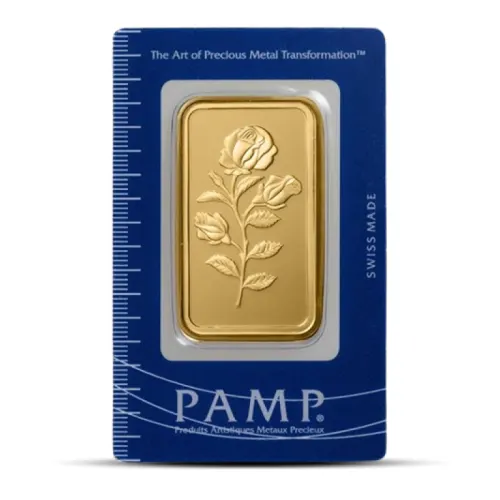
One of the most famous collectible gold bars in the world, the 50 Gram PAMP Suisse Rosa Gold Bar is credited to the Swiss gold refinery that started the idea of gold bars for decoration.Each bar is cast at 50 grams (1.6075 troy oz) of .9999 fine gold, is serially numbered and comes in a CertiPAMP sealed assay card which certifies the weight, purity and authenticity of the bar.The Rosa is one of PAMP's two signature design families and the 50g weight bar is the largest in the Rosa family of bars.
Obverse — The Rosa
On the obverse, the rose is in full bloom, PAMP's signature Rosa design. The composition focuses on a fully opened rose bloom that is atop a stem, and two rose buds are just starting to open inside the leaves. The relief is in fine detail minted work, with each petal, leaf vein and stem created in a raised relief, slightly frosted field. The edge of the bar is slightly raised, clean, and minimal, and it allows the floral design to be fully realized on the face of the bar. On the obverse, there are no inscriptions, only the rose.
Reverse — Identifying Marks
All of the above authentication markings are set vertically on the reverse, from top to bottom: "Suisse" (with the PAMP Suisse logo, the letters PAMP surrounded by a four-pointed star, on top), followed by "50 g FINE GOLD 999.9" (the hallmark) and the bar's individual serial number, a unique one-letter, 6-digit code assigned to each bar upon creation.
Each of the bars in the series is different.
Founded in 1977 in Ticino, Switzerland, PAMP is the company's name, which is a tribute to the philosophy that was formulated at the company's inception.PAMP, which is located in Castel San Pietro close to the Italian border, is an independent precious metals refinery that is built on a very creative goal: to rise above the mere functional ingot. Prior to PAMP, gold bars were all but unmarked and only marked for weight and purity. The first world's refinery to decorate gold bars with motifs of good fortune was PAMP. In 1979, the Lady Fortuna bar was launched as the standard. The Rosa series was to follow, with a second iconic design from the same refinery for the collectors. Both continue to be made today.PAMP was established in Geneva in 1979 by the founder of the MKS PAMP Group Mahmoud Kassem Shakarchi, and has since expanded into one of the world's biggest precious metals trading groups spread throughout Europe, Asia, the Americas, and the Middle East.PAMP is a recognized good delivery institution by the LBMA, the world's most renowned and strict quality criteria in the bullion sector. All the bars exiting the Ticino facility do so before they exit the refinery.
A .9999 purity level signifies that the bar is made of 9,999 parts of every 10,000 of pure gold or 99.99% gold, with 1 part of every 10,000 comprised of a trace metal. This is the highest of purity levels as far as gold bars are concerned and is the minimum level needed to be eligible for IRS approved Gold IRA inclusion. The 50 Gram PAMP Rosa bar is eligible for Precious Metals IRAs and it meets this threshold. This bar is qualified for investors who put allocated gold into an individual retirement account.
Each 50 Gram PAMP Rosa bar comes in a factory-sealed protective format, CertiPAMP, which PAMP developed. The assay card can play three roles: it will prevent the surface of the bar from being marred by handling; it gives authentication by the signature of the assayer and the bar's individual serial number; it facilitates re-verification due to the sealed format which preserves the bar in its original unhandled state for future buyers or storage facilities. The only requirement for checking the bar is to open the assay card and having it sealed will increase the re-sale value.
One of the most famous collectible gold bars in the world, the 50 Gram PAMP Suisse Rosa Gold Bar is credited to the Swiss gold refinery that started the idea of gold bars for decoration.Each bar is cast at 50 grams (1.6075 troy oz) of .9999 fine gold, is serially numbered and comes in a CertiPAMP sealed assay card which certifies the weight, purity and authenticity of the bar.The Rosa is one of PAMP's two signature design families and the 50g weight bar is the largest in the Rosa family of bars.
Obverse — The Rosa
On the obverse, the rose is in full bloom, PAMP's signature Rosa design. The composition focuses on a fully opened rose bloom that is atop a stem, and two rose buds are just starting to open inside the leaves. The relief is in fine detail minted work, with each petal, leaf vein and stem created in a raised relief, slightly frosted field. The edge of the bar is slightly raised, clean, and minimal, and it allows the floral design to be fully realized on the face of the bar. On the obverse, there are no inscriptions, only the rose.
Reverse — Identifying Marks
All of the above authentication markings are set vertically on the reverse, from top to bottom: "Suisse" (with the PAMP Suisse logo, the letters PAMP surrounded by a four-pointed star, on top), followed by "50 g FINE GOLD 999.9" (the hallmark) and the bar's individual serial number, a unique one-letter, 6-digit code assigned to each bar upon creation.
Each of the bars in the series is different.
Founded in 1977 in Ticino, Switzerland, PAMP is the company's name, which is a tribute to the philosophy that was formulated at the company's inception.PAMP, which is located in Castel San Pietro close to the Italian border, is an independent precious metals refinery that is built on a very creative goal: to rise above the mere functional ingot. Prior to PAMP, gold bars were all but unmarked and only marked for weight and purity. The first world's refinery to decorate gold bars with motifs of good fortune was PAMP. In 1979, the Lady Fortuna bar was launched as the standard. The Rosa series was to follow, with a second iconic design from the same refinery for the collectors. Both continue to be made today.PAMP was established in Geneva in 1979 by the founder of the MKS PAMP Group Mahmoud Kassem Shakarchi, and has since expanded into one of the world's biggest precious metals trading groups spread throughout Europe, Asia, the Americas, and the Middle East.PAMP is a recognized good delivery institution by the LBMA, the world's most renowned and strict quality criteria in the bullion sector. All the bars exiting the Ticino facility do so before they exit the refinery.
A .9999 purity level signifies that the bar is made of 9,999 parts of every 10,000 of pure gold or 99.99% gold, with 1 part of every 10,000 comprised of a trace metal. This is the highest of purity levels as far as gold bars are concerned and is the minimum level needed to be eligible for IRS approved Gold IRA inclusion. The 50 Gram PAMP Rosa bar is eligible for Precious Metals IRAs and it meets this threshold. This bar is qualified for investors who put allocated gold into an individual retirement account.
Each 50 Gram PAMP Rosa bar comes in a factory-sealed protective format, CertiPAMP, which PAMP developed. The assay card can play three roles: it will prevent the surface of the bar from being marred by handling; it gives authentication by the signature of the assayer and the bar's individual serial number; it facilitates re-verification due to the sealed format which preserves the bar in its original unhandled state for future buyers or storage facilities. The only requirement for checking the bar is to open the assay card and having it sealed will increase the re-sale value.


Affiliations


Copyright BOLD Precious Metals 2026