

Share
| Quantity | Cash/Check | Credit Card | Paypal/Pay |
|---|---|---|---|
| 1 - 2 | $75.39 | $78.56 | $79.54 |
| 3 - 4 | $74.74 | $77.88 | $78.85 |
| 5 or more | $74.09 | $77.20 | $78.16 |
Share
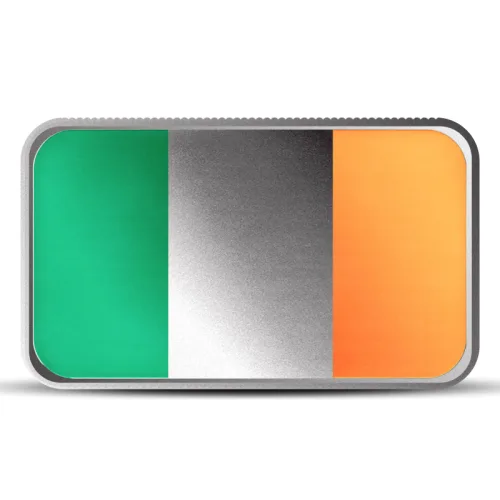
The Irish flag is one of the most symbolically loaded tricolors in the world, three colors, one aspiration, and over 175 years of contested history behind it. The 1 oz Ireland Country Flag Silver Bar from Scottsdale Mint renders that flag in full color on a .999 fine silver bar, capturing the green, white, and orange in precise detail on a 29 mm × 50 mm canvas.
Scottsdale Mint produces its Country Flag Silver Bar series for collectors who want sovereign national identity, not generic bullion. Each bar in the series is struck in one troy oz of .999 fine silver with a color-applied obverse showing a nation's flag in true tones. The reverse carries Scottsdale Mint's signature crowned lion logo, purity inscription "1 TROY OZ FINE SILVER .999," and "SCOTTSDALE MINT" along the left edge. The bars are compact at 29 mm × 50 mm, purpose-sized for display, storage, or accumulation.
The Irish national flag, officially called the National Flag of Ireland, more commonly known as the Irish Tricolor, consists of three equal vertical bands, left to right.
Green represents the Gaelic and Catholic tradition of Ireland. White represents peace and the hope of unity between the two traditions. Orange represents the Protestant tradition and the followers of William of Orange (King William III), the Dutch-born monarch whose victory at the Battle of the Boyne in 1690 shaped the religious divide the flag seeks to bridge. The white stripe in the center is not decorative; it is the argument. The flag was designed to say that green Ireland and orange Ireland could meet in the middle.
Thomas Francis Meagher, a leader of the Young Ireland movement, unveiled the Tricolor in Waterford in March 1848.He drew direct inspiration from the French Revolutionary tricolor, believing that the same ideal of national unity through shared identity could take root in Ireland.Meagher's vision was explicitly reconciliatory, a flag that belonged equally to Catholic nationalists and Protestant unionists.The Tricolor was first carried into battle during the 1916 Easter Rising, flying over the General Post Office in Dublin during the rebellion against British rule.It became the de facto national flag during Ireland's War of Independence (1919–1921) and received full constitutional recognition on December 29, 1937, under the Constitution of Ireland.
The obverse displays the Irish Tricolor in its correct vertical orientation, green at the hoist (left), white in the center, orange at the fly (right). The color application reproduces the flag's proportions accurately. No face value is stamped; this is a private mint bullion bar with value derived from silver content and collectibility. The reverse is clean and functional: Scottsdale Mint's crowned lion portrait runs along the right edge, with "SCOTTSDALE MINT" vertical on the left and "1 TROY OZ FINE SILVER .999" inscribed across the top. Each bar arrives in a protective plastic capsule mounted on a chipboard backing, ready for display or storage.
The capsule protects the color finish from contact scratches.
The Irish flag is one of the most symbolically loaded tricolors in the world, three colors, one aspiration, and over 175 years of contested history behind it. The 1 oz Ireland Country Flag Silver Bar from Scottsdale Mint renders that flag in full color on a .999 fine silver bar, capturing the green, white, and orange in precise detail on a 29 mm × 50 mm canvas.
Scottsdale Mint produces its Country Flag Silver Bar series for collectors who want sovereign national identity, not generic bullion. Each bar in the series is struck in one troy oz of .999 fine silver with a color-applied obverse showing a nation's flag in true tones. The reverse carries Scottsdale Mint's signature crowned lion logo, purity inscription "1 TROY OZ FINE SILVER .999," and "SCOTTSDALE MINT" along the left edge. The bars are compact at 29 mm × 50 mm, purpose-sized for display, storage, or accumulation.
The Irish national flag, officially called the National Flag of Ireland, more commonly known as the Irish Tricolor, consists of three equal vertical bands, left to right.
Green represents the Gaelic and Catholic tradition of Ireland. White represents peace and the hope of unity between the two traditions. Orange represents the Protestant tradition and the followers of William of Orange (King William III), the Dutch-born monarch whose victory at the Battle of the Boyne in 1690 shaped the religious divide the flag seeks to bridge. The white stripe in the center is not decorative; it is the argument. The flag was designed to say that green Ireland and orange Ireland could meet in the middle.
Thomas Francis Meagher, a leader of the Young Ireland movement, unveiled the Tricolor in Waterford in March 1848.He drew direct inspiration from the French Revolutionary tricolor, believing that the same ideal of national unity through shared identity could take root in Ireland.Meagher's vision was explicitly reconciliatory, a flag that belonged equally to Catholic nationalists and Protestant unionists.The Tricolor was first carried into battle during the 1916 Easter Rising, flying over the General Post Office in Dublin during the rebellion against British rule.It became the de facto national flag during Ireland's War of Independence (1919–1921) and received full constitutional recognition on December 29, 1937, under the Constitution of Ireland.
The obverse displays the Irish Tricolor in its correct vertical orientation, green at the hoist (left), white in the center, orange at the fly (right). The color application reproduces the flag's proportions accurately. No face value is stamped; this is a private mint bullion bar with value derived from silver content and collectibility. The reverse is clean and functional: Scottsdale Mint's crowned lion portrait runs along the right edge, with "SCOTTSDALE MINT" vertical on the left and "1 TROY OZ FINE SILVER .999" inscribed across the top. Each bar arrives in a protective plastic capsule mounted on a chipboard backing, ready for display or storage.
The capsule protects the color finish from contact scratches.


Affiliations


Copyright BOLD Precious Metals 2026