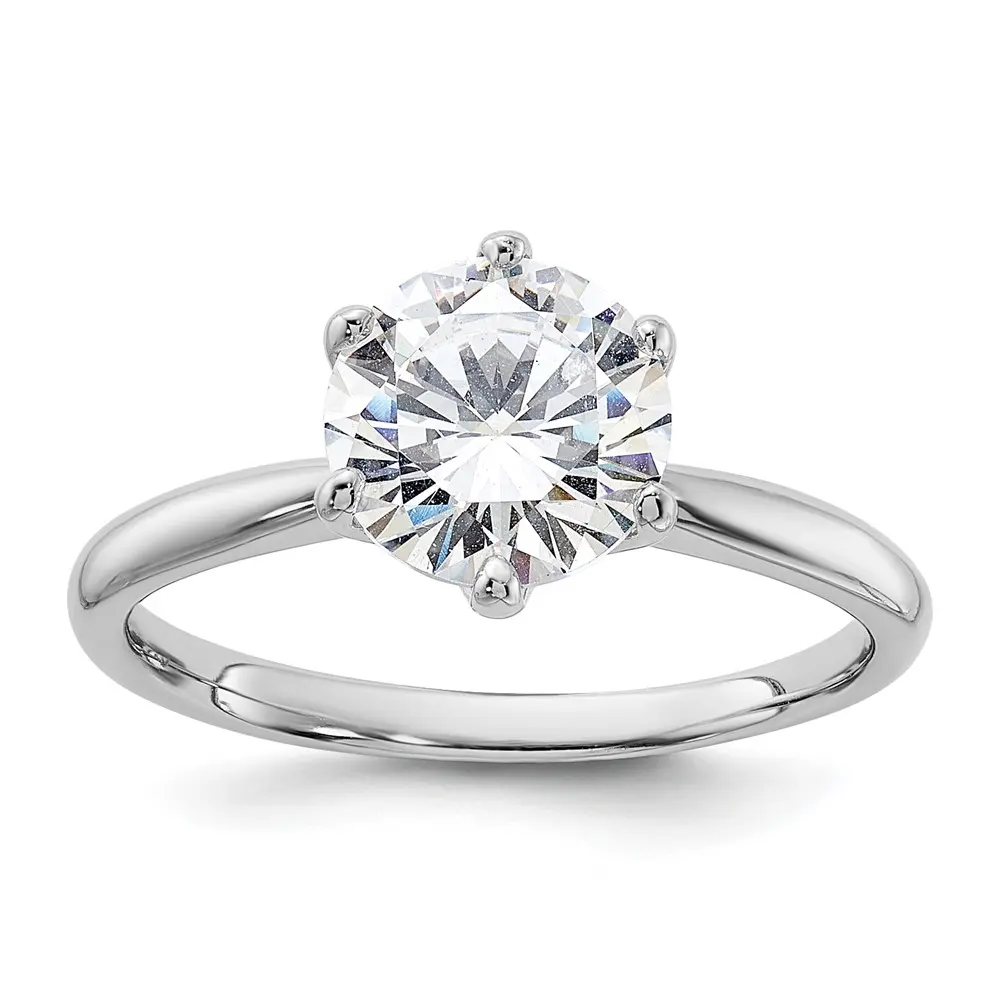
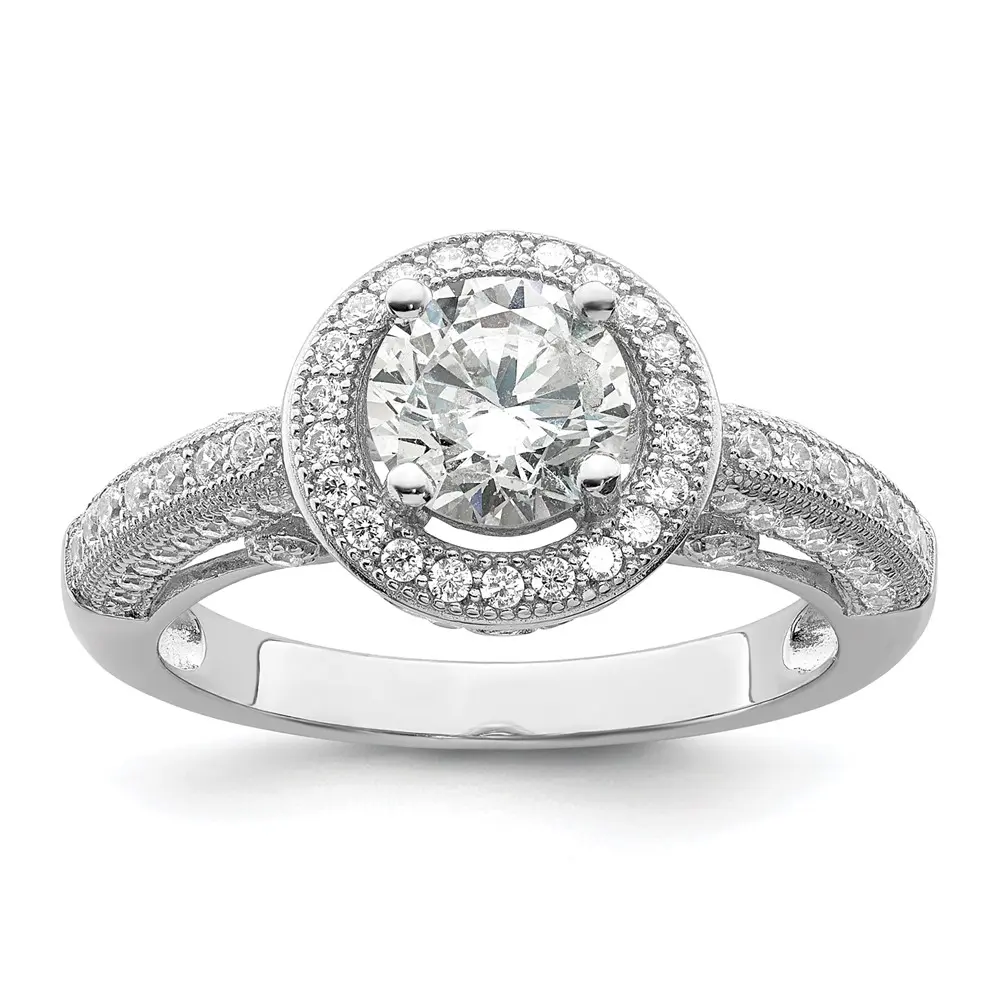
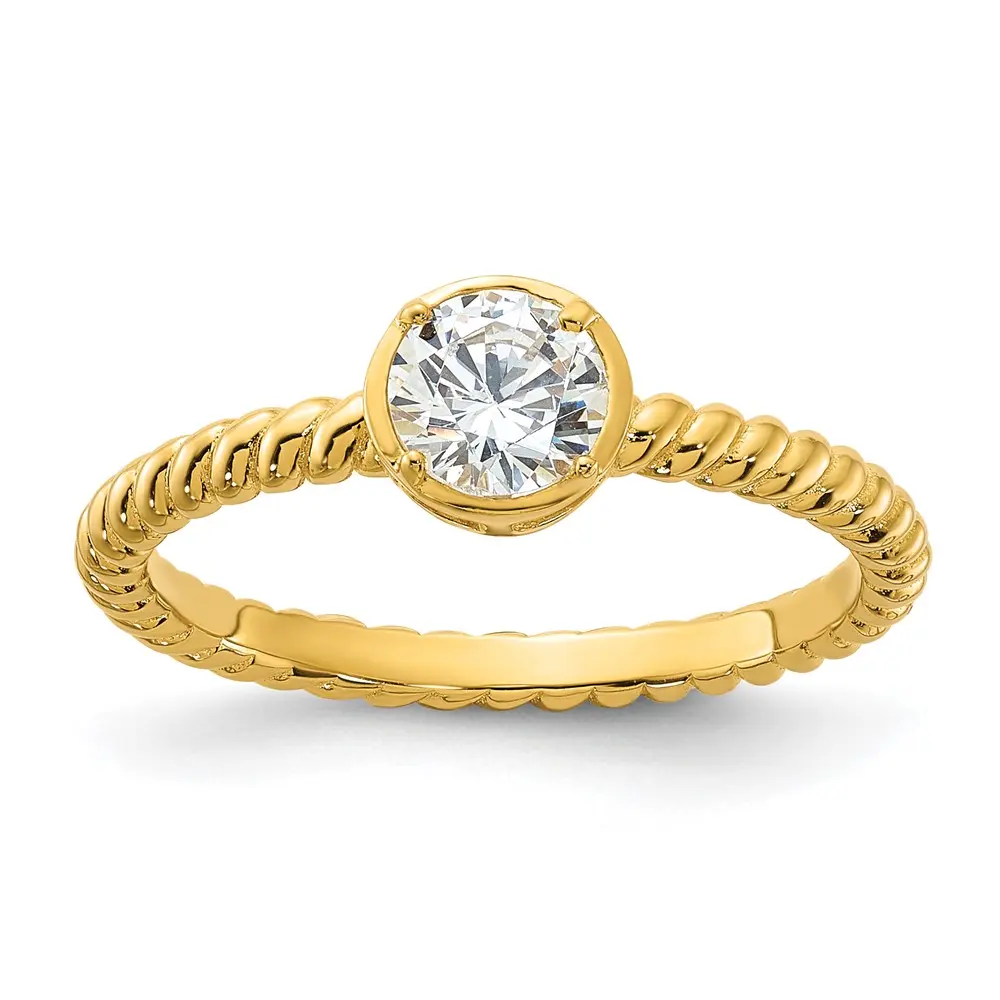
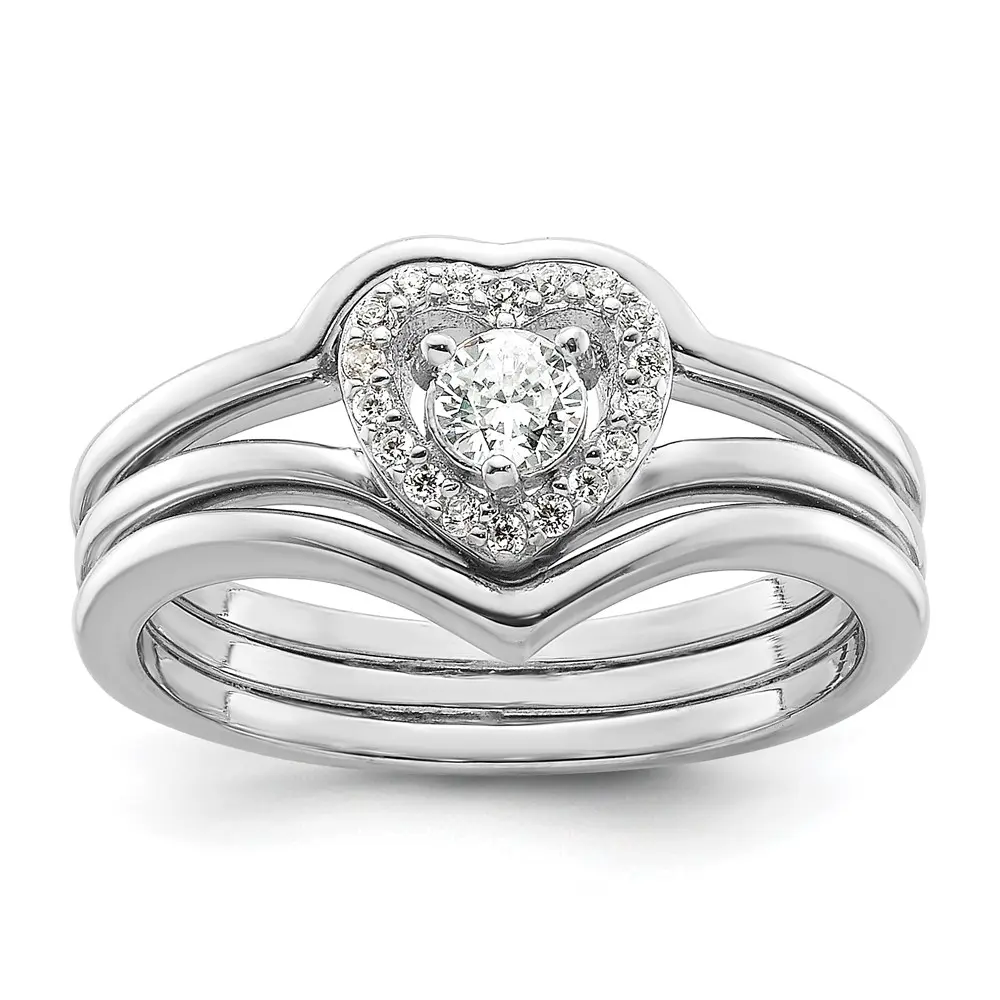
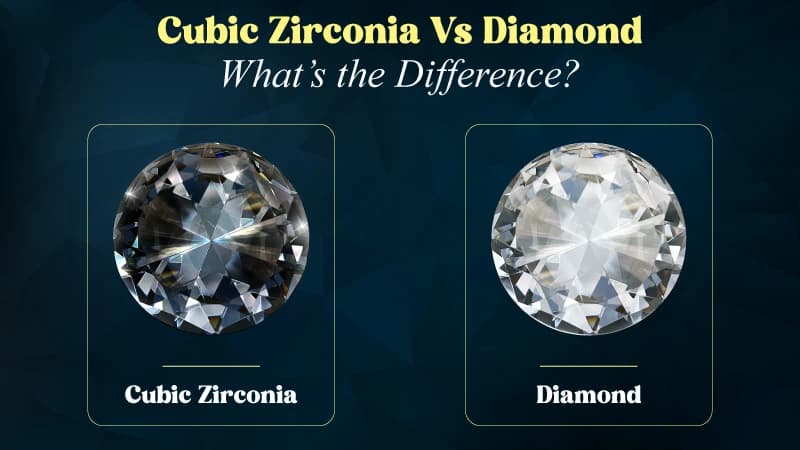
Yes — yes, with a resounding yes. No, if examined carefully by a knowledgeable person.
The truth is that's the best answer and it's more practical than the confident "yes" you'll see on most retail websites. The important thing is to know which differences are noticeable, by whom, and after how much time; a quality well-made CZ ring in a good setting will pass any kind of test without any difficulty, while a poor quality ring will show immediately.
Five tells separate cubic zirconia from diamond. Only one of them is visible to the naked eye across a room — the rest need a jeweller, a loupe, or a couple of years of wear.
This is the most reliable tell, and it's visible without any equipment.
Every transparent gemstone splits white light into colours. The measure of how strongly is called dispersion:
| Stone | Dispersion |
|---|---|
| Diamond | 0.044 |
| Cubic zirconia | 0.058 – 0.066 |
| Moissanite | 0.104 |
Diamond disperses light about 40% less than cubic zirconia. In actual practice, this translates to a different kind of light output: a diamond will have more luminous white light and coloured light will be an accent to that, while CZ will have more coloured light (rainbow flashes) and brilliant white light will be an accent.
This is sometimes referred to as CZ's "too sparkly." This is exactly what is taking place. It's not sparks that aren't as bright as diamonds anymore, it's sparks that are sparks in a different way and a lot of rainbow looks like it was made up once you notice it.
Cubic zirconia has a specific gravity of about 5.6–6.0. Diamond's is 3.52.
A CZ stone is therefore around 1.6 times heavier than a diamond of the same size. Anyone who handles jewellery regularly can feel this immediately when picking up the rings. It's the word a jeweler uses first.
Cubic zirconia has a Mohs hardness of 8 to 8.5. Diamond is 10.
This seems like a small gap, but it's not linear: diamond is several times harder, in real terms. The effect is not an immediate one of breaking but a slow one. As the day goes on, months and years later, the sharp edges of facets where they join erode and round progressively. These clean facet lines contribute much to the brilliance of a stone, and over time the ring fades in their snap.
CZ also captures the tiny surface scratches which allow the stone to reflect light, giving it a slight cloudiness. Abrasion will not be reversed by cleaning.
A typical daily use CZ will look great at 6 months and will be visibly duller at 2 years.
Natural diamonds have inclusions — tiny internal features formed over a billion years underground. Most are invisible without magnification, but they're there.
Cubic zirconia is grown in a lab and comes out flawless. Under a loupe, an utterly clean stone in an inexpensive setting is itself evidence. A gemologist looks for the absence of imperfection.
Standard diamond testers measure thermal conductivity, and diamond conducts heat far better than cubic zirconia. A basic tester distinguishes them instantly.
Worth noting: moissanite fools older thermal-only testers, which is why modern testers check electrical conductivity too. CZ fails both.
This is the part most people get wrong. They focus on the stone, when the setting is what actually determines whether a ring reads as genuine.
A 14k gold or sterling silver CZ is convincing. If the base metal is a plated one, the same stone appears fake — and it's the metal that is telling. Plating quickly flakes off the edges and shank leaving a new colour underneath, and there's no better way to be aware of costume jewellery.
When it comes to one thing, it's the metal you should buy.
Cheap CZ is scissored quite fast to make a close approximation to a brilliant. Proper proportions, accurate facet angles and clean meeting points are used in Better CZ. The differences in the ability of the stone to reflect light are marked and noticeable when seen side by side.
That's the primary difference between an $8 stone and a $40 stone.
There's more space for dispersion to shine in a large CZ than a modest one, and, of course, a very large "diamond" is subjected to more scrutiny than a modest one is.
A CZ that has passed in a good setting will be ignored. A four carat equivalent one does the attracting it can't live with.
This is greatly aided by bezel and halo settings. The metal is around the edges of the stone, shielding only the exposed facet junctions and concealing the girdle. The eye's focus is pulled away from the centre stone by small stones in a "halo".
These settings are the most grueling: One exposed stone and no other to distract from it.
A Note on "AAAAA" Grading
The CZ will be offered in quality of AAA, AAAA or AAAAA. There is no standardised grading system for cubic zirconia. These letters are not standardized by the GIA but have no consistent meaning between different retailers, unlike the GIA's framework.
Based on pictures, a brief description, and the type of metal, not the number of letters.
If your goal is a diamond look that lasts, this comparison matters more than anything above.
| Property | Cubic zirconia | Moissanite | Diamond |
|---|---|---|---|
| Mohs hardness | 8 – 8.5 | 9.25 | 10 |
| Refractive index | 2.15 – 2.18 | 2.65 – 2.69 | 2.42 |
| Dispersion | 0.058 – 0.066 | 0.104 | 0.044 |
| Holds appearance long-term | No | Yes | Yes |
| Relative cost | Lowest | Moderate | Highest |
Moissanite is harder than CZ by a meaningful margin and will not abrade or cloud with daily wear. Its refractive index is actually higher than diamond's, so it returns more light overall.
Its own tell is the opposite of CZ's: moissanite has more than twice diamond's dispersion, so it can look almost too brilliant, with pronounced rainbow flashes in bright light. Smaller moissanites are nearly indistinguishable from diamond; large ones read as unusually fiery.
Moissanite is also doubly refractive — under magnification you can see facet edges appear doubled. Diamond and CZ are singly refractive.
Our moissanite range is the better choice for a ring intended for years of daily wear. Our cubic zirconia rings make more sense for the situations below.
Shop CZ RingsCZ has real advantages, and they're worth stating plainly rather than treating it as a compromise:
A convincing ring you won't be devastated to lose is genuinely useful.
A style you'll wear for two seasons doesn't need to last twenty years.
Wearing a CZ in a particular cut and size for a few months tells you far more than any amount of browsing.
A ring that may later be replaced by an engagement ring doesn't need permanence.
A five-carat-equivalent cocktail ring in diamond is out of reach for almost everyone. In CZ it's affordable — and at that size nobody assumes it's a diamond anyway, which removes the whole question.
CZ's weakness is cumulative abrasion. A ring worn a dozen times a year will look good for a very long time.
Warm water, washing up liquid and a soft toothbrush. Rinse and dry with lint free cloth.
A Film of skin oil, hand cream and soap build-up is the worst thing that dulls CZ. Weekly cleaning makes a difference. Bi-weekly cleaning makes a difference.
Remove before applying hand cream, cleaning products, swimming pools and gym. Keep it away from other jewellery pieces as harder stones may scratch it if kept in the same box.
A jeweller can at once by weight and dispersion. The vast majority of people cannot keep a proper distance at a conversation. If viewed in bright light by someone with a sharp eye, the extra rainbow flash might be detectable.
Yes, over time. Lots of fine scratches on the surface of the stone caused by everyday usage, scatter light and make the stone dull. The cleaning process only affects oil film, it does not stop abrasion.
The stone is low cost – usually $10 to $40. A CZ ring in sterling silver or solid gold is a band that is sold for sterling silver or solid gold, the majority of the price tag is the metal.
It's a real gemstone — zirconium dioxide — that resembles diamond. It is not an imitation, it is a genuine material.
In smaller sizes, particularly, moissanite. It's more difficult, retains it's shine for a very long time, and looks more like a diamond.
Use as long as needed for occasional use. If you're wearing it every day, you can expect for it to look dull in about 2 years.


Affiliations


Copyright BOLD Precious Metals 2026