

Share
| Quantity | Cash/Check | Credit Card | Paypal/Pay |
|---|---|---|---|
| Any Quantity | $355.35 | $370.27 | $374.89 |
Share
Scottsdale Mint strikes the 2021 5 oz Fiji Terracotta Warriors Silver Coin in .999 fine silver under a sovereign agreement with Fiji, carrying a face value of $2 FJD as legal tender.
Mintage is limited to 5,000 coins worldwide. The antique-polish finish and hammered edge replicate the aged patina of the original 2,200-year-old clay sculptures, with two Terracotta Warriors in side-profile relief on the reverse. At 46 mm in diameter and 10 mm in thickness, it is a substantial collectible, packaged in a drawstring pouch with a Certificate of Authenticity from Scottsdale Mint, and IRA-eligible.
Obverse
The obverse features the Fijian crest, face value ($2), FIJI, year (2021), and 5 OZ .999 FINE SILVER.
Reverse
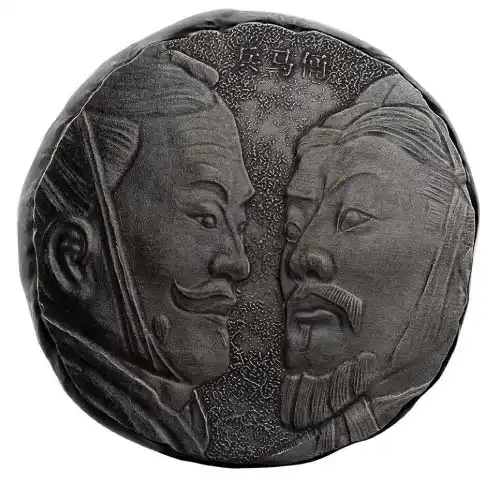
The reverse depicts two Terracotta Warriors in side-profile relief, the antique-polish treatment darkening recessed areas to simulate aged patina. The hammered rim reinforces the handcrafted aesthetic: Scottsdale Mint strikes this coin on rimless blanks with a deliberately ruptured edge, a technique that sets it apart from every other 5 oz silver round in BOLD's catalog.
On March 29, 1974, farmer Yang Zhifa and his brothers were digging a well approximately 1.5 kilometers east of a large burial mound near Mount Li in Lintong County, Xi'an, China.
Their shovels struck fragments of fired clay, the beginning of one of the most significant archaeological discoveries of the 20th century: the Terracotta Army of Qin Shi Huang, the first emperor of China. Qin Shi Huang unified seven warring states in 221 BC and ordered construction of his mausoleum almost immediately. An estimated 720,000 workers labored on the complex over decades. He was buried in 210–209 BC surrounded by a life-size army meant to protect him in the afterlife. Current estimates put the total at more than 8,000 soldiers, 130 chariots with 520 horses, and 150 cavalry horses, the majority still unexcavated. The inner burial chamber has never been opened, partly due to ancient accounts of mercury rivers and defensive mechanisms, and partly out of scientific caution until preservation methods improve. What makes the Terracotta Army extraordinary beyond its sheer scale is this: no two warriors share the same face. Each was individually modeled with unique facial features, hairstyle, armor, and stance, individualized on a production scale that remains remarkable even by modern manufacturing standards. The site was inscribed as a UNESCO World Heritage Site in 1987.
Scottsdale Mint strikes the 2021 5 oz Fiji Terracotta Warriors Silver Coin in .999 fine silver under a sovereign agreement with Fiji, carrying a face value of $2 FJD as legal tender.
Mintage is limited to 5,000 coins worldwide. The antique-polish finish and hammered edge replicate the aged patina of the original 2,200-year-old clay sculptures, with two Terracotta Warriors in side-profile relief on the reverse. At 46 mm in diameter and 10 mm in thickness, it is a substantial collectible, packaged in a drawstring pouch with a Certificate of Authenticity from Scottsdale Mint, and IRA-eligible.
Obverse
The obverse features the Fijian crest, face value ($2), FIJI, year (2021), and 5 OZ .999 FINE SILVER.
Reverse
The reverse depicts two Terracotta Warriors in side-profile relief, the antique-polish treatment darkening recessed areas to simulate aged patina. The hammered rim reinforces the handcrafted aesthetic: Scottsdale Mint strikes this coin on rimless blanks with a deliberately ruptured edge, a technique that sets it apart from every other 5 oz silver round in BOLD's catalog.
On March 29, 1974, farmer Yang Zhifa and his brothers were digging a well approximately 1.5 kilometers east of a large burial mound near Mount Li in Lintong County, Xi'an, China.
Their shovels struck fragments of fired clay, the beginning of one of the most significant archaeological discoveries of the 20th century: the Terracotta Army of Qin Shi Huang, the first emperor of China. Qin Shi Huang unified seven warring states in 221 BC and ordered construction of his mausoleum almost immediately. An estimated 720,000 workers labored on the complex over decades. He was buried in 210–209 BC surrounded by a life-size army meant to protect him in the afterlife. Current estimates put the total at more than 8,000 soldiers, 130 chariots with 520 horses, and 150 cavalry horses, the majority still unexcavated. The inner burial chamber has never been opened, partly due to ancient accounts of mercury rivers and defensive mechanisms, and partly out of scientific caution until preservation methods improve. What makes the Terracotta Army extraordinary beyond its sheer scale is this: no two warriors share the same face. Each was individually modeled with unique facial features, hairstyle, armor, and stance, individualized on a production scale that remains remarkable even by modern manufacturing standards. The site was inscribed as a UNESCO World Heritage Site in 1987.


Affiliations


Copyright BOLD Precious Metals 2026