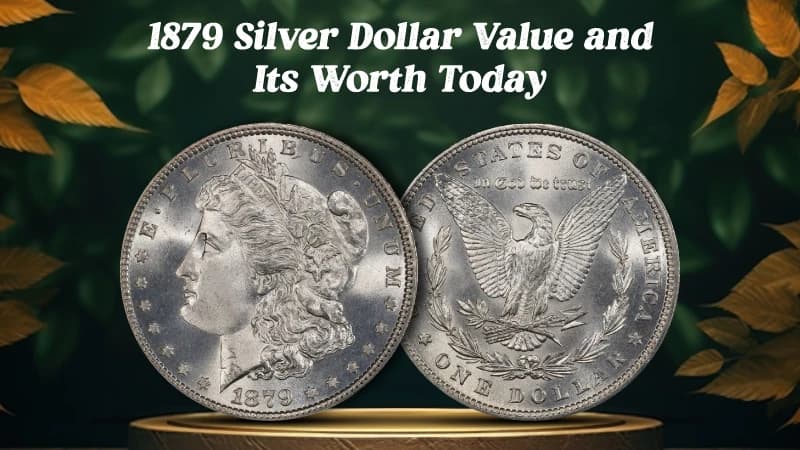
Morgan Silver Dollars are the buzzer-beaters of the bullion investment game. You can never go wrong with a Morgan Silver Dollar in your collection. Minted from 1878 to 1921, the 1879 silver dollar value is significant, standing as a cornerstone of numismatic history. While many investors focus on the high purity and liquidity of modern silver coins, these vintage assets offer unique historical premiums.
This coin is not just about its silver content; it holds a piece of history. Its value today depends on factors like condition, rarity, and demand among collectors.
Let’s explore what makes this coin special and how much it is worth in the current market.

The absence of a mint mark signifies the coin was struck at the Philadelphia facility of the US Mint. As the primary sovereign mint for American legal tender, Philadelphia’s 1879 production run serves as a benchmark for silver bullion quality
| Coin Type | Condition | Value |
|---|---|---|
| 1879 Silver Dollar | Higher-graded | $37,500 |
| 1879 DMPL silver dollars | MS65 | $10,500 |
| Proof-like Silver Dollar | MS60 and below | $2,500 |

Of the 1,100 proof silver dollars made in 1879, only a small portion still survive. Depending on the qualities that make them more collectible, their prices range from less than $775 to $11,500.
| Coin Type | Condition | Value |
|---|---|---|
| CAM grade coins | Various conditions | $2,600 - $18,000 |
| Silver dollar (PR68) | Pristine condition | $52,500 |

1879 silver dollars with the CC mint mark were struck at the Carson City mint. Since there were only 756,000 coins minted, you may think that those in good condition will be expensive.
| Coin Type | Condition | Value |
|---|---|---|
| 1879 Silver Dollar | Circulated | $190 - $5,250 |
| 1879 Silver Dollar (Mint State) | MS60 - MS65 | $5,350 - $125,000 |
| 1879 Silver Dollar (PL Quality) | MS65 | $35,000 |
| 1879 CC DMPL Silver Dollar | MS65 | $90,000 |

In 1879, 2,887,000 Morgan dollars were made in the New Orleans Mint. Coins in circulation typically cost between $36 and $135; however, coins with a flawless appearance might vary in price based on different conditions.
| Coin Type | Condition | Value |
|---|---|---|
| 1879 Silver Dollar | Most Grades | $180 – $750 |
| 1879 Silver Dollar | MS65 | $2,750 |
| 1879 Silver Dollar | MS66 | Up to $12,000 |
| Proof-like Morgan Dollar | All grades | $275 – $11,500 |
| 1879 O DMPL Silver Dollar | All Grades | $475 – $40,000 |

The second-highest mintage of 1879 S silver dollars, or exactly 9,110,000 pieces, was produced at the San Francisco mint. Interestingly, even though they were struck in the same year, two varieties had different dates on the obverse. Naturally, this detail has a big impact on their costs.
| Coin Type | Condition | Value |
|---|---|---|
| 879 Morgan Silver Dollar (Reverse) | MS 68 | Up to $6,500 |
| 1879 S Reverse | Varies | $32 to $1,000 |
| 1879 S PL Reverse | Proof-Like | $115 to $2,700 |
| 1879 Morgan Silver Dollar | MS 68 (Record Value) | $10,000 |
| 1879 S | Deep Mirror Proof-Like (DMPL) | $180 to $13,000 |
Everyone wants to have the most eye-catching collection, but it's difficult to achieve with Morgan Silver Dollars. This is because these coins are so old that they have had plenty of time to deteriorate and wear down. Unlike modern silver coins, which often maintain a pristine strike, these historical pieces show significant variation in condition based on their years in circulation.
Usually, a coin would be sent to a professional group for grading if someone wanted their coin's condition assessed.
Below are some standard coin grades:
When a coin is declared uncirculated, it indicates that it was either never in circulation or only briefly in circulation. These coins will still have all of their original texture and imagery, giving the impression that they were newly produced. These are frequently the priciest coins available to collectors.
A coin that was only in circulation for a short period of time is deemed to be of Extremely Fine grade. These coins will be in perfect condition for the most part, with only very minor surface wear. Although the price of these coins is likewise expensive, their attractive appearance helps to justify the greater cost.
A coin that has been in circulation for a long time and may have some degradation is considered to be of fine grade. Practically speaking, there isn't much damage to these coins, but you will notice some light scratches that are persistent and a decline in texture.
The lowest grade a coin can be given is good, which typically denotes a piece that has seen significant circulation throughout the course of its life.
Grading is essential for verifying the strike and luster of historic coinage. For instance, while a perfect MS70 grade is common for contemporary American Silver Eagle coins , achieving a high mint-state grade for an 1879 Morgan is far rarer.
The 1879 CC capped die error on the silver dollar is a wonderful gem. A rusty die cap caused these coins to appear with distorted and indistinct CC mint markings.
While those in immaculate condition can be expensive, those in circulated condition should cost between $160 to $3,850. The range of their prices is $4,250 to $50,000.
The average auction values for the 1879 CC PL capped die silver dollars range from $3,200 to $60,000, depending on their condition. Lastly, one lovely 1879 CC DMPL capped die Morgan dollar will cost you between $7,200 and $120,000.
The pricing range for the 1879 S reverse of 1878 Morgans is $60 to $8,500. Depending on their appearance and the day of the sale, the finest-graded coins, which are in MS 66 grade, can get between $42,000 and $50,400.
The price of the 1879 S PL reverse of 1878 silver dollars is higher than that of typical specimens, nevertheless.
They are rare and usually cost between $3,200 and $3,850 for pieces graded an MS 63 and $50,000 to $60,000 for those ranked an MS 66. Depending on condition, DMPL dollars bearing the reverse of 1878 can range in value from $1,800 to $24,000.
A few Morgan dollars went through the upsetting mill twice before striking it twice. Such a rare coin is costly and difficult to find. The auction record for 2013 is $8,225 for this error coin.
Uncentered broad striking error in 1879 S Morgan dollars is caused by an improperly positioned planchet. The finest artifacts can be very expensive since they are very uncommon. One specimen in MS 64+ grade, for example, sold for $3,800 at auction.
Due to a badly positioned planchet, several 1879 S Morgan dollars have an uncentered broad strike error. The best items might be expensive since they are quite scarce. For example, a specimen in MS 64+ grade sold for $3,800 at auction.
The table below shows you the value of every error coin along with condition and grading:
| Error | Value Range |
|---|---|
| CC Over CC—capped Die (1879 CC Morgan) |
|
| Reverse of 1878 (1879 S Morgan) |
|
| Silver Dollars Passed through Upsetting Mill (1879 Morgan) | $8,225 (auction record in 2013) |
| Uncentered Broad Strike (1879 S Morgan) | $3,800 (MS 64+ grade auction price) |
| Partial Collar Strike (1879 S Morgan) | $3,800 (MS 64+ grade auction price) |
The 1879 Silver Dollar value is determined by its mint mark, rarity, and condition. Depending on the coin's grade and whether it bears a mint mark, the price might vary from $36 to $125,000 or more.
Uncommon mistakes and variations, like capped dies or uncentered strikes, add value. Since well-preserved coins are the most valuable on the market, collectors usually look for them. In the end, the value of the 1879 Silver Dollar varies greatly, which makes it a valuable item for coin collectors.
Explore the variations of the Morgan Silver Dollars available at BOLD with the NGC or PCGS certification with the best prices. If you're also interested in diversifying your precious metals portfolio, consider our American Silver Eagle coins for a modern bullion alternative.
The condition and mint mark of an 1879 Morgan Silver Dollar influence its value.
Although even lower-quality pieces are expensive, one 1879 silver dollar of MS 67 grade can fetch a fortune of $28,500 to $38,500. Circulated examples can get up to $65 at auction, while finely crafted ones fetch between $70 and $1,600.
Particularly those in the finest grades, Morgans struck between the late 19th and early 20th centuries can be expensive. In addition, some uncommon and collectible errors might fetch several hundred thousand dollars.


Affiliations











Copyright BOLD Precious Metals 2026