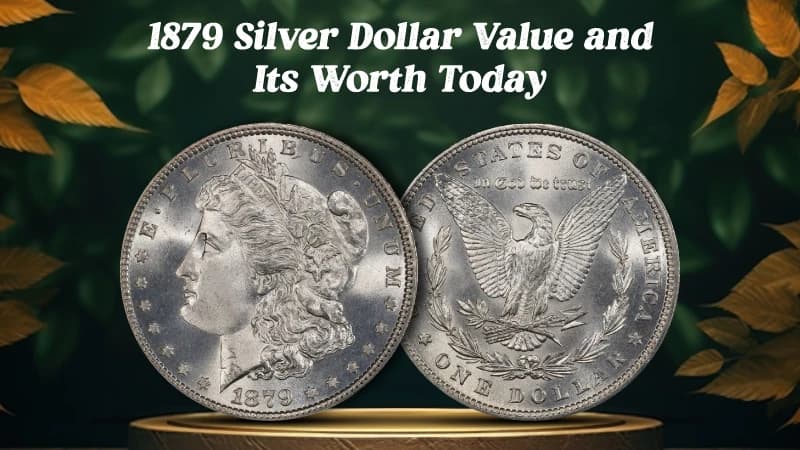
Morgan Silver Dollars are the buzzer-beaters of the bullion investment game. You can never go wrong with a Morgan Silver Dollar in your collection. Minted from 1878 to 1921, the 1879 silver dollar value is significant, standing as a cornerstone of numismatic history. While many investors focus on the high purity and liquidity of modern silver coins, these vintage assets offer unique historical premiums.
This coin is not just about its silver content; it holds a piece of history. In the current 2026 market, its value depends heavily on factors like condition, rarity, and the recent surge in silver spot prices.
Let’s explore what makes this coin special and how much it is worth in today's market.

The absence of a mint mark signifies the coin was struck at the Philadelphia facility of the US Mint. As the primary sovereign mint for American legal tender, Philadelphia’s 1879 production run serves as a benchmark for silver bullion quality.
| Coin Type | Condition | Value (2026 Est.) |
|---|---|---|
| 1879 Silver Dollar | MS67 Grade | $29,500 - $38,500 |
| 1879 DMPL silver dollars | MS65 | $12,000+ |
| Proof-like Silver Dollar | MS60 and below | $3,200 |

Of the 1,100 proof silver dollars made in 1879, only a small portion still survive. With current demand for high-relief vintage strikes, their prices range from approximately $900 to over $15,000 for top-tier specimens.
| Coin Type | Condition | Value |
|---|---|---|
| CAM grade coins | Various conditions | $3,100 - $22,000 |
| Silver dollar (PR68) | Pristine condition | $58,000+ |

1879 silver dollars with the CC mint mark were struck at the Carson City mint. Given the low mintage of 756,000, these remain some of the most liquid assets for collectors. In 2026, even circulated G-4 grades are commanding premiums near $200.
| Coin Type | Condition | Value |
|---|---|---|
| 1879 Silver Dollar | Circulated | $215 - $5,500 |
| 1879 Silver Dollar (Mint State) | MS60 - MS65 | $6,500 - $145,000 |
| 1879 Silver Dollar (PL Quality) | MS65 | $42,000 |
| 1879 CC DMPL Silver Dollar | MS65 | $105,000 |

The New Orleans Mint produced 2,887,000 Morgan dollars in 1879. While historically common, the recent 2026 floor for silver has pushed the value of circulated "O" mint marks to a range of $45 to $150 for average grades.
| Coin Type | Condition | Value |
|---|---|---|
| 1879 Silver Dollar | Most Grades | $210 – $850 |
| 1879 Silver Dollar | MS65 | $3,200 |
| 1879 Silver Dollar | MS66 | Up to $14,500 |
| Proof-like Morgan Dollar | All grades | $325 – $13,000 |
| 1879 O DMPL Silver Dollar | All Grades | $550 – $45,000 |

The San Francisco mint produced 9,110,000 pieces. This mintage is known for having some of the most beautiful strikes in the series. In 2026, collectors continue to pay high premiums for the "Reverse of 1878" variety.
| Coin Type | Condition | Value |
|---|---|---|
| 1879 Morgan Silver Dollar (Reverse) | MS 68 | Up to $7,800 |
| 1879 S Reverse | Varies | $45 to $1,200 |
| 1879 S PL Reverse | Proof-Like | $145 to $3,100 |
| 1879 Morgan Silver Dollar | MS 68 (Record Value) | $32,900 |
| 1879 S | Deep Mirror Proof-Like (DMPL) | $220 to $15,000 |
Everyone wants to have the most eye-catching collection, but it's difficult to achieve with Morgan Silver Dollars. This is because these coins are so old that they have had plenty of time to deteriorate and wear down. Unlike modern silver coins, which often maintain a pristine strike, these historical pieces show significant variation in condition based on their years in circulation.
Usually, a coin would be sent to a professional group for grading if someone wanted their coin's condition assessed.
Below are some standard coin grades:
When a coin is declared uncirculated, it indicates that it was either never in circulation or only briefly in circulation. In 2026, uncirculated Morgans are the primary target for those looking to hedge against inflation.
A coin that was only in circulation for a short period of time is deemed to be of Extremely Fine grade. These coins will be in perfect condition for the most part, with only very minor surface wear.
A coin that has been in circulation for a long time and may have some degradation is considered to be of fine grade. Practically speaking, there isn't much damage to these coins, but you will notice some light scratches.
The lowest grade a coin can be given is "Good," which typically denotes a piece that has seen significant circulation throughout the course of its life.
Grading is essential for verifying the strike and luster of historic coinage. For instance, while a perfect MS70 grade is common for contemporary American Silver Eagle coins, achieving a high mint-state grade for an 1879 Morgan is far rarer.
The 1879 CC capped die error on the silver dollar is a wonderful gem. A rusty die cap caused these coins to appear with distorted and indistinct CC mint markings.
While those in immaculate condition can be expensive, those in circulated condition in 2026 typically cost between $185 to $4,500.
The average auction values for the 1879 CC PL capped die silver dollars range from $3,500 to $65,000, depending on their condition. Lastly, one lovely 1879 CC DMPL capped die Morgan dollar will cost you between $8,000 and $135,000.
The pricing range for the 1879 S reverse of 1878 Morgans is $70 to $9,500. Depending on their appearance and the day of the sale, the finest-graded coins, which are in MS 66 grade, can get between $45,000 and $55,000.
The price of the 1879 S PL reverse of 1878 silver dollars is higher than that of typical specimens, nevertheless.
They are rare and usually cost between $3,500 and $4,200 for pieces graded an MS 63 and $55,000 to $68,000 for those ranked an MS 66.
A few Morgan dollars went through the upsetting mill twice before striking it twice. Such a rare coin is costly and difficult to find. Recent 2020s auction records have seen these fetch upwards of $9,000.
Uncentered broad striking error in 1879 S Morgan dollars is caused by an improperly positioned planchet. The finest artifacts can be very expensive since they are very uncommon.
Due to a badly positioned planchet, several 1879 S Morgan dollars have an uncentered broad strike error. The best items might be expensive since they are quite scarce. In today's market, a specimen in MS 64+ grade can easily exceed $4,000 at auction.
The table below shows you the value of every error coin along with condition and grading:
| Error | Value Range (2026) |
|---|---|
| CC Over CC—capped Die (1879 CC Morgan) |
|
| Reverse of 1878 (1879 S Morgan) |
|
| Silver Dollars Passed through Upsetting Mill (1879 Morgan) | $9,000+ (estimated record) |
| Uncentered Broad Strike (1879 S Morgan) | $4,200 (MS 64+ grade auction price) |
| Partial Collar Strike (1879 S Morgan) | $4,200 (MS 64+ grade auction price) |
The 1879 Silver Dollar value is determined by its mint mark, rarity, and condition. Depending on the coin's grade and whether it bears a mint mark, the price might vary from $45 to $145,000 or more in the 2026 market.
Uncommon mistakes and variations, like capped dies or uncentered strikes, add value. Since well-preserved coins are the most valuable on the market, collectors usually look for them. In the end, the value of the 1879 Silver Dollar varies greatly, which makes it a valuable item for coin collectors.
Explore the variations of the Morgan Silver Dollars available at BOLD with the NGC or PCGS certification with the best prices. If you're also interested in diversifying your precious metals portfolio, consider our American Silver Eagle coins for a modern bullion alternative.
The current 2026 silver spot price, condition, and mint mark of an 1879 Morgan Silver Dollar influence its market value.
In 2026, one 1879 silver dollar of MS 67 grade can fetch $29,500 to $38,500. Circulated examples typically start around $69-$85, while mid-range mint state pieces fetch between $135 and $1,800.
Low mintage numbers (like the Carson City 756,000 strike) and high-grade survival rates make specific 1879 Morgans rare. Additionally, the "Reverse of 1878" variety for the San Francisco mint is a highly sought-after rarity in the current market.


Affiliations











Copyright BOLD Precious Metals 2026