Are you interested in collecting rare and old coins and love to explore their historical significance? If so, reading about the 1890 Indian Head Penny will excite you. This coin is not only an important piece of American history but also serves as a reminder of the skill of coinage at a critical stage in our country's history—much like how collectors today appreciate modern silver coins for their craftsmanship and investment value.
Even though many 1890 Indian Head Penny coins are still in circulation, it can be challenging to find them in exceptional condition. Because of this, collectors are prepared to spend a lot of money on a rare find.
Such 1890 Indian head pennies are a scarce find if you are lucky or have fortunately witnessed one. You may wish to find out about the coin's history and worth. This is where this article comes in. We will take you on an adventure through a time of this American numismatic legacy.
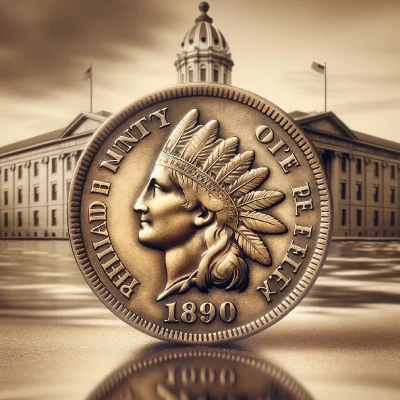
The Indian Head Penny was one of the first coins to include the laurel wreath on the reverse. Striking and circulating it first in 1859. In all other 1860s and subsequent images, an oak wreath can be seen in place. This arrangement was valid till 1909 when the U.S. Mint's switched out these coins for a totally new Lincoln penny.
It's interesting to note that the Philadelphia Mint was the only authorized facility to produce these one-cent coins and five-cent nickels. As a result, during the 50 years of coinage, practically all of the coins were unmarked.
The one-cent coin was gaining popularity by the time the 1890 Indian Head Penny was struck. At the beginning of the 1880s, the nation was going through an economic crisis, which decreased demand for currency. By the end of the 1880s, the economy was beginning to recover, and mintage increased significantly.
Furthermore, during this same period, the US Post Office reduced the cost of a stamp to two cents. Because of this, the three-cent nickel was essentially useless by 1890 and discontinued. This led to the 1890 Indian Head Penny being used by more people, and its mintage kept rising.
The 1890 Indian Head Penny value depends upon its condition, type, and rarity caused by the errors. As of 2026, market demand for high-grade specimens remains strong, with collectors focusing on "Red" (RD) designations.
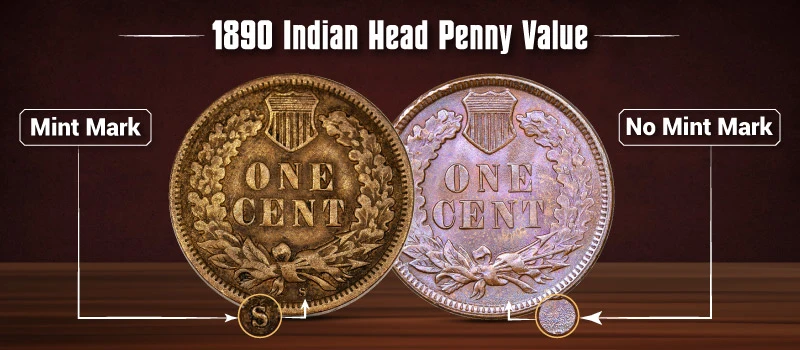
Only the Philadelphia Mint produced 57,180,114 Indian Head pennies in total in 1890. While common in lower grades, recent 2025 auctions have shown that MS66 Red specimens are becoming increasingly difficult to source.
| Description | Price Range |
|---|---|
| Average condition (brown-toned, low-grade) | $3 to $50 |
| Mint State (MS 63-65) | $45 to $850 |
| MS 66 grade (Red) | $4,200 to $8,400 (Recent 2025 Sales) |
| Red-brown pennies (MS 64-66) | $260 to $1,800 |
| MS 67+ grade (red) | Record Sale: $91,063 |
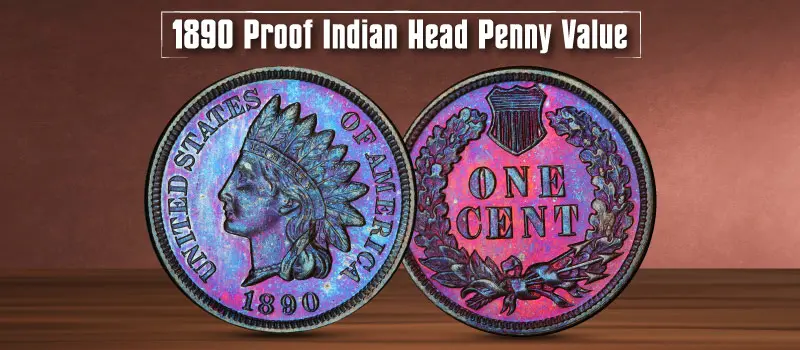
In addition to circulated pennies, the Philadelphia Mint produced 2,740 proofs in 1890 for collectors. Unlike the heavy wear seen on century-old copper, the pristine strike of a modern American Silver Eagle provides a sharp contrast in how different metals age and are graded by the PCGS or NGC.
| Penny Type | Grade Range | Price Range |
|---|---|---|
| Brown Proof (PR) | PR 60 - PR 67 | $185 to $2,000 |
| Red-Brown Proof (PR) | PR 60 - PR 67 | $200 to $2,640 |
| Red Proof (PR) | PR 60 - PR 66 | $250 to $5,040 |
| Proof Cameo (CAM) | PR 64 - PR 65 | $1,500 to $5,000+ |
This particular collection of Indian pennies minted in 1890 is uncommonly low in number with imperfect strikes. Notable varieties like the "Snow-6" Misplaced Date (MPD) continue to see active bidding in 2026 auctions.
| Error Type | Description | Value Range |
|---|---|---|
| Double Strike | Takes place when the die strikes the same coin twice, resulting in an off-center design. | $500 to $2,000 |
| Tripled Die Obverse | Arises from a coin hub and die that are not properly aligned. | $460 to $560 |
| Misplaced Date (MPD) | One or more date digits are positioned incorrectly. Snow-6 varieties are highly sought after. | $18 to $700+ |
| Misaligned Die Clash | Results from hammer and anvil dies being out of alignment, leaving surface imperfections. | $900+ |
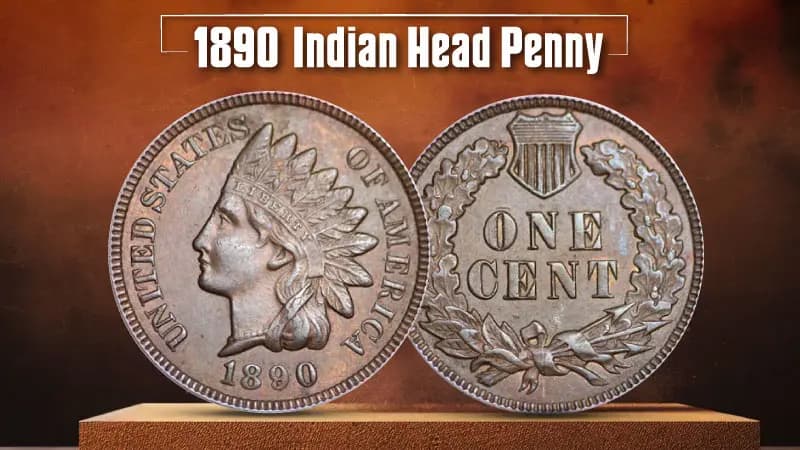
This 1890 Indian Head Penny obverse design is designed by the Longacre.
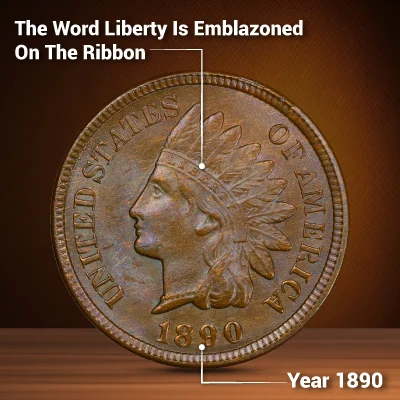
It turned out that the coin's obverse featured a Caucasian woman, despite Longacre's original plan to design it with an Indian girl. Her headdress, an Indian chief's, is somewhat out of place on her, and it looks odd worn with a pearl necklace.
The year 1890 is displayed below her effigy, with the “United States” on her left and “of America” on her right. The word LIBERTY is emblazoned on the ribbon that was inserted into her hair.
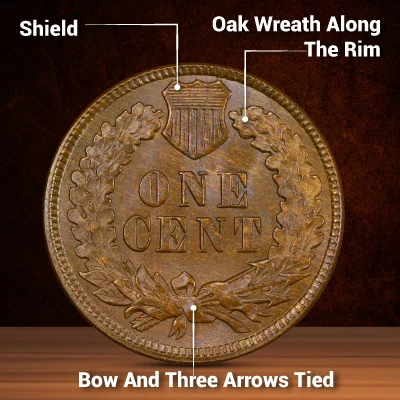
The reverse of the 1980 Head penny is tastefully simple with few decorations. It displays a shield-topped denomination in the middle.
All subsequent pennies, such as this one from 1890, had an oak wreath around the rim, in contrast to the original specimens from 1859, which had a laurel wreath. Three arrows tied at the bottom and a bow were used to secure them.
The 1890 Indian Head pennies were 1.47 mm (0,058 inches) thick and composed of a 95% copper alloy. Their diameter was 0.75 inches/19.05 mm, and their weight was 0.10970 ounces/3.11 g. While the 1890 Indian Head Penny is a copper classic, many collectors diversify their holdings with modern silver coins. These offer a blend of historical design and tangible precious metal value.
More than just a coin, the 1890 Indian Head Penny is a piece of American history that illustrates numismatic artistry and economic recovery. The 1890 penny provides an exciting window into a bygone era, whether you're an experienced collector or simply interested in learning more about it—just as collectors today value American Silver Eagle coins for their iconic design and numismatic significance. Every feature, from its elaborate design to its value and rarity, contributes to its appeal.
So, the 1890 Indian Head Penny is a treasure worth discovering, whether you're fortunate enough to find one in your collection or just want to admire its history.


Affiliations











Copyright BOLD Precious Metals 2026