If you reside in the United States, you are aware that some coins are worth more because of their historical significance. For instance, consider the 1901 Indian Head Penny. Its 125-year history as we approach 2026 makes this rare and incredible coin a treasure of American numismatic history, featuring a distinct design modification on the reverse side and a specific metal composition.
Collecting the Indian Head Penny is a must for every avid collector. Since these coins are among the last few in the Indian Head series, their value has increased. The fact that they are over a century old makes it all the more challenging to locate one in pristine shape, unlike modern silver coins which are readily available in mint condition.
Would you like to learn more about the 1901 Indian Head Penny value and history? This blog post will provide you with more amazing information.
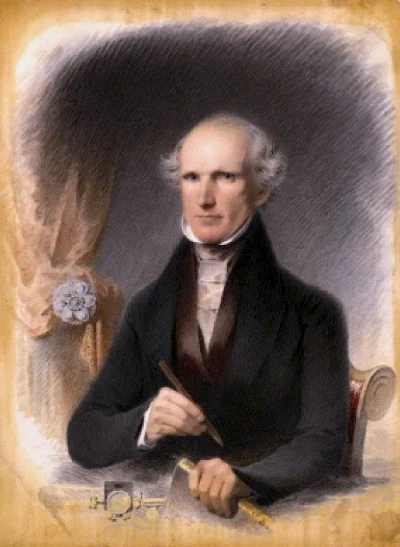
From 1859 to 1909, the United States Bureau of the Mint produced the Indian Head cent, also known as an Indian Head penny. It was designed by James Barton Longacre, the Chief Engraver at the Philadelphia Mint.
The Indian Head cent, minted in 1901, was one of the first coins struck at the newly built United States Mint facility in Philadelphia, constructed at 1700 Spring Garden Street. The new factory, with its advanced equipment, resulted in increased production.
The end of the Panic of 1893 had forced the Mint to reduce mintages several years earlier. However, by 1901, the country's economy was thriving, and the demand for cent coins was increasing at an unprecedented rate.
The extensive use of coin-operated machines, such as early vending machines, was the main reason for the increasing need for coins. In 1901, a penny had the equivalent buying power of approximately $0.35 in modern currency.
While this heightened preference for the one-cent coin occurred, only the U.S. Mint in Philadelphia could engrave these coins at the time. It took until 1906 for other facilities to assist, making the 1901 Indian Head cent one of the most circulated cents the US had ever produced.
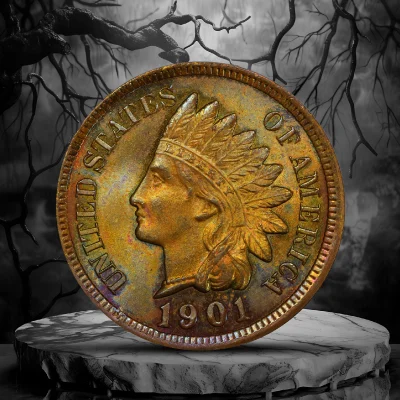
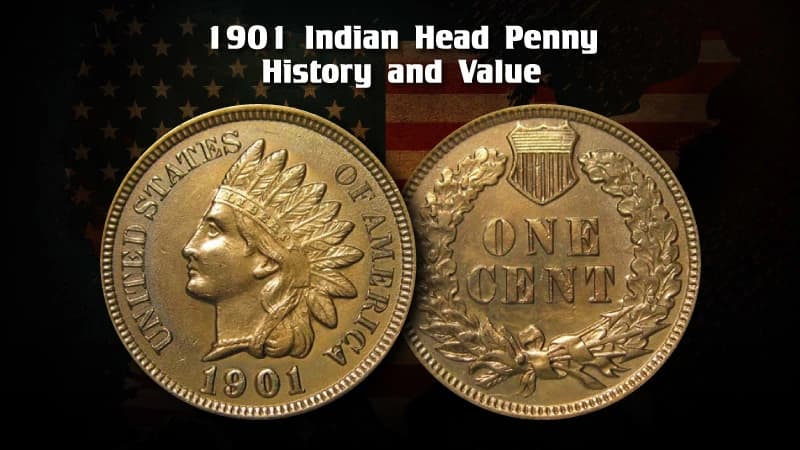
The Indian Head cent's obverse features a bust of Miss Liberty facing left and wearing a feathered headdress that symbolizes Native American culture. The headpiece is decorated with elaborate ribbons, one of which is a sizable ribbon with the word LIBERTY engraved at the base of the headdress beneath the feathers covering Liberty's forehead.
A smaller ribbon laced with a diamond pattern hangs down Miss Liberty's neck. In 1864, the initial "L" for Longacre was placed on a different ribbon segment deeper in Liberty's lower hair detail, acquiring greater numismatic significance.
At the bottommost center of the obverse, right below Liberty's neck, is the date 1901. The legend UNITED STATES OF AMERICA is inscribed in the field along the obverse rim.
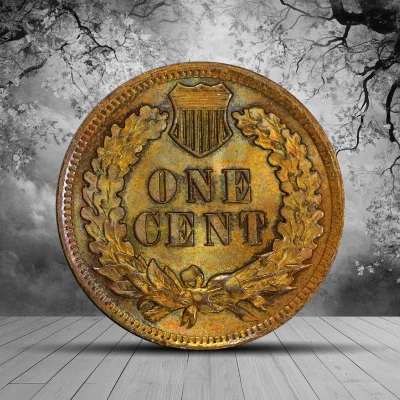
The 1901 Indian Head cent's reverse has a Union shield at the top center of the field, surrounded by an oak wreath. The word "ONE CENT," written in two lines in the middle of the reverse, is surrounded by a wreath. There is no mintmark on this coin because it was struck in Philadelphia.
The value of 1901 Indian head pennies is increasing rapidly for coins in better condition, and precise "grading" is essential in distinguishing a coin worth a few dollars from one worth hundreds.
In the current 2026 market, the value of the 1901 Indian Head Penny is heavily influenced by the coin's mint state condition and color (Red, Red-Brown, or Brown).
| Conditions | Images | Description | Value |
|---|---|---|---|
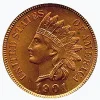
| Uncirculated |
|
This penny is as good as new. The coin's toning might seem dark red or brown, but the design remains sharp and untampered. | $25+ |
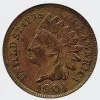
| Extremely Fine |
|
Clear boundaries with only a tiny bit of wear on the hair above the ear. A beautiful coin with strong eye appeal. | $12 |
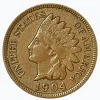
| Fine |
|
Main design elements are evident and separated, though some finer details are smoothed. | $5.50 |
| Good |
|
A heavily worn coin that is still clearly identifiable as a 1901 Indian penny. | $2.50 |
The 1901 Indian Head Penny’s timeless design by James Longacre depicts the Native American imagery of Lady Liberty rather than a specific historical figure. The coin comprises 95% Copper and 5% Zinc and Tin. The Indian Head Penny has a diameter of 19 mm and weighs 3.11 grams. With a mintage of approximately 79.6 million coins, it remains one of the most accessible vintage copper treasures.
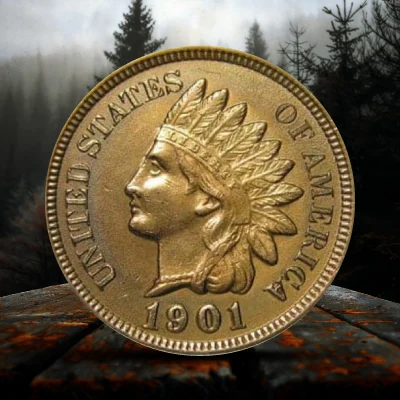
The Indian Head Penny was primarily minted in the US Mint facility in Philadelphia. Coins struck here lack mint marks. In today's market, MS66-graded BN coins can often fetch over $650 depending on the specific eye appeal.
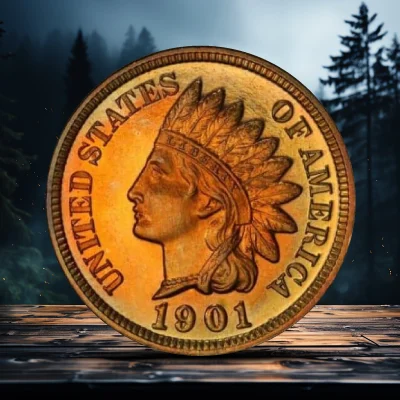
The Philadelphia Mint produced only 1,985 proof coins for 1901, featuring mirror-like fields. These are highly sought after; a PR 67 CAM can reach valuations well above $50,000 in major auctions.
Errors in striking are highly valued by modern collectors. Here are some notable 1901 errors that command a premium:
A broadstruck coin occurs when the coin is struck without the retaining collar, resulting in a flatter, wider appearance. Even lower-graded examples can be valued at $50 or more.
This happens when a coin is struck on a planchet that was improperly cut from the metal strip. These distinctive "bites" out of the coin's edge add significant collector interest and value.
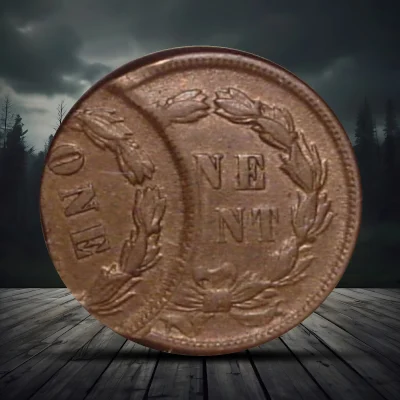
This occurs when a coin fails to eject and is struck again while partially out of the die. An AU 53 BN example with both off-center and double-strike characteristics has been valued at over $745.
If the date punch was struck into the die more than once, a Repunched Date (RPD) occurs. These are visible under magnification and are highly prized by variety collectors in the 2026 market.
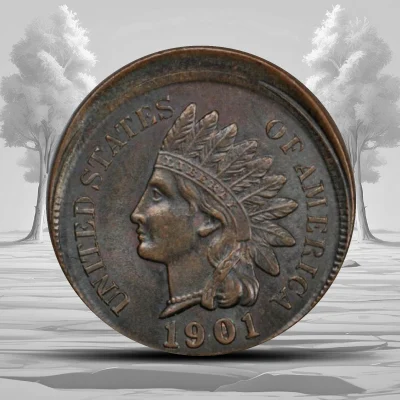
When a planchet is misaligned during the first strike, only part of the design is impressed. Depending on the percentage of the design showing and the condition, these can range from $180 to over $500.
Delving into the Indian Head Penny of 1901 is a peek into much more than a coin; it is a doorway to the world of numismatics and the exciting story of America's past. This coin reflects the hard labor and innovation of the Philadelphia Mint during a period of great economic transition.
The Indian Head Penny of 1901 appeals to beginners and experts alike, much like those who invest in modern silver bullion. It isn't just about monetary value; it's about the histories and tales these copper treasures carry across generations.


Affiliations











Copyright BOLD Precious Metals 2026