1919 Lincoln (Wheat) Penny Value

Popular Categories

Curious about your 1919 penny value? Do you have one? Or perhaps you'd like to add one to your collection of coins!
Of all the coins in circulation today, the Lincoln series wheat pennies are among the most in demand due to their sentimental and monetary value.
While most of the coins you see today are only worth their face value, 1919 wheat pennies can fetch a few hundred or even thousands of dollars in pristine condition. Pennies with special minting mistakes also tend to bring in significant premiums.
All you need to know about 1919 penny value will be covered in our guide. At the end, you can decide whether this classic cent will be a valuable addition to your collection.
Value of the 1919 Lincoln Penny
Among all Wheat penny collectors, mint-condition 1919 Lincoln Wheat pennies are highly sought after. To determine the 1919 penny value, one must consider several determining factors. A number of variables come into play that define the retail price, including color (Red, Red-Brown, or Brown), mintage figures, and the presence of any manufacturing faults.
Three basic factors define the 1919 penny value: the condition of the coin, the mint mark, and the total mintage—similar considerations collectors make when evaluating modern silver coins for investment purposes.
As of 2026, a 1919 cent in average circulated condition is typically assessed at a value between $0.15 and $12.00. In higher grades, uncirculated or mint state examples often start in the $15.00 to $25.00 range.
The far more valuable "Red" variety 1919 Wheat Penny can sell for thousands in high Mint State grades. While brown varieties are common, high-end specimens with original copper luster have seen recent auction records reaching as high as $18,000 to $43,000 for rare mint marks in MS-66RD condition. For collectors looking to complete a set, the Wheat Penny series remains a highly accessible and rewarding choice.
1. 1919-S Penny

• Mintage: 139,760,000
• Value Range: Depending on circulation, it may be worth a few cents to roughly $60. Uncirculated copies can sell for $150 to $800, with exceptional pieces in MS-66RD recently commanding over $43,000 at elite auctions.
2. 1919-D Penny

• Mintage: 57,154,000
• Value Range: Circulated 1919-D pennies are common and worth a few cents to $55. High-quality uncirculated coins can fetch between $120 and $650, contingent upon their eye appeal and specific grade.
3. 1919 Wheat Penny (No Mint Mark - Philadelphia)

-
Mintage: Over 392 million
-
Value Range: The Philadelphia issue is the most common. Circulated examples range from $0.10 to $5. Coins in MS-67 or better grades can fetch significant premiums, with most uncirculated examples costing between $15 and $150.
The mint mark and degree of preservation are the primary factors affecting coin value. Navigating a sale or purchase requires a careful look at each of these elements.
How to Identify a 1919 Lincoln Penny
Knowing the specific features of the 1919 wheat penny can make it easier to find a specimen worth money.
-
The 1919 Wheat Penny's Obverse

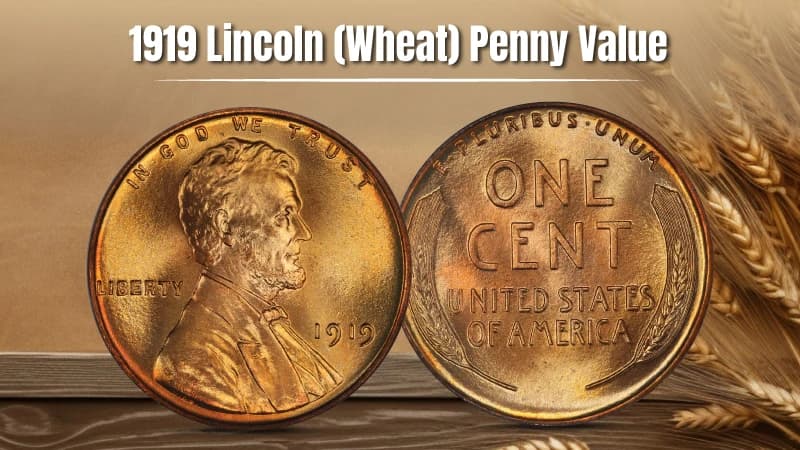
The obverse features Abraham Lincoln facing right. Along the top rim is the motto "IN GOD WE TRUST," with the year 1919 to the right and "LIBERTY" to the left.
On high-grade 1919 coins, you can see the designer's initials "VDB" at the base of Lincoln's shoulder, a feature restored to the series in late 1918.
-
The 1919 Wheat Penny in Reverse

The reverse displays two wheat ears encircling the words "ONE CENT" and "UNITED STATES OF AMERICA." The motto "E PLURIBUS UNUM" is inscribed along the top rim.
Other Features of the 1919 Wheat Penny
The 1919 Lincoln wheat cent is composed of 95% copper and 5% tin and zinc. It has a diameter of 19.00 mm and weighs 3.11 grams.
-
Date Validation:
Authentic wheat pennies were produced from 1909 to 1958. Ensure the date is clear and lacks signs of alteration.
-
Errors:
Coins with major errors, such as a double die or broadstrikes, can be worth significantly more than standard issues.
Caring for Your 1919 Lincoln Penny
1. Storage and Handling Tips
- Handle with Care: Always hold the penny by the edges to avoid transferring skin oils that cause corrosion.
- Store in a Dry Place: Humidity is the enemy of copper coins; keep your collection in a cool, low-humidity environment.
- Use Protective Holders: Acid-free plastic flips or capsules protect the surface from scratches and environmental damage.
2. Cleaning and Preservation
- Never Clean Harshly: Scrubbing or polishing a coin usually removes its natural patina and destroys its numismatic value.
- Avoid Chemicals: Commercial cleaners can cause permanent chemical damage to the copper alloy.
Collecting 1919 Lincoln Pennies
Grading the 1919 Lincoln Penny
- Uncirculated (MS): No trace of wear; original mint luster is present across all surfaces.
- Extremely Fine (XF): Very light wear on high points (Lincoln's cheek and the wheat tips), but most details are sharp.
- Fine (F): Moderate wear; major details are visible but some smoothing is apparent on the edges.
- Good (G): Heavily worn, though the date and major inscriptions remain legible.
Rare 1919 Wheat Penny Errors List
-
1919 "L on Rim" Doubled-Die Obverse
This rare error features the "L" in LIBERTY appearing to merge with the rim. When combined with a doubled-die obverse, these specimens can be valued at up to $265–$1,000 depending on condition.
-
1919 Misaligned Die Error
A misaligned die results in a shifted design on one side. Obvious examples from 1919 can sell for $200 or more in higher grades.
-
1919 Lamination Crack Error
Caused by impurities in the metal planchet flaking off, these "woody" or lamination errors can fetch around $110, depending on severity.
-
1919 Uncentered Broadstrike Error

Occurs when the coin is struck outside its protective collar, resulting in a wider, thinner appearance. Collectors often pay up to $235 for a well-preserved 1919 broadstrike.
Conclusion
In conclusion, the 1919 Lincoln Wheat Penny is a fascinating coin for both collectors and history enthusiasts. Its value depends largely on its condition, mint mark, and any unique errors it may possess. While common pennies may only fetch a few cents, rare and well-preserved examples can be worth significant sums. With proper care and attention, your 1919 wheat penny could be a prized possession for years to come.