Whenever you hear the term US Mint Gold coins, the American buffalo is a sure short mention. It was and prominently is a crowd favorite for its investment value and potential growth. However, this article will address its original creation, the Buffalo Nickel, precisely discussing the 1927 Buffalo Nickel value, its errors, value, and variations.
Hang on with us while we decipher the 1927 Indian head Buffalo Nickel and why its value can go as high as $24,000!
In 1904, President Theodore Roosevelt expressed disappointment on the American coin designs. This was taken care by Augustus Saint-Gaudens until 1907.
In 1911, Treasury Secretary Franklin MacVeagh commissioned the redesign of the Liberty Head Nickel.
Saint-Gaudens successor, James E. Fraser took over the responsibility and designed a new Five Cent coin, the Buffalo Nickel.
On March 14, 1913, the new Buffalo Nickel came into circulation and became the face of American coinage.
1916 issue experienced modifications to strengthen the date and details, while from 1921-1925, regular minting of the Nickels was stopped due to economic factors.
1918 and 1935 were the years when two popular error were introduced to the world.
The legendary Buffalo Nickel and James Earle Fraser’s design was officially retired from circulation in 1938, after 25 years.
The Jefferson Nickel succeeded the Buffalo Nickel in October 1938.
Since then, the coin has been an investor and collectors favorite for not only its value, but also its historical importance, much like modern silver bullion products today.
The US Mint introduced the Gold Buffalos in 2006 to continue the Buffalo Nickel heritage, and they have been issued annually since then.
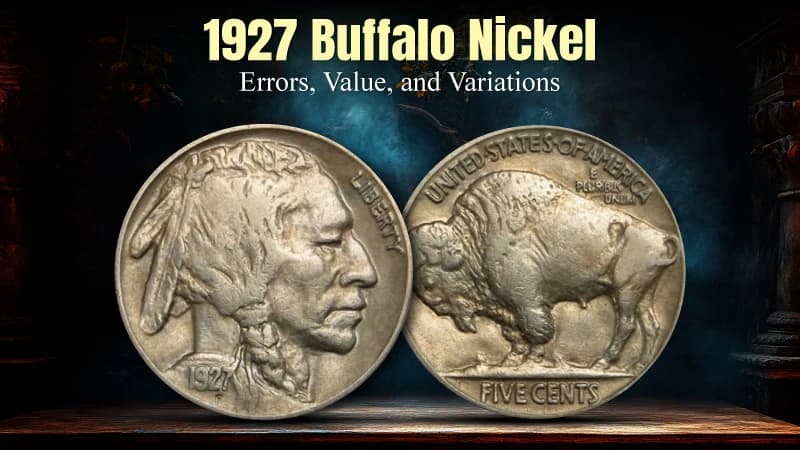
Obverse: Native American Indian Chief with braided hair and “LIBERTY. 1927” inscribed.
Reverse: American Bison standing with its head down along with inscriptions: “UNITED STATES OF AMERICA. E PLURIBUS UNUM. FIVE CENTS” and the mintmark.
Composition: Copper-nickel alloy (75% Copper, 25% Nickel)
Dimensions: Diameter of 21.2 mm and thickness of 1.95 mm.
Year Issued: 1927
Face Value: Five Cents ($0.05)
Determining the 1927 Buffalo nickel value includes factors like mintmark, condition, and errors—similar to how modern investors evaluate silver bars for purity and certification. This nickel was struck in the US Mint facilities of Philadelphia, Denver, and San Fransisco.
Let’s discuss them in detail with updated 2026 market values:

The coins that are struck at the Philadelphia Mint generally lack a mintmark. The Philadelphia Mint struck a total of 37,981,000 coins in 1927.
Circulated 1927 Nickel mintage from Philadelphia can fetch between $1.25 and $25.
Mint State (MS) condition coins from MS60 to MS66 can be worth $55 to $650.
Grades above MS66 are highly sought after; an MS67+ example holds the record at $24,000.

In 1927, the Philadelphia Mint also introduced Special strikes nickels that were struck from chromium-plated dies. Only five are known to exist, making them elite rarities.
The 1927 buffalo nickel worth for these specimens is historic; a SP 65 graded nickel once sold at a staggering $47,150.

The Denver Mint struck 5,730,000 coins with the “D” mintmark. These are considered "Mythic" in higher grades due to their scarcity.
Circulated coins range from $8 to $155 depending on wear.
Uncirculated MS60 to MS64 coins fetch $350 to $1,310, while MS65 specimens are valued near $4,750.
Top-tier grades above MS65 can command between $25,000 and $46,000.

With a mintage of only 3,430,000, the 1927-S is the "Divine" key date of the year.
• Circulated nickels are worth $5 to $180, while AU coins bring $465 to $510.
• Uncirculated MS60 to MS65 grades range from $1,050 to $17,500.
• High-grade MS66+ specimens are estimated between $65,000 and $125,000 based on recent auction demand.
| Condition | Meaning | Value (Avg) |
|---|---|---|
| Uncirculated (MS60-MS67) | Retains original mint luster with no flaws. | $25 to $570+ |
| Extremely Fine (XF) | Circulated for a short time with minimal wear on the high points. | $13 to $95 |
| Fine (F) | Displays wear on the Indian's cheekbone and the bison's legs. | $3 to $10 |
| Good (G) | Considerable wear and flattened details from long circulation. | $1.25 to $2.50 |
Uncommon manufacturing defects significantly contribute to the 1927 buffalo nickel worth. Here are the most recognizable errors:

The "Two Feathers" error, caused by over-polishing the die, depicts only two feathers on the Indian Chief's head. These error coins can fetch values from $400 to over $2,280 in high grades.

Observed on Denver strikes, this error features a missing partial leg on the bison. An MS62 specimen recently sold for $7,475, proving that striking errors can outperform standard high-grade coins.

Found primarily in San Francisco strikes, the DDO error shows doubling in the date or LIBERTY inscription. Values for these can reach $840 and beyond at auction.

This uncommon error displays a mintmark struck twice. Even in circulated condition, these unique pieces command interest, with values often exceeding $200 for clear examples.
The 1927 Buffalo nickel remains an essential piece of American numismatic history. Whether you hold a common Philadelphia strike or a rare branch-mint variety, these coins are a crowd favorite in the collector market, similar to how investors value government-minted products like Canadian Silver Maple Leaf coins.
The US Mint continues this legacy with the modern American Gold Buffalo coins. Secure your own piece of history from BOLD today!


Affiliations











Copyright BOLD Precious Metals 2026