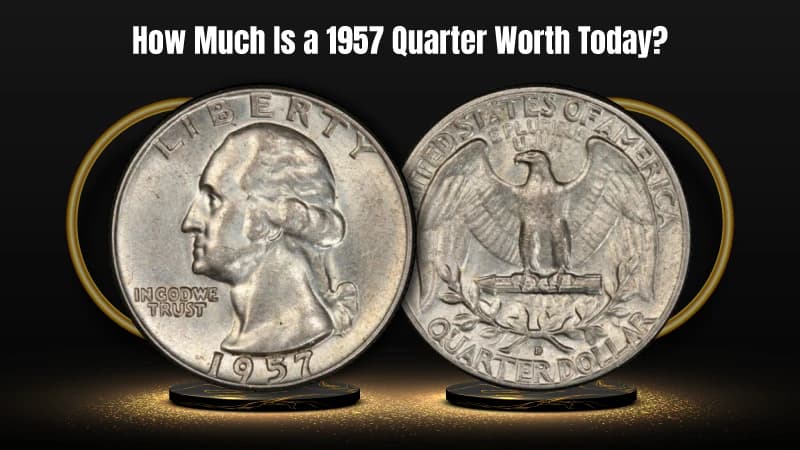
Have you ever held a coin and wondered what its story was? Coins are more than simply pieces of metal; they are small time capsules that preserve the legacy of their era. Among the many coins jingling in pockets, the 1957 quarter stands out to collectors and enthusiasts alike.
So, how much is a 1957 Quarter worth today?
While it has a face value of only 25 cents, its current value might much exceed the number printed on the surface. Whether it's the historical fascination, the dazzling silver content, or the possibility of rarity, this little piece of history could hold a surprising wealth. Those interested in silver content today often turn to silver rounds and bars for investment purposes.
Are you ready to unravel the secrets of your 1957 quarter value? As of April 2026, market demand for 90% silver coinage remains at an all-time high, driven by recent surges in the spot price of silver.
Let's dive in!
1957 Quarter value can be more than you think. The table below shows the approximate value for the 1957 quarters as of April 2026; however, they are not the standard values.
| Mint Mark | Good | Fine | Extremely Fine | Uncirculated (MS-60) |
|---|---|---|---|---|
| 1957 No-Mint Mark Quarter | $14.25 | $14.25 | $14.25 | $18.75 |
| 1957-D Quarter | $14.00 | $14.00 | $14.00 | $18.50 |
| 1957 Proof Quarter | - | - | - | $160.00 |
The 1957 quarter value varies according to the condition. These quarters have many varieties.
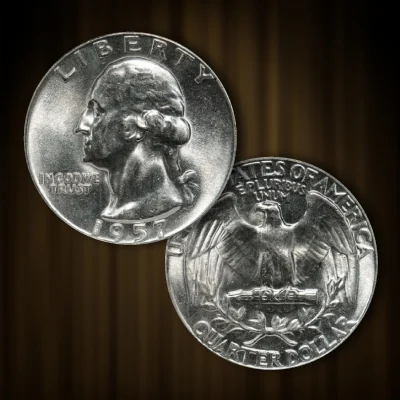
In 1957, approximately 46,532,000 Washington quarters were struck by the Philadelphia Mint. The quarters arriving from Philadelphia that year were badly struck since mint employees continued to use old or repolished dies from 1956.
To improve the strike, the mint experimented with last year's proof dies. Because proof dies were used rather than ordinary dies, the reverse of many 1957 quarters without a mint mark is slightly brighter with crisper details, while the obverse is dull with a poor strike. At current market rates, circulated 1957 no-mint mark quarters are linked directly to their silver melt value, which is currently around $13.73.
Uncirculated samples are also reasonably priced; a quarter with MS63 grade costs around $23.75, but quarters graded MS67, which are extremely uncommon and can sell for up to $700, can cost much more.
If you are fortunate enough to find a gem-quality 1967 no-mint mark quarter (rated MS67 and higher), be ready to either spend a lot of money or sell the coin for a good profit.
The most costly 1957 no-mint mark quarter to date was an MS68 that brought $3,819 in a Heritage Auctions sale. More recently, in early 2026, bidding for high-grade specimens has intensified at major auction houses.
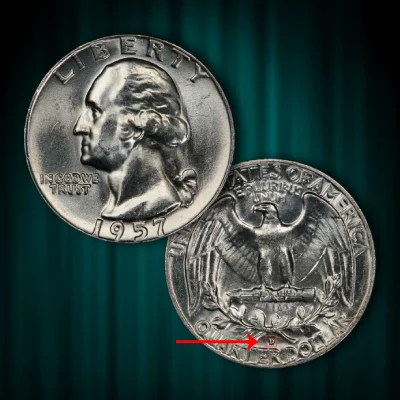
In 1957, the Denver Mint produced the most Washington quarters since 1944, with approximately 77,924,160 being struck.
Gems broken from previously hoarded rolls that are rated MS67 and higher are easily accessible. The value of a 1957 silver quarter in circulation tracks closely with current bullion pricing. These coins are collectible because, similar to the Philadelphia quarters, their price is far more than their face value.
• In an uncirculated condition, the 1957-D quarters are considerably more valuable; an MS67 piece can reach $200.
• Paying $11,400 for an MS68 1957-D quarter at a past auction, a collector shattered the record. As of 2026, the PCGS population of MS-68 specimens remains extremely low, making any new discoveries highly lucrative.
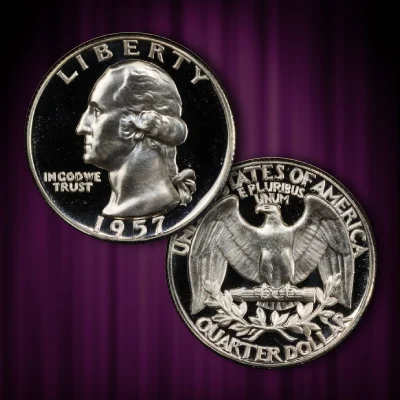
The Philadelphia Mint created proof coins for collectors in addition to the standard strike coins. In 1957, the factory produced an estimated 1,247,952 proof quarters, a notably large mintage that resulted in a decline in coin quality.
Collectors over ordered proof sets in 1957 as a result of the 1956 proof set speculation, and the Mint, therefore, minted more coins to satisfy the demand. The 1957 proof quarters exhibit signs of worn or over-polished dies, despite the fact that proof coins are meant to have excellent strike, brilliant luster, and remarkable visual appeal.
It is quite difficult to get fully dazzling proofs since the deep cameo population is so small, even if they are prevalent up to grade PF69.
While the uncommon deep cameo can sell for as much as $12,500, as was the case with a PF69DCAM sold at a 2023 auction, a 1957 quarter proof will often bring approximately $160 in today's 2026 market.
These are some popular varieties of 1957 quarters. Although the worth of these quarters depends upon condition, some 1957 quarters with errors are worth more.
Let's look upon rare 1957 quarter errors:
Though mint employees usually take care to apply mint markings in the proper location, misplaced mint mark errors are rare. QUARTER DOLLARS normally have the D mint mark between E and R on the reverse.
However, the mint mark appears to be a little out of alignment and is oriented closer toward the R in 1957. Depending on the coin's condition, such a mistake may sell for anywhere between $200 and $270.
When the punching die hits the mint mark more than once, the mark seems to double, which is known as a repunched mint mark error. The mint mark can also be filled in by this multiple hitting. High-mintage series frequently have mint mark defects; a 1957 repunched mint mark error can fetch up to $75 from enthusiasts.
In the Washington quarter series from 1957, this is the most frequent mistake. As of April 2026, specimens approved by CAC in MS-63 or higher continue to see strong auction performance, with prices recently reaching up to $2,300 for toned gems. Quarters from 1957 were struck using proof dies on the back and normal dies on the front. This mistake might have happened because the Philly Mint's employees used proof dies to strike coins because the normal dies were so poor. At least $200 can be earned from a type B reverse-proof strike error, which is highly desirable.
Due to its history, silver content, and collectible variations, the 1957 Quarter is worth more than its face value. High-quality, uncirculated 1957 quarters can sell for anywhere from $18 to over $11,000, while circulated ones sell for a premium over their melt value. Modern investors seeking silver content often choose silver bars for their straightforward investment value.
Its value can also be greatly increased by proof quarters and uncommon mint mistakes, such as the Type B reverse error or the missed mint mark. Investigating the 1957 Quarter Value can uncover a hidden gem in your possession, regardless of your level of interest in collecting.
So if you are worrying about the 1957 quarter value, forget your worries and get ready to earn profits from 1957 quarters.
Is a 1957 quarter made out of silver?
Yes, 90% silver and 10% copper were used to make 1957 Washington quarters. They are valuable as investments in bullion and as collectibles because of their composition. Today's investors often prefer modern options like American Silver Eagle coins for pure silver content.
How much does a 1957 silver quarter weigh?
The 1957 silver quarter weighs between 6.25 and 6.35 grams.


Affiliations











Copyright BOLD Precious Metals 2026