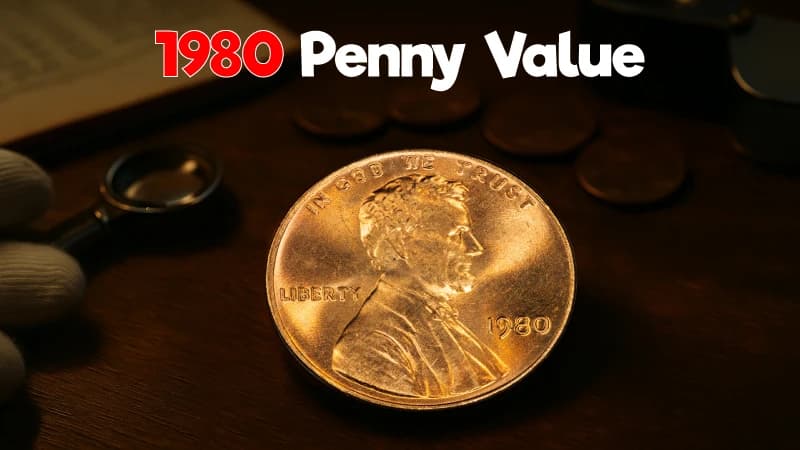
Ever curious if the 1980 penny in your attic or locker is worth more than a cent? The 1980 penny value is drastically determined by its errors, mint marks, and the overall condition. The 1980 penny or the Lincoln Cent is the longest-running and still in circulation series from the US Mint. This makes the penny pretty common but some editions are worth a fortune!
This guide will cover all the factors that can make the 1980 penny more valuable, so you can examine and determine if you have a potential treasure in your possession.
Under the influence of their condition, grade, and collector value, 1980 pennies can be either valuable or not, so high-grade pennies in no less than uncirculated issue are valued the most.
A great influence on the value of a penny lies in the mint marks; Denver and San Francisco mints are the most desired as opposed to the standard Philadelphia mint.
Minting mistakes, including doubled-die obverses and coins on wrong planchets, will raise the value of a penny by tremendous amounts, and some errors are valued at hundreds and even thousands of dollars.
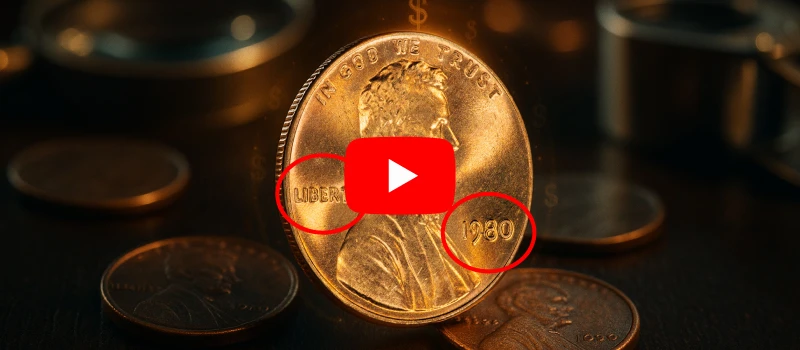
The worth of a 1980 penny comes from more than just face value and there are quite a few factors involved that are important:
Pennies that are in really good condition are able to sell for a lot more money than those with a lot of circulation.
It is a criterion that gives an assessment of the condition of a coin and is important in settling on the market value of a coin.
Coins in better grade are of greater collector interest, which generally increases auction price.
Collectors are also fond of high-grade 1980 pennies, more so the non-circulated ones. It is important to ensure that these coins are kept in the best state possible because a little blemish can greatly decrease the value of a coin. Handling and storage of saved pennies are critical in maximizing the value of pennies.
An understanding of these nuances provides a reason as to why some Lincoln cents and the lincoln penny are worth more.
Though they are minute, mint marks may have a great impact on the worth of a penny. These marks are used to show where the coin was produced and certain mints in the past were more valuable since they are rarer and are favored by collectors. A penny with a mint mark may be of great value, especially based on its source.
In 1980, the pennies were also minted in three different molds, which were Philadelphia, Denver, and San Francisco. The more the number of mint marks, the more the historical and collectible value one gains, making it more desired.
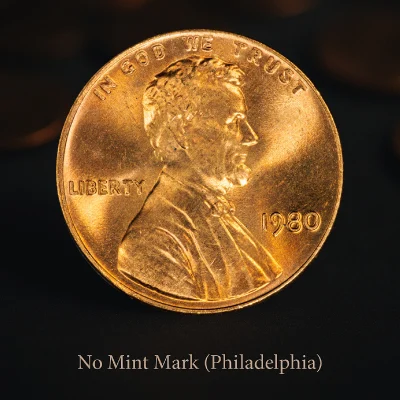
The 1980 coin stood at 7,414,705,000 pennies produced by the philadelphia mint which did not carry a mint mark. Philadelphia pennies are worth their weight in gold and yet are plentiful since they are in large quantities.
Despite the high mintages, it can be a satisfying hunt to locate mint-state Philadelphia pennies, and even uncirculated ones.
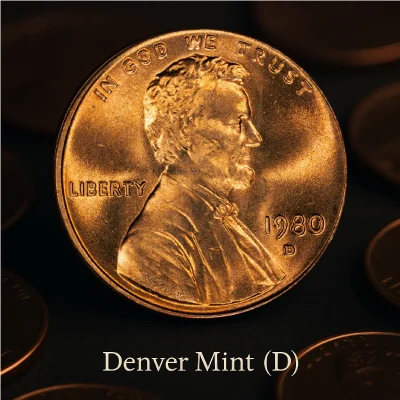
The one with the D mark, which identifies the Denver mint, issued 5,140,098,660 pennies in 1980. Denver pennies have important facts as follows:
Denver pennies are also rather common, though there are a few fewer of them.
Denver specimens of the first grade, and especially those grading MS 67, can be worthwhile.
These high-quality specimens can be as expensive as 140 dollars.
These coins prove to be popular when it comes to investment.
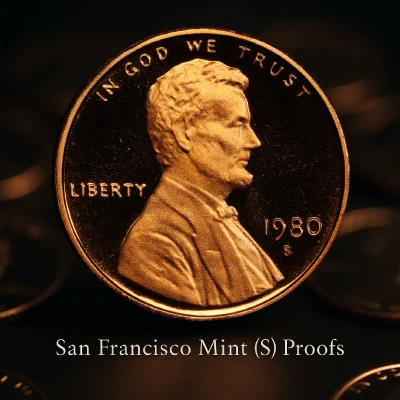
However, in 1980, 3,554,806 proof pennies were made by the San Francisco Mint. These proof pennies are in high demand, as they were minted in lesser numbers and are of high quality.
The intricate minting procedure brings about proof coins, which are highly detailed and final, as a result of which they are more apt to gather and therefore possess a higher worth.
The coins used as error coins make a very interesting study in numismatics and the 1980 pennies especially come into focus. Minting mistakes make the coin quite fetching and profitable. Successful coin error varieties that turn in huge demand are doubled die obverse, wrong planchet strikes, and overstrikes.
All the types of errors are distinctive and different in their character, which makes them noticeable in collections.
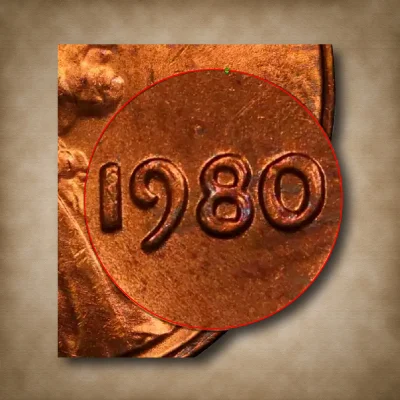
One of the most unique errors of 1980 pennies is the doubled die obverse (FS-101). This malfunction is caused by the die being out of position, and as a result, there is a duplication of an image on the back side. Error coins are no exception and are by far in high demand by collectors; a 1980 penny in MS 65 grade with a doubled die obverse achieved a price of $715 - indicating its high premium value.
Doubling can be seen on the inscriptions and date and hence is quite easy to detect. This is because the state of the coin is very important in ascertaining its value. Better quality examples of this mistake are preferred and can sell for hundreds of dollars, depending on the market demand and the extent to which the doubling occurs.
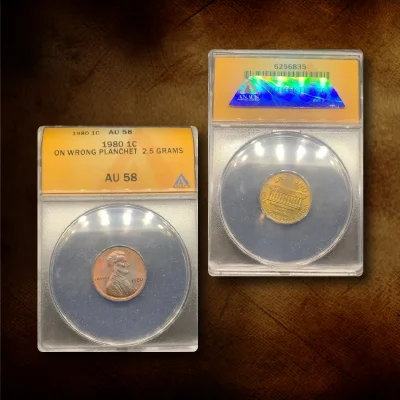
Other interesting mistakes include pennies made with misprepared planchets, such as those of dimes. These coins have errors:
They are smaller and lighter than ordinary pennies so that they can be distinguished the moment they are seen.
They are scarce and unique in their look, which make them very desirable by collectors.
They can be priced very high, usually between 100 and 2,500, depending on the condition they are in and whether the error can be seen or not
They arise as a result of feeding the coin press with the wrong metal blanks in the process of minting coins. The original unique coin can therefore command premiums at the collectors market. Finding one in your set is like striking gold, as they command high prices in the market.
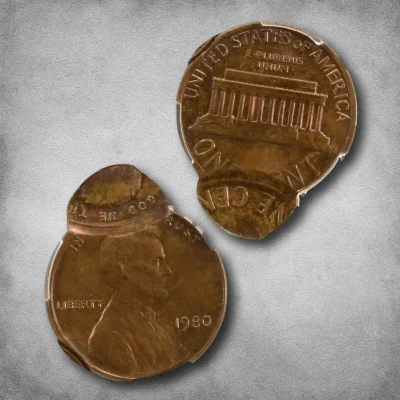
Another interesting and rare coin error is that of overstruck coins. They are formed when the penny is molded over a coin such as a dime so that the result is two coins with the characteristics of the penny and the coin.
Overstruck coins are desirable by reason of their peculiarities. As an example, a 1980 dime that has been overstruck on the penny would consist of features of both different coins, which would provide the creation of a unique, desirable coin.
Those same coins are collected due to their rarity and the detailed imagery added to them through the process of overstriking. Such errors have a healthy market and their prices are based on their collectability and distinctiveness.
Overstruck coins draw attention to the intrigues surrounding the reverse coin minting and the mystique of the rare human-struck objects of the plain us mint such as the overstruck coin.
The level of grading and condition are among the essential aspects that affect the value of a 1980 penny. This is because uncirculated coins, more so PCGS-graded ones, fetch better prices. High-grade coins, especially those rated as Red (RD), are in high demand.
Investors or collectors pay premium prices over mint state pennies because they are in such perfect shape with no wear on them.
Graham Mint states grades vary between MS60 which is minimal or uncirculated and perfect MS70. The 1980 Lincoln cents will be worth a lot when graded in this way:
MS65 cent: approx. $14.14.
MS66 pennies: they sell for between $15 and $25.
MS67RD pennies (most difficult and best valued): They sell for $ 100 to $ 150.
MS68 penny (the only one): worth $8,000.
These high-grade coins attract collectors and investors due to their exceptional condition and limited supply, resulting in high auction returns. An example of this is the MS67+ 1980 Lincoln cent, which sold on the auction block for $2,233, demonstrating the prospective value of carefully kept coins. Just as collectors pursue high-grade pennies, investors often seek investment silver for portfolio diversification.
1980 pennies that had been in circulation tend to have a low market value in comparison to uncirculated pennies. The wear and tear of the circulation will detract from their value as aesthetic and collectible items. A below-average to above-average circulated 1980 penny is worth approximately $4.29.
The uncirculated pennies, particularly of the higher grades, in contrast, can command considerably more, and hence the role of good condition in numismatics.
One can feel good selling 1980 pennies and this can be achieved with the appropriate markets. Options include:
Digital sources, which have a wide coverage
Local coin stores that grant access to dealers that have professional coin shop owners
Coin shows, at which you may meet like-minded people and professionals You can easily find the coin enthusiasts and professionals; each of the venues has its own benefits, starting with the wide range of people on online markets and ending with the professional experience of coin dealers.
Becoming aware of them could help you utilize the full potential of a penny and make the selling flow as smooth as possible to save on time. Here are some of the best options:
There is a huge number of visitors to the internet sites such as eBay and locating a prospective customer is not much of a problem. You should be aware of the costs that may be spent and lower the profitability.
Both Etsy and Facebook Marketplace are also convenient options with their peculiar advantages and difficulties. eBay does have listing and transaction fees, but at least it allows auctions, where the price may go even higher.
There are a number of advantages to selling to professional coin dealers:
Its cash sales are immediate
Expert valuation
The rarity of some varieties often has higher prices
Selling faster than selling online. Strategic partnerships in operations in the future locally oriented
This also ensures that they are a dependable entity when it comes to obtaining a fair price for 1980 pennies.
The wide knowledge gained by coin dealers in respect of the numismatic market is very useful in ascertaining the real value of your pennies. They provide the expertise and suggestions that buyers who are not inclined towards buying products casually may not, thereby making the process of selling these products smoother and better.
Selling one or more rare collectible pennies, or even a collection of such items, requires professional coin dealers who offer expertise and immediacy because online markets cannot.
The prices of the 1980 pennies are determined by various factors, among which are:
Minting defects like doubled die obverse or struck on strange planchets which adds a lot of value to the market because of the rarity.
Collector demand.
Composition.
The price determinants of the selling of pennies are as follows:
Market insights
You know which seller to sell to, eBay, etc
Laws of supply and demand
Grading
Collector interest
Finally, the above factors play essential roles in establishing the value of such pennies.
The 1980 penny is 95% copper with 5% zinc, making it one of the last traditional copper-composition pennies produced before the U.S. Mint transitioned to copper-plated zinc in 1982. This large amount of copper adds intrinsic value to copper pennies, which is why they are more sought after by collectors and others interested in their metal content, similar to how modern silver coins derive value from their precious metal composition.
The item of composition greatly influences the amount of the collector value because copper coins of the type of penny are commonly regarded as more significant than those of zinc.
The demand of the collectors is also a very important aspect of determining the prices of the 1980 pennies. There are preferred coins that fetch collectors and thus the given coin can become extremely expensive because it is in demand. Even ordinary 1980 pennies without any errors may turn into a valuable piece in case there is enough attention given to collectors and investors.
The supply and demand in the market have a significant determination of whether a penny will be sold above face value or not.
There are some of the 1980 pennies that are extremely rare and valuable and this only applies to those pennies that were struck on dime planchets. Such error coins can even fetch between $ 100 and $2,500, depending on the condition and the visibility of the error.
Other pennies, such as the overstrucks, where one penny is struck on top of another coin, are also very much wanted, as they have these particular characteristics and are rare. The presence of these rare varieties can significantly increase the value of a penny collection.
Additionally, specific high-grade examples of 1980 pennies can fetch impressive prices:
The sole 1980 Lincoln cent graded MS68 is valued at $8,000.
An MS67+ penny once sold for $2,233 at auction.
The FS-101 cent in MS-63 condition is valued at $350.
These examples highlight the significant impact of condition and rarity on a penny’s worth.
These rare coins are true gems in the numismatic world, offering rarer substantial returns for collectors.
To determine the value of 1980 pennies, one must explore the world of their mint marks, common errors, grading, and market dynamics. Rare pennies, premium-grade errors, and valuable pennies can garner phenomenal prices with good reason to scrutinize and protect them, especially in storage.
Whether you are a longtime collector or a beginner with interests in the field, being aware of the factors that determine the value of an old penny can not only make it a thrilling adventure but also a profitable one. Watch out on those treasure hunts and good luck!
A penny can be valuable because of condition, mint mark, and minting breaks in a 1980 penny. Specimens with high grades or rare errors will fetch higher prices.
In 1980, the most sought-after errors are the doubled die obverse errors, the pennies struck in the wrong planchets, and the overstruck coins. Such kinds of mistakes are capable of adding great worth to the coin among collectors.
In order to sell your 1980 pennies, you should at least consider selling them online through specific websites such as eBay or you should go to your local coin shops or even coin shows to sell your pennies. All of them can assist you in attracting more people and getting a good price.
A 1980 penny is made of 95% copper and 5% zinc, so it has more value for its metal than the contemporary pennies.
The realm of grading directly influences the prices of a 1980 penny: the finer the coin, especially those in mint state, the higher the price fetched when compared to circulated coins. So it is necessary to grade and assess the grading that determines the market worth of the grading.


Affiliations











Copyright BOLD Precious Metals 2026