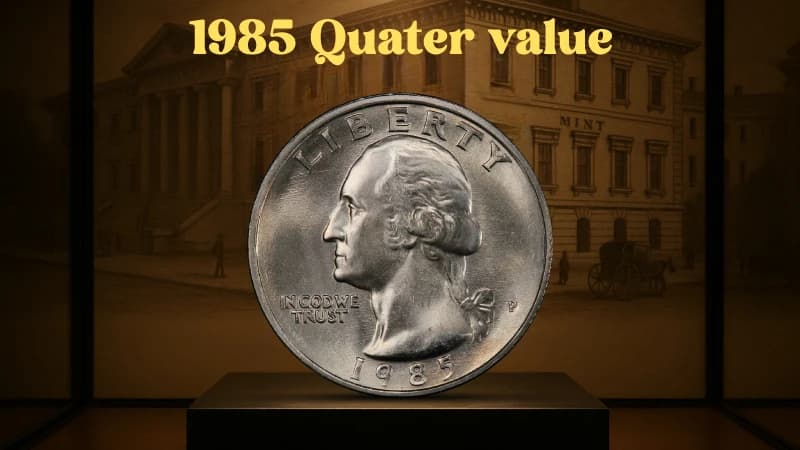
Though the Washington quarter of 1985 appears to be just like any other coin of common change, it holds a secret: hidden among the billions minted are rare varieties and mistakes for which dealers will pay an arm and a leg, from a few dollars to a staggering six figures. If you've ever wondered whether that forgotten quarter in your pocket is worth more than its face value of 25 cents, then you've come to the right location.
This is the ultimate guide to the value of the 1985 quarter. We will cover all the nitty-gritty—all the way from its composition and mint mark variations to the place that coin grading serves and a closer examination of the particular, high-dollar miscuts you will be on the lookout for.
| Coin Type | Circulated Value | Uncirculated Value | Key Feature |
|---|---|---|---|
| 1985-P Quarter | 25 cents | $2 - $450+ | The most common value is in the top grade. |
| 1985-D Quarter | 25 cents | $2 - $400+ | High mintage; value requires high grade. |
| 1985-S Proof Quarter | Collector Coin | $3 - $125+ | "S" mint mark; mirror-like finish. |
| 1985 DDO Error | $25 - $100+ | $300 - $600+ | Doubling on "IN GOD WE TRUST". |
| Major Errors | $10 - $1,000+ | $10 - $1,000+ | Off-centers, broadstrikes, etc. |
To accurately value your coin, you must first understand what it is made of and how its condition is judged.
Let's clear this up right away: No, the 1985 quarter is not silver. All Washington quarters produced for circulation since 1965 are a "clad" composition.
Construction: A central copper core covered between two layers of 75% copper, 25% nickel alloy.
Significance: The worth is not in the metal but is purely numismatic, i.e., based on condition and rarity as judged by collectors.
The "grade," or state, of a coin is the most critical consideration in assigning value to it. The Sheldon Scale (1 to 70) quantifies it.
Worn: Circulation-worn coins (grades G-4 to AU-58). A 1985 quarter in this grade will generally be worth face value unless it's an error.
Mint State (MS): Never circulated and with no wear. MS-60 is not circulated but has numerous marks. MS-65 (Gem) is the benchmark of a good coin to have. MS-67 is extremely rare and very expensive.
Proof (PR): Specimen coin with a mirror-like finish. Its ideal grade is PR-70.
The little letter on the front (obverse) of your coin, to the right of Washington's ponytail, is the mint mark. It informs you where the coin was manufactured and matters for its valuation.
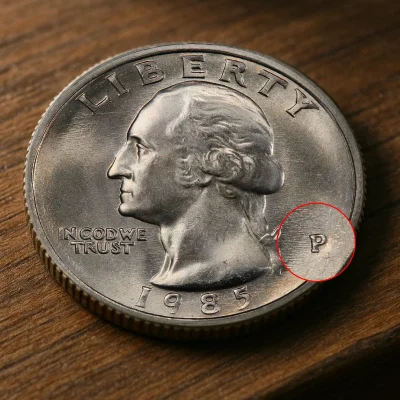
With a staggering mintage of 585,547,424, the 1985-P is very common.
In circulation: 25 cents face value.
Uncirculated: A typical uncirculated coin will sell for $2-$4, but the grade causes the price to skyrocket. An MS-65 will bring $15-$22. An MS-67, which is extremely rare, can fetch $450 to $600.
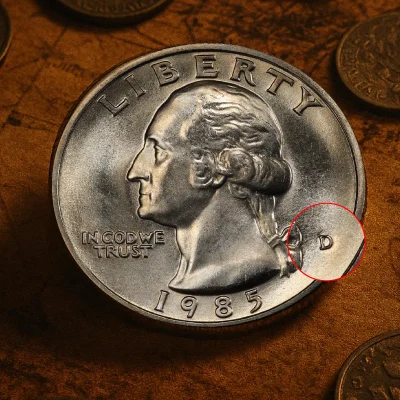
Also struck in large numbers (521,809,629 mintage), the 1985-D also has a similar pattern of worth.
In circulation: Worth 25 cents.
Uncirculated: Almost identical to 1985-P values. Condition makes all the difference. An MS-65 sells for $15-$22, but an MS-67 condition specimen is a real find, with prices between $300 and $500.
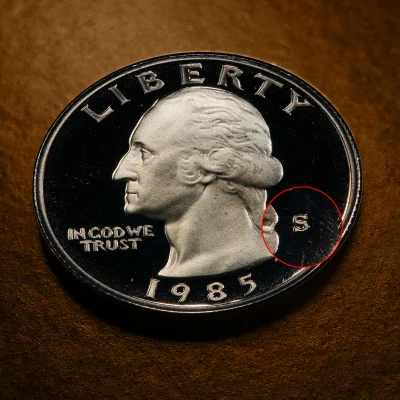
This is the one to seek. The "S" mint mark means a proof coin that was made just for collectors.
Standard Proofs: Most 1985-S quarters are in mint condition. The standard grade is PR-69 and is valued from $3-$7.
"Deep Cameo" (DCAM) Proofs: They are sharp proofs with a beautiful, icy-looking design that is a dramatic contrast to the mirror background. A PR-69 DCAM is superior, at a price of $15-$25.
The Perfect PR-70 DCAM: The holy grail of a proof collector is the ultimate reward. Coins graded this perfectly can retail between $75 to $125 or more.
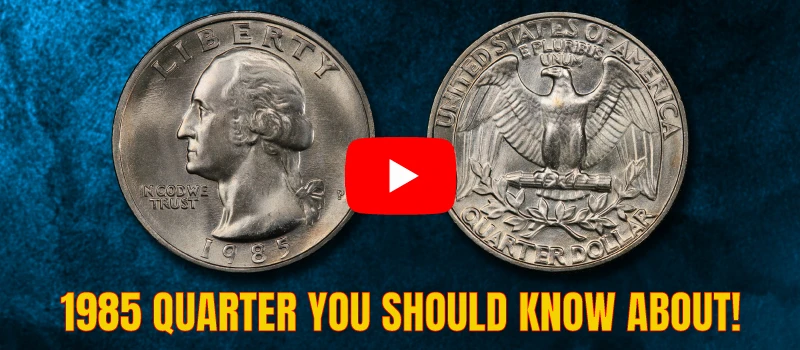
This is where the life-changing worth lies. Mint errors create scarce forms that are in high demand. Look over your coins through a 5x or 10x magnifier for these.
It is the most recognized 1985 quarter error. It is not simple machine doubling; it is a simple die defect.
What to See: Single, clear, and distinct doubling of the letters in "IN GOD WE TRUST" and "LIBERTY".
Value: This is a significant find. A circulated DDO can command $25-$100. Value increases to $300-$600 in Mint State, with better-quality specimens commanding higher prices.
The coin was off-center when it was minted, resulting in an off-center appearance.
What to Look For: An abnormal crescent-shaped blank space on the coin's side.
Value: A small 5-10% off-center strike is valued at $15-$30. A stunning 50% off-center strike, where the date and mint mark are still legible, is a treasure that is valued at $100 or more.
This is legend stuff. A very odd mistake took place when a 1985-D quarter was accidentally struck on an unused 90% silver planchet from a 1964 Roosevelt dime.
How to Identify It: You'd be very unlikely to find another, and it would be significantly smaller, more slender, and lighter than a standard quarter and would be silver in construction.
Value: The only documented specimen, PCGS-graded, sold for a staggering $132,000 at auction to become the world's most valuable 1985 quarter.
Broadstrike: A coin struck off of its retaining collar and thus abnormally thin and broad. Value: $10-$25.
Clipped Planchet: A crescent-shaped piece missing from the edge of the coin, a flaw caused while punching the blank. Value: $5-$20.
Struck-Through: An object (such as wire or cloth) was struck into the face of the coin and left an impression. Value: $10-$100+, depending upon the object.
A circulated 1985 quarter that lacks a 'P' or 'D' mint mark is only worth face value at 25 cents. Its value only rises if it is in mint, uncirculated form or if it is an error coin and is uncommon.
No. All quarters minted for circulation in 1985 were copper-nickel clad coins. The U.S. Mint discontinued using silver in circulating quarters in 1964. Today, investors seeking silver content turn to investment silver products specifically designed for precious metals portfolios.
Three primary factors: 1) Exceptional Condition: In a very high uncirculated grade (MS-65 or higher). 2) Proof Issue: Being an "S" mint mark proof coin, particularly with "Deep Cameo" contrast. 3) Mint Errors: Having an error that is verifiable, such as the very valuable Doubled Die Obverse (DDO).
A 1985 quarter with no noticeable mint mark is a coin from the Philadelphia Mint. Philadelphia in 1985 produced a "P" mint mark. If you can't find it, then probably it is a 1985-P when the mark was weakly impressed or worn off. It is not rare.
The best-known and most valuable error to seek out is the 1985 Doubled Die Obverse (DDO), which is worth many hundreds of dollars and more. The best-known rare error is the 1985-D quarter error incorrectly stamped on a 1964 silver dime planchet and being sold for $132,000.
No! Cleaning a collectible coin will permanently disfigure its surface, take away its original mint brilliance, and greatly decrease its value. Numismatists consider cleaned coins to be damaged goods.
Handle it carefully by the edges to avoid fingerprints. To confirm its value and make it easier to sell, you should have it authenticated and graded by a reputable third-party grading service like PCGS (Professional Coin Grading Service) or NGC (Numismatic Guaranty Corporation).


Affiliations










Copyright BOLD Precious Metals 2026