Gold has been appreciated over a long period of time due to its rarity, resistance, and beauty. Most individuals wish to know how to tell genuine gold whether in jewelry, in coins, or even in gold bullion.
Gold has been regarded as a safe-haven asset, and it is significant in portfolio diversification. Numerous investors conduct research on the usefulness of investing in gold before joining the precious metal market.
Through this guide, we will find the answer to: is gold magnetic, why it acts the way it does, and how we can determine, using simple tests, whether the gold is genuine.
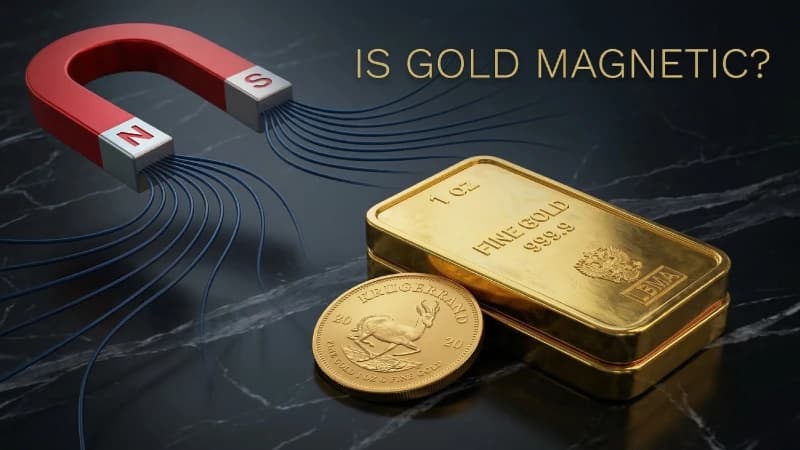
Pure gold is not magnetic. It is a diamagnetic metal and does not attract magnets.
Magnets can help spot fake gold. If a gold item strongly sticks to a magnet, it likely contains metals like iron or nickel.
The magnet test is only a basic check. Some non-magnetic metals can still pass the test.
Gold jewelry may show a slight reaction due to alloy metals or steel clasps.
Use multiple tests, such as hallmark checks, weight tests, and professional verification, to confirm real gold.
The simple answer is no — pure gold is not magnetic.
Gold is classified as a diamagnetic metal, meaning it does not attract magnets. Gold does not get attracted by the magnet, but rather it exerts a very weak repelling force when subjected to strong magnets.
This effect is extremely weak and cannot be noticed without scientific instruments. When you put a magnet near pure gold, you will, as a rule, see no effect whatever.
Due to this quality, magnets tend to be utilized as a fast method in determining whether a gold object is counterfeit.
| Magnetic Metals | Non-Magnetic Metals |
|---|---|
| Iron | Gold |
| Nickel | Silver |
| Cobalt | Copper |
| Steel | Aluminum |
| Magnetite (iron ore) | Platinum |
Gold is a type of metallic element known as a diamagnetic metals and this implies that it repels magnets and may exhibit a very weak repulsive force in a powerful magnetic field.
You might still ask, Is gold magnetic? Actually, it isn’t. To understand this, knowing how magnetism works is essential!
Magnetism is the ability of the electrons within the atoms to align in a manner that gives rise to a magnetic field. These atoms are strongly magnetic because of their ability to align to achieve a structure that is metallic in nature, e.g., iron, nickel, and cobalt.
Gold behaves differently.
Paired electrons neutralize magnetic effects in gold atoms. Due to this arrangement, gold is incapable of generating a magnetic field that will attract the magnet.
This is referred to as the property of diamagnetism, i.e., the metal has a weak repulsion of the magnetic field instead of attraction.
No, real gold does not adhere to a magnet.
When a gold coin, bar, or jewelry item clings to a magnet so firmly, it is likely to have other metals like iron or nickel.
But in some cases, a little magnetic response may take place, but that doesn’t give a concrete answer to: is gold magnetic?
Other metals are sometimes used together with gold jewelry in order to make it durable. These metals are referred to as alloys and, at times, may lead to a slight magnetic effect.
| Gold Type | Magnetic Behavior |
|---|---|
| 24K Gold | Not magnetic |
| 18K Gold | Usually not magnetic |
| 14K Gold | May show a slight response |
| Gold-plated items | Maybe magnetic |
The fastening of a necklace or bracelet at times can respond to a magnet as it has steel elements, though the gold can be real.
In a normal circumstance, pure gold cannot be made magnetic.
Nevertheless, magnetic behavior can manifest itself in some rare cases.
Some of the alloy metals included in many jewelry products include:
When the quantity of these metals is high, the alloy could exhibit a low magnetic response.
There are jewelry items that have metal components inside them, such as springs or pins, which may respond in response to a magnet.
Dependent on the type of laboratory procedure, magnetic fields may be strong or weak.
A strong repelling effect can be observed in gold in very strong laboratory magnetic fields due to its diamagnetic properties. But this cannot be realized in a normal situation.
A quick authenticity check at home involves the magnet test for gold as one of the easiest methods.
Nevertheless, when you are intending to invest in physical gold, it is always advisable to learn how to purchase gold safely with reputable dealers.
The gold magnet test might be useful, but it should be used as the first screening technique and not as the definitive evidence of authenticity.
To check the authenticity of gold, experts normally suggest a combination of some of these methods.
Gold is extremely dense. When it has a lighter feel than what its size implies, then it may not be real gold.
Many genuine gold items contain purity marks such as:
These are marks that show the purity of gold.
Gold analysis through advanced equipment is done by professional dealers and refiners.
These are some of the things one should consider when venturing into the precious metals market, hence the reason why most investors begin by reading a precious metals investing guide before buying the bullion.
Professional precious metals dealers and refineries commonly use X-ray fluorescence (XRF) analyzers and precise density measurements to verify the purity of gold coins and bullion products.
The magnet test is helpful, but it alone cannot confirm whether gold is real.
The magnet test can also be passed through some non-magnetic metals, including brass and copper. This is the reason why expert investors do not depend on only one verification procedure.
Also, in the case of precious metals investment, numerous traders examine the market indicators, such as the silver-to-gold ratio, to make sense of the market.
The small denominations, like 1 gram gold bars, are the smallest denominations that people buy to begin their investment since they are cheap and easy to deal with.
Once the real gold is bought, it becomes extremely important to store it in a proper way. Researchers on the storage and security of precious metals usually involve investors in ensuring that their property is not stolen or damaged.
Bank safe-deposit boxes, home safes, and professional vault storage are secure storage.
Gold is non-magnetic. Pure gold does not attract magnets because it is classified as a diamagnetic metal.
A magnet can help identify some fake gold items, but it cannot guarantee authenticity because some counterfeit metals are also non-magnetic.
No. Pure 24K gold will not stick to a magnet.
Some gold jewelry contains alloy metals or internal steel components like clasps, which may create a magnetic reaction.
So, is gold magnetic?
The response is no, pure gold is not magnetic. Gold is a diamagnetic metal, i.e., one that is not attracted by magnets and repelled to some degree by strong magnets.
Due to the property, the magnets can be used to detect fake gold sometimes. Nevertheless, checking the magnet test is not sufficient to prove authenticity. Jewelry can have alloy metals or concealed pieces that are responsive to magnets.
To achieve maximum, the magnet test should be incorporated with other tests like density tests, hallmark tests, and professional tests.
Knowledge of these properties allows buyers and investors to make informed choices when they are buying real gold.


Affiliations











Copyright BOLD Precious Metals 2026