
Affiliations











Copyright BOLD Precious Metals 2026
Johnson Matthey gold bars are available as original products at a reasonable price at BOLD Precious Metals. Each bar is meticulously checked in terms of weight, purity and state, and sent out safely at a transparent price based on live gold spot prices, and fully insured. Purchasing of Johnson Matthey gold bars is a safe and reliable procedure, which give investors peace of mind. Just like long-term wealth preservation or the security of tangible assets, Johnson Matthey gold bars are still an option you can count on when deciding to become a serious gold buyer.
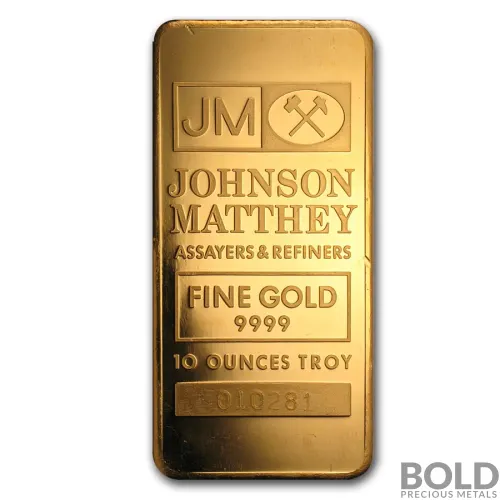
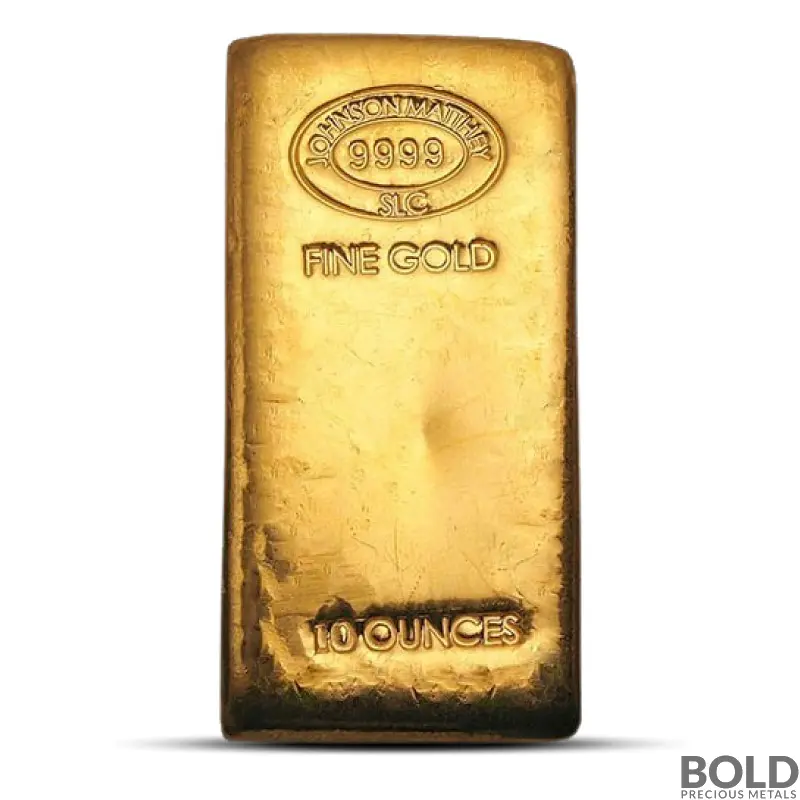
Gold Bar Johnson Matthey - 10 oz
Out of Stock
Dealer Insight — Why JM Bars Still Lead the Secondary Market
"In over 15 years of dealing bullion, Johnson Matthey bars remain among the easiest to liquidate at spot or above. Dealers and secondary buyers recognize the JM stamp on sight — there's no haggling over legitimacy the way you sometimes see with obscure refiner bars. The 2015 discontinuation hasn't hurt demand one bit; if anything, it's separated serious JM inventory from the flood of newly-minted alternatives. When a client asks me what vintage refiner bar to hold long-term, JM is still the first name I say."
— Ryan Cochran, Senior Bullion Dealer, BOLD Precious Metals
Founded in London in 1817, Johnson Matthey built its reputation across platinum group metals, industrial chemistry, and precious metals refining. By the mid-20th century, JM had become one of the London Bullion Market Association's (LBMA) original Good Delivery refiners — a designation that represents the gold standard of bar authentication in global wholesale markets.
JM bars struck in the 1970s through 2015 carry that LBMA Good Delivery legacy in their pedigree. The stamp "J.M." or "JOHNSON MATTHEY" with assay mark and bar weight has been instantly recognizable to professional dealers across North America, Europe, and Asia for generations. That recognition translates directly into liquidity when you're ready to sell.
Overlooked Fact — Domestic U.S. Production
Johnson Matthey's North American refining operations were headquartered in Salt Lake City, Utah — not London. Many of the JM gold bars circulating in the U.S. secondary market today were refined domestically, which matters for buyers who prioritize chain-of-custody transparency in their due diligence.
The secondary market concentrates JM gold bars heavily in two sizes. Understanding the format differences is critical to making the right purchase decision for your goals. Browse our full gold bars collection to compare across all refiners and sizes.
| Size | Purity | Typical Format | Collector Premium | Best For |
|---|---|---|---|---|
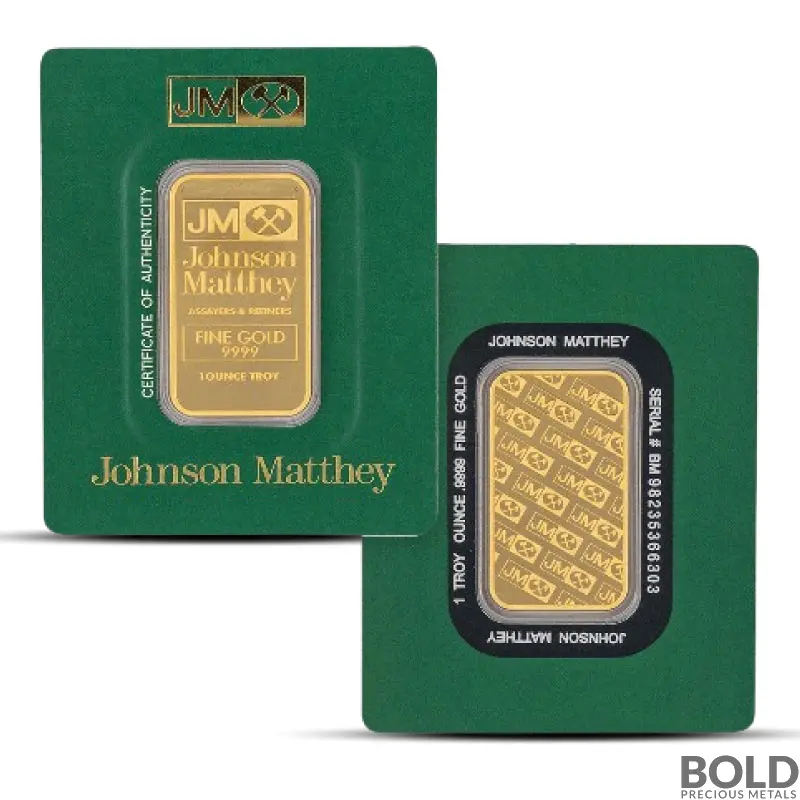
| 1 oz | .9999 fine | Assay card (select); loose bar | Highest — especially assay-carded | Liquidity, gifting, IRA diversification |
| 10 oz | .9999 fine | Loose stamped bar | Moderate | Institutional stacking, lower per-oz premium |
| 100 gram | .9999 fine | Loose stamped bar | Low to moderate | Mid-size investment, international buyers |
| 1 kilo | .9999 fine | Serial-numbered, loose | Low (rarity offsets collector interest) | High-value wealth storage |
Assay Packaging — Worth the Premium?
Not all JM gold bars come in assay cards. A 1 oz JM bar in original sealed assay packaging commands a measurable premium over an identical raw bar — typically $5–$15/oz depending on market conditions. If you're buying to resell or building a high-liquidity position, the assay-carded versions are worth the additional cost at purchase. If you're stacking strictly for spot-value exposure, the raw bar is the lower-cost route to the same .9999 gold content.
Buyers frequently weigh JM against Engelhard and Credit Suisse. Here's how they stack up on the factors that actually drive resale value and dealer acceptance.
| Feature | Johnson Matthey | Engelhard | Credit Suisse |
|---|---|---|---|
| Founded | 1817 | 1839 | 1856 |
| Production Status | Discontinued 2015 | Discontinued 1988 | Active |
| Standard Purity | .9999 fine | Mostly .999 fine | .9999 fine |
| LBMA Good Delivery | Yes | Yes | Yes |
| North American Dealer Recognition | Extremely High | Very High | High |
| Counterfeit Risk | Low (distinctive stamp) | Low-Moderate | Low |
| Resale Liquidity |
When Johnson Matthey stopped gold bar production in 2015, they created a fixed supply. Unlike a government mint that can strike another million coins next year, JM gold bars are finite. Available supply either stays flat or contracts as bars are melted, lost, or absorbed into permanent collections. This has three direct implications for buyers making purchasing decisions right now.
Condition Commands a Premium
A JM bar with strong strike clarity, clean surfaces, and no edge damage is worth more than a worn example of identical weight and purity. We grade the condition of every JM bar in our inventory before listing — you know exactly what you're receiving before it ships.
Timing Matters More Than With New-Production Bullion
As gold prices rise and secondary market inventory gets absorbed by long-term holders, JM bars in the most popular sizes — particularly 1 oz — become genuinely harder to source at competitive premiums. The window to buy at low premiums over spot narrows with each market cycle. There is no restock button.
Scarcity Is Structural, Not Manufactured
There's no new JM inventory coming. What exists today is what exists. That's a fundamentally different supply dynamic than buying PAMP Suisse or Perth Mint bars where restocking is a phone call away. Fixed supply plus sustained institutional demand is a straightforward long-term value case.
Because JM bars are vintage and no longer produced, counterfeit concerns are a legitimate buyer consideration — though the risk is lower than with government coins due to the wholesale-market provenance of most circulating JM inventory.
Authentication Checklist — What Genuine Bars Exhibit
Are Johnson Matthey gold bars still being made?
No. Johnson Matthey exited gold bar production in 2015. All JM gold bars available today are secondary market inventory — authentic vintage bullion with no new supply entering the market. This makes current availability finite and condition-dependent.
Are Johnson Matthey gold bars a good investment?
For investors prioritizing liquidity and institutional recognition, yes. JM bars are among the most widely accepted vintage refiner bars in North America. They trade at or near spot with minimal dealer friction, making them a reliable wealth-storage vehicle rather than a speculative collectible.
Do Johnson Matthey gold bars come with assay certificates?
Select 1 oz JM bars were produced in sealed assay card packaging, some with SecureDesign security features. Larger bars (10 oz, kilo) are typically loose stamped bars without assay packaging. Assay-carded 1 oz versions carry a collector premium worth paying if resale is a priority.
What is a Johnson Matthey SecureDesign gold bar?
SecureDesign is JM's proprietary assay card format used on certain 1 oz gold bars. The card incorporates tamper-evident features and security printing to authenticate the bar without requiring it to be removed from packaging. SecureDesign bars trade at a premium over raw 1 oz JM bars of identical weight and purity.
Where can I sell Johnson Matthey gold bars?
JM bars are accepted by virtually all major bullion dealers, coin shops, and secondary market platforms in North America. BOLD also buys back JM gold bars — visit our Sell to Us page for current buy pricing. The high dealer recognition of the JM stamp means you won't face the verification delays or discount offers that sometimes apply to obscure refiner bars.
How can I verify a Johnson Matthey gold bar is authentic?
Check stamp depth and consistency, verify exact troy weight (31.1035g for 1 oz), inspect any assay card for tampering signs, and request XRF test documentation if purchasing high-value quantities. BOLD tests and authenticates every JM bar before listing — ask our team for specific verification details on any bar in our inventory.
Ryan's Verdict — Should You Buy Johnson Matthey Gold Bars?
"Buy Johnson Matthey gold bars if you want institutional-grade vintage bullion with a name every dealer in North America will recognize without a second look. Don't buy them expecting dramatic numismatic premiums over spot — these are investment-grade bars first, collector pieces second. But for pure wealth storage, portfolio weight in physical gold, and long-term resale confidence, JM bars are as close to a sure thing as vintage bullion gets."
— Ryan Cochran, BOLD Precious Metals
Johnson Matthey is the gold standard of vintage refiner bars — but it's not the only name worth owning. If you're building a diversified vintage bullion position, these pages are worth a look.
Still in active production, widely available in assay card format, .9999 fine. A strong alternative if new-production assay bar packaging is a priority.
Shop Credit Suisse Gold BarsThe benchmark for current-production art bars. Higher visual appeal, consistent premium over spot, widely recognized internationally. Ideal if new-production with premium design matters.
Shop PAMP Suisse Gold Bars