
Affiliations











Copyright BOLD Precious Metals 2026
Buy Chinese Gold Panda Coins Online! Among the globally renowned .999 pure gold for their unique annual designs, long-term investment value, and authenticity.
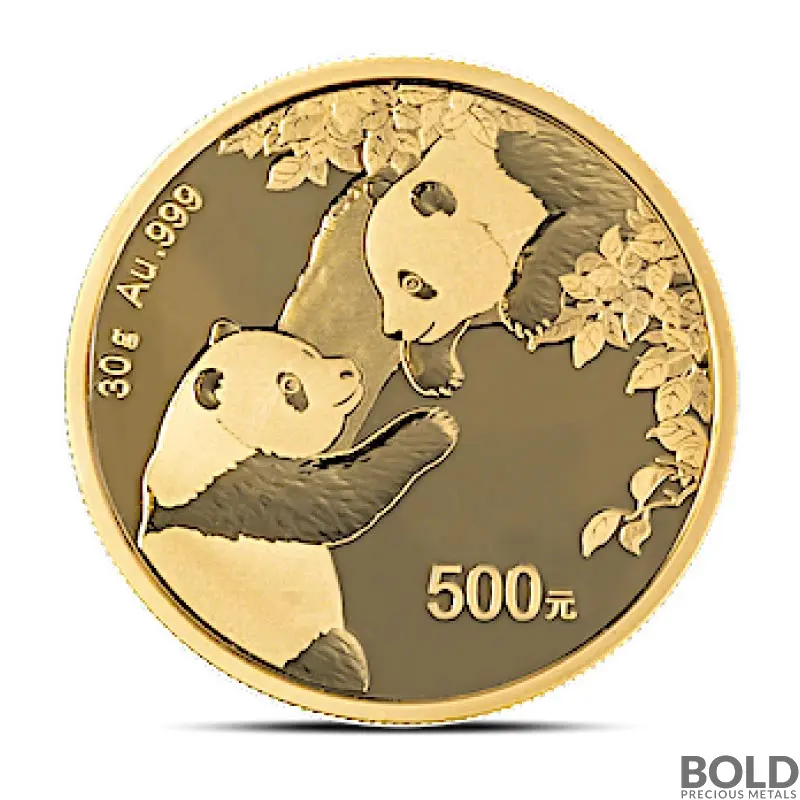
2023 30 Gram China Panda Gold Coin (BU)
Out of Stock
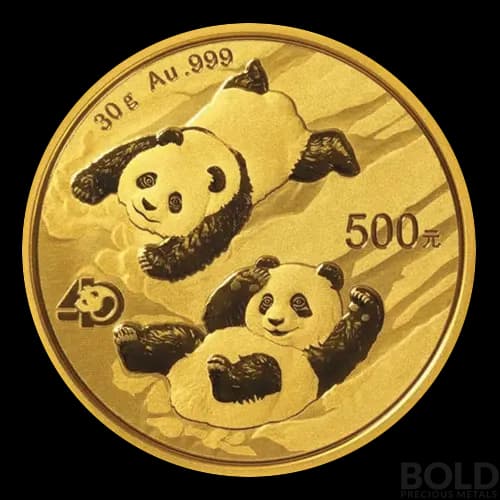
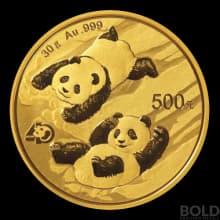
2022 China Panda 30 gram Gold BU
Out of Stock
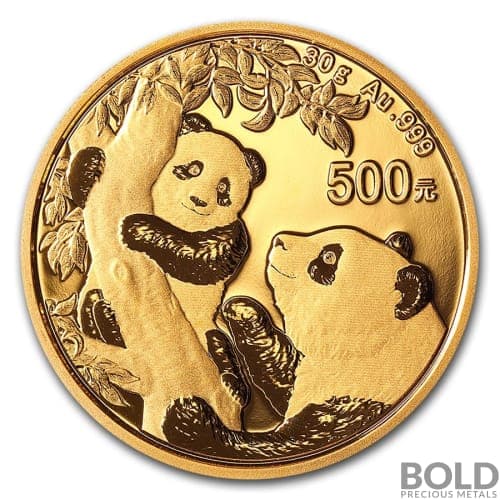
2021 China Panda 30 gram Gold BU
Out of Stock
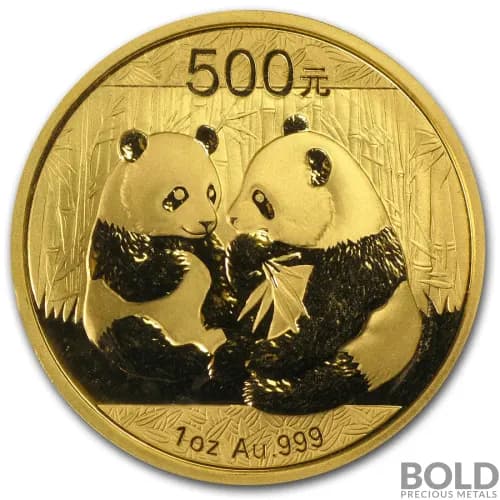
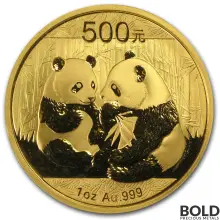
1 oz Chinese Panda Gold Coin (Random Date)
Out of Stock
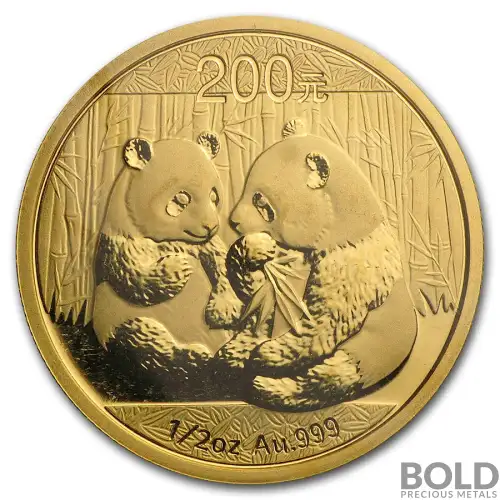
Gold Chinese Panda *Random Date* - 1/2 oz
Out of Stock
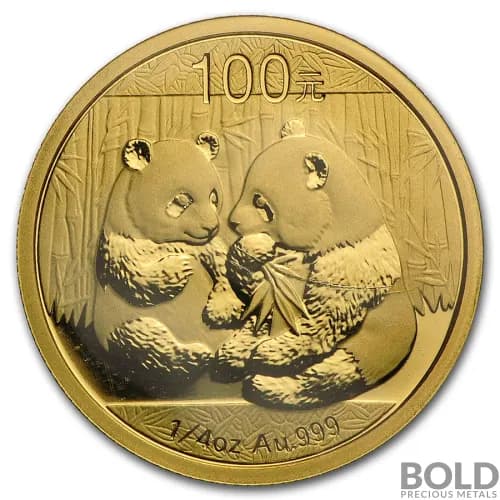
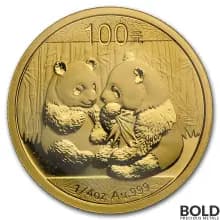
Gold Chinese Panda *Random Date* - 1/4 oz
Out of Stock
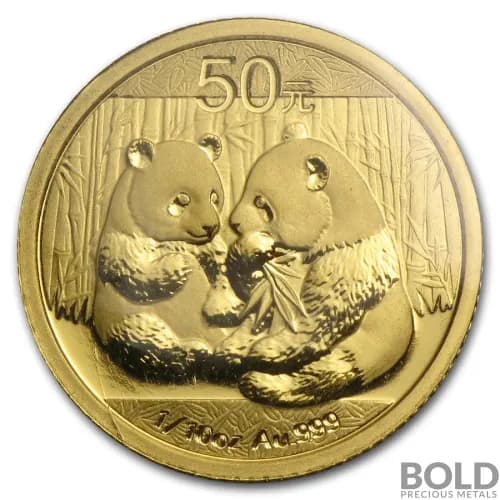
Gold Chinese Panda *Random Date* - 1/10 oz
Out of Stock
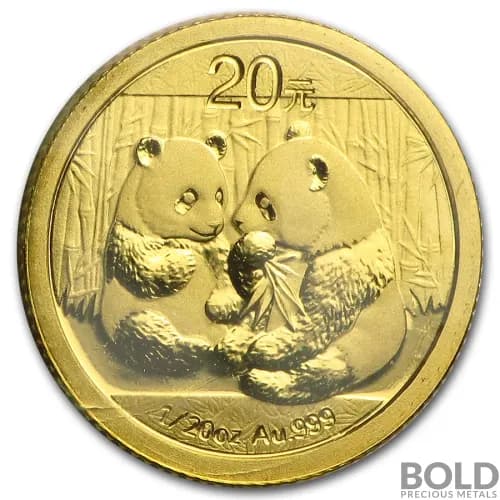
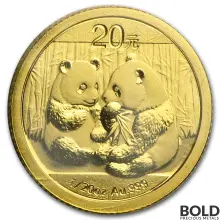
Gold Chinese Panda *Random Date* - 1/20 oz
Out of Stock
The China Gold Coin Corporation strikes Gold Pandas to .999 fine gold — the same purity as the Canadian Gold Maple Leaf and American Gold Buffalo, a step above the .9167 alloy of the American Gold Eagle. Here's what most dealers won't tell you upfront.
Like every major sovereign gold coin, the Gold Panda's core value is anchored to the gold spot price. At .999 fine purity, every gram of coin weight is almost entirely fine gold. The melt value floor is identical to any other .999 fine sovereign coin of equivalent weight.
Unlike the Maple Leaf or Krugerrand, Gold Pandas carry a collector premium tied to year, mintage, and design. That dual-value structure creates a price floor above spot that purely fungible coins don't always enjoy. You're buying a limited annual release from a sovereign mint with a documented collector market in China and globally.
In 2016, the Chinese Mint made a significant structural change that still confuses buyers and even some dealers today. Prior to 2016, Gold Pandas were struck in troy ounce denominations. Starting in 2016, the entire series converted to metric weights.
Critical Buying Warning
A pre-2016 1 oz Gold Panda contains 31.1 grams of gold. A post-2016 30g Gold Panda contains exactly 30 grams — roughly 1.1 grams less per coin. At current gold prices, that difference represents real money. Always check the weight specification, not just the size category, when comparing prices across different year issues.
| Era | Denomination | Gold Content | Purity | IRA Eligible |
|---|---|---|---|---|
| Pre-2016 | 1 oz | 31.1g | .999 fine | Yes (1986+) |
| Pre-2016 | 1/2 oz | 15.55g | .999 fine | Yes (1986+) |
| Pre-2016 | 1/4 oz | 7.78g | .999 fine | Yes (1986+) |
| Post-2016 | 30g | 30g | .999 fine | Yes |
| Post-2016 | 15g | 15g | .999 fine | Yes |
| Post-2016 | 8g | 8g | .999 fine | Yes |
| Post-2016 | 3g | 3g | .999 fine | Yes |
| Post-2016 | 1g | 1g | .999 fine | Yes |
Teal-highlighted rows show the 1 oz (pre-2016) and 30g (post-2016) — the two sizes with the strongest secondary market liquidity and cleanest IRA positions.
Dealer Insight on Sizing
For pure investment stacking, the 30g (post-2016) and pre-2016 1 oz coins offer the strongest secondary market liquidity. Fractional Pandas — especially the smaller gram sizes — carry higher premiums over spot and are harder to move quickly if you need to liquidate at spot-adjacent prices. Buy fractionals for gifting or small-position building, not as your primary gold holding.
Since 1982, the China Gold Coin Corporation has issued a new Giant Panda design on the reverse of each year's coin — a practice that sets this series apart from nearly every other major gold bullion program in the world.
Annually unique reverse — a built-in year-set collecting market
The Krugerrand has used the same springbok design since 1967. The Maple Leaf has run the same imagery for decades. The Gold Panda gives collectors a genuinely new, annually unique coin from a sovereign issuer. The obverse remains consistent — the Hall of Prayer for Good Harvests at the Temple of Heaven in Beijing — creating a deliberate design philosophy that generates a year-set collecting market no other bullion series produces.
The 2001/2002 exception — a key acquisition target for complete sets
In 2002, the China Gold Coin Corporation broke the annual design tradition and reused the 2001 panda reverse design. The collector community responded with enough criticism that the Mint formally committed to resuming the annual design rotation in 2003. For buyers building a year-set collection, both 2001 and 2002 share a design — a deliberate acquisition target for serious Panda collectors, and a historical footnote that adds genuine narrative interest to the series.
Early-era Pandas (1982–1987) — collector pieces, not just bullion
Early-year Pandas were struck with frosted designs on a mirror finish — a proof-like quality that later gave way to bullion-strike standards. Coins from this early era in original mint condition routinely trade at significant premiums above gold melt value because of their production rarity and the difficulty of finding them undamaged. A 1982 1 oz Gold Panda in original packaging is a collector piece, not just a bullion coin.
Overlooked Fact — Original Packaging Is Non-Negotiable
A coin that's been removed from its capsule and handled can lose 20–40% of its collector premium instantly. BOLD ships every Gold Panda in original mint capsule or packaging — and keeping it that way is the single most important thing you can do to protect resale value above spot. Condition and original packaging are everything in the collector market for specific years.
Chinese Gold Panda Coins struck in 1986 or later qualify as IRS-approved precious metals for a Self-Directed Gold IRA under IRC Section 408(m)(3). At .999 fine, Gold Pandas exceed the IRS minimum fineness threshold of .995 for gold. Three things must be in place.
Self-Directed IRA Custodian
You need a custodian that specifically approves precious metals holdings — not all IRA custodians do. Firms like Equity Trust, STRATA Trust, and New Direction IRA are common choices in the bullion industry.
Approved Third-Party Depository
IRS rules prohibit home storage of IRA-held precious metals. Coins must be stored at an approved depository such as Brink's, Delaware Depository, or Loomis. BOLD can help coordinate delivery directly to your chosen depository — you never need to handle the coins.
New, Uncirculated Condition — 1986 or Later
IRA-held coins must be purchased new and remain in original mint packaging. Used or circulated examples may be rejected by custodians. Gold Pandas minted before 1986 do not qualify for IRA inclusion regardless of purity. At BOLD, all IRA-eligible inventory is clearly designated so you're never guessing at the point of purchase.
IRA Year Restriction — Important
Gold Pandas minted before 1986 do not qualify for IRA inclusion regardless of their purity. If you're building a Gold IRA position, stick to 1986 and later issues exclusively. Visit our Gold IRA page for a step-by-step setup guide and custodian introductions.
How the Gold Panda competes against the world's most traded sovereign gold coins across every attribute that affects your purchase decision. For a full view of alternatives, see our complete gold coins collection.
| Coin | Purity | Annual Design | IRA Eligible | Global Liquidity | Typical Premium |
|---|---|---|---|---|---|
| Chinese Gold Panda (30g) | .999 | Yes — every year | Yes (1986+) | Good (strong in Asia) | 4–8% |
| Canadian Gold Maple Leaf | .9999 | No | Yes | Excellent (global) | 3–5% |
| American Gold Eagle | .9167 | No | Yes | Excellent (U.S.) | 4–6% |
| American Gold Buffalo | .9999 | No | Yes | Very Good | 4–7% |
| South African Krugerrand | .9167 | No | No | Excellent (global) | 2–4% |
Premium ranges are approximate and vary with market conditions and dealer inventory levels. All prices at BOLD update live against the global spot market.
If your only goal is to acquire gold at the tightest possible premium over spot, a Maple Leaf or Krugerrand will typically get you there with marginally lower transaction costs and deeper global liquidity. But if you want gold that does more than sit inert in a safe — Gold Pandas belong in your portfolio. Here's my buying framework by buyer type.
Buy current-year 30g Pandas in tubes or multiples for the best per-coin pricing. Keep original capsules intact. The 30g size offers the strongest combination of cost efficiency and secondary market liquidity for buyers focused on accumulating gold weight.
Target current-year plus one or two key historical years — the 1982 inaugural issue, the 2001/2002 matched pair, or any documented low-mintage proof year your budget allows. These carry numismatic optionality that a current-year stacking position simply doesn't.
1986-and-later mint years only, purchased new, delivered directly to your approved depository. The 1 oz (pre-2016) and 30g (post-2016) are the cleanest IRA positions for liquidity at drawdown. Contact our IRA team for custodian coordination.
Yes — for coins struck in 1986 or later. Gold Pandas meet the IRS minimum fineness of .995 at .999 fine and are issued by a sovereign government mint. Coins minted before 1986 do not qualify for IRA inclusion. IRA-held Gold Pandas must be purchased new, kept in original mint packaging, and stored at an IRS-approved third-party depository — home storage is not permitted. Contact our IRA team for custodian introductions and depository coordination.
Before 2016, Gold Pandas were struck in troy ounce denominations (1 oz = 31.1 grams). Starting in 2016, the entire series converted to metric weights, with the largest standard size becoming 30 grams — roughly 1.1 grams less gold than the pre-2016 1 oz coin. This matters when comparing prices across years. A pre-2016 1 oz Panda and a post-2016 30g Panda are not directly equivalent in gold content. Always check the exact gram weight specified on any listing before comparing prices.
Chinese Gold Panda Coins carry an annually changing design issued by a sovereign government mint — a combination that creates genuine numismatic demand independent of gold spot price. Specific year issues with documented low mintage figures, early-era coins (1982–1987) with proof-like finishes, and key dates like the 2001/2002 shared design trade at premiums driven by collector demand from Chinese and international numismatic markets. Coins in original mint packaging consistently command more than removed examples.
The Canadian Gold Maple Leaf is struck at .9999 fine (four nines); Chinese Gold Pandas are .999 fine (three nines). In practical terms this is a minimal difference — both are 24-karat gold with virtually no base metal alloy. The Maple Leaf's advantage is marginally higher purity and deeper global liquidity outside of Asian markets. The Gold Panda's advantage is the annually unique design and the documented collector premium it generates on specific dates. For IRA purposes, both qualify equally.
Yes. BOLD's buyback program covers all current-year and recent-year Gold Panda coins at competitive market rates. Coins in original mint packaging receive our standard buyback rate without additional verification delay. Contact our team for a real-time buyback quote. Keeping coins in original capsules is the single most important factor in protecting resale value above spot — particularly for collector-demand years.
In 2002, the China Gold Coin Corporation broke its annual design rotation and reused the 2001 panda reverse design — the only time in the series' history this occurred. The collector community's criticism was significant enough that the Mint formally committed to resuming annual design changes in 2003. For buyers building a complete year-set collection, both 2001 and 2002 share a design, making them a matched pair and a deliberate acquisition target. The episode is a documented piece of series history that adds narrative interest for serious Panda collectors.
Authorized Distributor · Original Mint Packaging · Live Spot Pricing
A+ BBB-rated · 100,000+ Investors Served · Price-Match Guarantee · IRA-Eligible (1986+) · Free Insured Shipping $199+