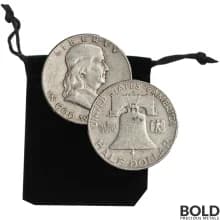

Affiliations










Copyright BOLD Precious Metals 2026
Stack pre-1965 US dimes, quarters, and half dollars — 90% US Constitutional silver bags and rolls at the lowest premiums in the industry. BOLD Precious Metals is an A+ BBB-rated bullion dealer trusted by more than 100,000 investors, with competitive live pricing against silver spot, full transparency on every face value lot, fully insured delivery, and a 100% authenticity guarantee on every order.
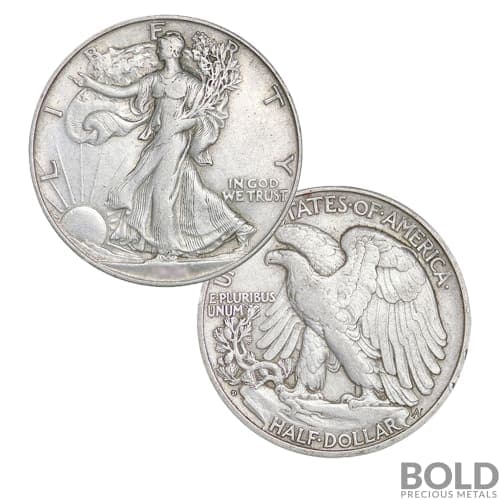
90% Silver - $0.50 FV Liberty Walking Half Dollars Circulated/Junk
In Stock
AS LOW AS
$33.03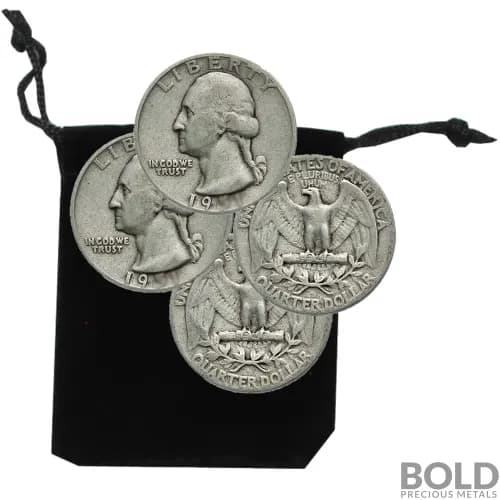
90% Silver - $1 FV Washington Quarter Circulated
Out of Stock
The word "junk" is misleading. Junk silver coins are genuine United States Mint coins struck in 90% silver before 1965. The term simply means they carry no numismatic or collectible premium — you are not paying for rarity, grade, or condition. You are paying for the silver itself, at the lowest available premium over spot.
Constitutional silver refers to the same coins. The name comes from Article I, Section 10 of the U.S. Constitution, which designates gold and silver as legal tender. These coins — Mercury Dimes, Roosevelt Dimes, Washington Quarters, Franklin Half Dollars, Walking Liberty Half Dollars, and the 1964 Kennedy Half Dollar — were the everyday currency of America for decades. Today they are the preferred fractional silver vehicle for serious stackers.
Key Formula
Every $1.00 of face value in 90% junk silver coins contains approximately 0.715 troy ounces of pure silver — regardless of denomination. This ratio is fixed by US Mint production standards and is the universal pricing baseline for the entire constitutional silver market.
BOLD offers junk silver in multiple face value increments — each priced dynamically against the live silver spot price. The per-ounce premium drops as bag size increases, making larger lots significantly more cost-efficient for serious stackers.
| Face Value | Approx. Silver Content | Typical Premium Over Spot | Best For |
|---|---|---|---|
| $10 Face Value | ~7.15 troy oz | Highest per-oz | First-time stackers, barter prep |
| $50 Face Value | ~35.75 troy oz | Mid-range | Mid-level accumulators |
| $100 Face Value | ~71.5 troy oz | Lowest per-oz (retail) | Bulk buyers, wealth preservation |
| $1,000 Face Value | ~715 troy oz | Institutional-grade spread | High-volume investors |
Dealer Insight
The per-ounce premium gap between a $10 bag and a $100 bag can exceed 15% at the same dealer on the same day. Buy the largest lot your budget allows — the math always favors larger bags.
I've handled tens of thousands of 90% constitutional silver coins across every major denomination. Each coin type carries the same melt-value formula — the difference is denomination size, mintage history, and how fast local coin shops will cut you a check when you walk in.
1916–1945 — Most Iconic Design
One of the most iconic American coin designs. Mercury Dimes contain 0.07234 troy oz of pure silver each and are a favorite for their historical appeal and affordable fractional size. They trade at spot-adjacent premiums across every major bullion dealer network.
1946–1964 — Fastest Liquidation
The most liquid fractional silver unit in existence. Any coin shop in America will quote a buy price in under two minutes — no verification required. If you need to liquidate a small silver position quickly, Roosevelt Dimes are your fastest exit. Each contains 0.07234 troy oz of silver.
1932–1964 — Market Workhorse
The workhorse denomination of the junk silver market. At 0.18084 troy oz per coin, a standard $10 face value roll of 40 quarters contains roughly 7.23 troy oz of silver. Washington Quarters are the most commonly requested coin type at coin shops nationwide — instant liquidity, zero friction.
Overlooked Fact
Washington Quarters minted 1932–1964 have a combined mintage exceeding 5 billion coins. That scale of original production is why junk silver quarters trade without friction — the supply guarantees instant global recognizability.
1916–1947 — Most Beautiful Design
One of the most recognizable American coin designs. Walking Liberty Half Dollars contain 0.36169 troy oz of silver each. At BOLD, our Walking Liberty inventory is priced at bullion rates — you pay for silver weight, not condition grading.
1948–1963 — Dealer Preferred
The dealer's preferred coin for large-lot buyback transactions. Franklin Halves have consistent silver content across the full production run, no grading ambiguity, and zero collector argument in a buyback negotiation. Each contains 0.36169 troy oz of silver. Buy at melt, sell at melt — clean and efficient.
1964 Only — Final 90% Year
The final year of 90% silver Kennedy production. Contains the same 0.36169 troy oz of silver as a Franklin Half Dollar — the buyback market treats them identically. BOLD clearly distinguishes 1964 (90%) from 1965–1970 Kennedy Half Dollars (40% silver), so you always know exactly what you are purchasing.
Dealer Warning — 1964 vs. 1965–1970 Kennedy Mix-Up
The 1964 vs. 1965–1970 Kennedy Half Dollar mix-up is the most common error in junk silver transactions. At 0.36169 oz vs. 0.1479 oz per coin, the silver content difference is nearly 60%. Only buy from dealers — like BOLD — who label every lot explicitly by purity and segregate 40% and 90% inventory clearly.
There's a reason junk silver has been the backbone of serious silver stacks for three generations. These are the six structural advantages that separate constitutional silver from every other retail bullion format.
The price of a junk silver bag follows a formula the entire market uses: Face Value × 0.715 troy oz per dollar × Current Silver Spot Price + Dealer Premium. At BOLD, our dealer premium on junk silver is among the tightest in the industry — and our live pricing engine updates automatically as spot moves throughout the trading day.
90% Silver Melt Value Formula
Everything you pay above the melt value result is the dealer premium. At BOLD, we show you the math transparently so you can verify it yourself before you buy.
~7.15 oz silver. Entry-level lot. Higher per-oz cost; easiest budget to clear.
~71.5 oz silver. Lowest retail per-oz premium. Maximum divisibility on exit.
~715 oz silver. Tightest spread available retail. For high-volume investors.
Premium Reference
Typical premium on a $100 face bag runs 5–12% over melt versus 15–25%+ on Silver Eagles or silver rounds. The premium on junk silver bags also compresses when spot rises rapidly — buying during a flat or slowly rising spot environment typically gives the tightest entry.
Both are excellent forms of physical silver but serve different purposes in a stacking strategy. Understanding the tradeoff helps you allocate your dollars efficiently.
| Feature | Junk Silver Coins | 100 oz Silver Bars | Silver Rounds (1 oz) |
|---|---|---|---|
| Premium Over Spot | 5–12% (large lots) | Lowest available | Moderate |
| Divisibility | Excellent — coin by coin | None — all-or-nothing sale | Good — oz by oz |
| Assay Required | Never — US Mint origin | Sometimes — private mint | Sometimes — private mint |
| Legal Tender Status | Yes | No | No |
| Best For | Liquidity, barter, flexibility | Bulk accumulation, cost efficiency | Balanced stacking |
Stacker Strategy
Many experienced investors hold both. Junk silver for instant liquidity and partial exits; 100 oz silver bars for maximum cost-per-ounce efficiency on bulk accumulation. The two products are complementary — not competing — in a well-structured precious metals portfolio.
Buying junk silver in bulk requires a dealer you can trust. Worn coins, short-weight bags, and mixed-purity lots are real risks when purchasing from unknown sources. At BOLD, we eliminate that uncertainty with a rigorous verification process before any bag ships to your door.
Store junk silver in coin rolls, plastic tubes, or canvas bags in a cool, dry environment. Humidity is the primary threat — toning and surface changes on circulated 90% silver do not affect melt value or dealer buyback pricing at the primary dealer level, but can cause hesitation at local shops. Keep bags sealed in a stable environment. Surface condition does not affect melt value at any primary dealer.
When you are ready to liquidate, BOLD's Sell to Us program offers competitive buy-back prices on all constitutional silver with no assay requirement. Because these are official pre-1965 US Mint coins, purity is self-evident. Selling junk silver back to a primary bullion dealer is the fastest liquidation process in physical precious metals.
Dealer Insight
Most customers who sell junk silver back to BOLD do so in partial lots — keeping a core holding while liquidating enough to cover near-term cash needs. When you need $500 in liquidity from your silver position, a junk silver bag gives you a clean partial exit. A 100 oz silver bar gives you an all-or-nothing decision.
Junk silver is priced for stackers — pure silver weight at the lowest premium over spot. If you are instead looking for 90% silver coins in mirror-finish collector condition with original US Mint packaging — birthday gifts, complete set runs, collector holdings — those are a different product category. Browse BOLD's proof 90% silver coins collection for US Mint proof sets and individual proof coins.
The term junk refers strictly to numismatic value — these coins have no collector premium, no grading upside, no mint-state appeal. You pay for silver weight at melt-adjacent prices. Junk silver coins are pre-1965 US dimes, quarters, and half dollars with 90% silver content, officially issued by the US Mint and universally recognized by every bullion dealer worldwide.
Every $1.00 of face value in 90% junk silver coins contains approximately 0.715 troy ounces of pure silver. A $10 face value bag holds ~7.15 troy oz, a $100 bag holds ~71.5 troy oz, and the classic $1,000 face value monster bag contains approximately 715 troy oz of silver.
Yes. Pre-1965 US dimes, quarters, and half dollars remain legal tender at face value. Their silver melt value is many times higher than their face value at current spot prices — but the legal tender status provides a price floor that no private mint product can offer. In practice, no one spends a 1964 Roosevelt Dime as a ten-cent coin.
US dimes, quarters, and half dollars minted through 1964 are 90% silver. Kennedy Half Dollars struck 1965–1970 are only 40% silver — nearly 60% less silver per coin at the same physical size (0.36169 oz vs. 0.1479 oz). BOLD clearly labels all listings by silver composition so you always know exactly what purity you are purchasing.
Both serve different purposes. Junk silver offers superior divisibility and instant global recognition, making it ideal for stackers who want flexible liquidity and partial exits. 100 oz silver bars typically carry the lowest premiums per ounce and are better suited for long-term bulk accumulation. Many investors hold both to balance cost efficiency with exit flexibility.
Store in coin rolls, plastic tubes, or canvas bags in a cool, dry location. Junk silver coins are circulated and do not require airtight capsules. A home safe or bank safe deposit box are both popular options. The coins maintain their full silver melt value regardless of surface appearance or handling.
No. Pre-1965 US Mint coins require no third-party assay at any reputable dealer. The government origin is your authentication. BOLD's Sell to Us program offers competitive, transparent buy-back prices on all constitutional silver — no paperwork, no lab wait times, no documentation burden.
BOLD prices all junk silver in real time using the formula: Face Value × 0.715 troy oz per dollar × Live Silver Spot Price + Dealer Premium. Prices update automatically throughout the trading day. You always see an accurate, live price before committing to a purchase — no hidden fees, no stale pricing.
No. Pre-1965 junk silver coins do not meet IRS purity requirements for a Precious Metals IRA (which requires .999 or higher fineness). For IRA-eligible silver, browse BOLD's selection of IRA-approved silver products including American Silver Eagles and silver bars from approved refiners.