
Affiliations











Copyright BOLD Precious Metals 2026
Buy the world-famous Austrian Philharmonic minted in Austria in pure .9999 gold. Purchase with confidence from BOLD Precious Metals, an A+ BBB-rated, family-owned dealer trusted by over 100,000 customers since 2015. Enjoy secure checkout, insured shipping, and guaranteed authenticity.
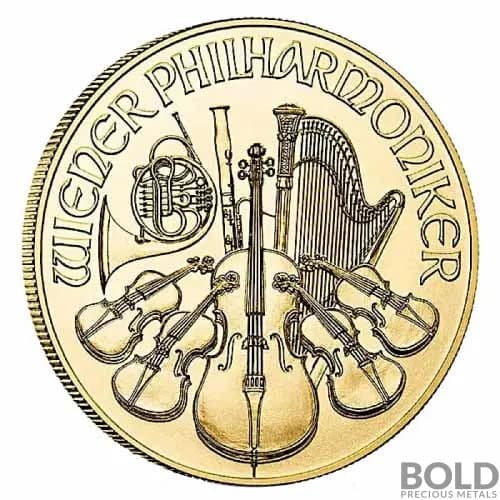
2023 Gold 1/2 oz Austria Philharmonic BU
Out of Stock
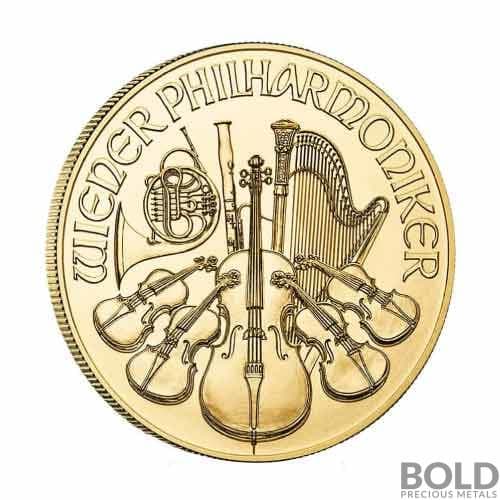
2023 Gold 1/4 oz Austria Philharmonic BU
Out of Stock
2023 Gold 1/10 oz Austria Philharmonic BU
Out of Stock
2023 Gold 1 oz Austria Philharmonic BU
Out of Stock
2022 Gold Austrian Philharmonic - 1/25 oz
Out of Stock
2022 Gold Austria Philharmonic - 1/2 oz
Out of Stock
2022 Gold Austria Philharmonic - 1/4 oz
Out of Stock
2022 Gold Austria Philharmonic - 1/10 oz
Out of Stock
2022 Austria Philharmonic 1 oz Gold BU
Out of Stock
2021 Austria Philharmonic 1 oz Gold BU
Out of Stock
2020 Gold Austria Philharmonic - 1/10 oz
Out of Stock
2020 Gold Austrian Philharmonic - 1 oz
Out of Stock
2019 Gold Austrian Philharmonic - 1 oz
Out of Stock
2017 Gold Austrian Philharmonic - 1 oz
Out of Stock
2016 Gold Austrian Philharmonic - 1 oz
Out of Stock
2021 Gold Austria Philharmonic - 1/2 oz
Out of Stock
2021 Gold Austria Philharmonic - 1/4 oz
Out of Stock
The Austrian Mint issues the Philharmonic in four primary denominations. Each serves a distinct investment strategy. Here's how they compare:
| Size | Gold Content | Face Value (EUR) | Best For | IRA Eligible |
|---|---|---|---|---|
| 1 oz | 31.1g / .9999 | €100 | Core holding, lowest per-oz premium, IRA stacking | Yes |
| 1/2 oz | 15.55g / .9999 | €50 | Mid-tier portfolio balancing, flexible gifting | Yes |
| 1/4 oz | 7.78g / .9999 | €25 | Incremental stacking, first gift to a new investor | Yes |
| 1/10 oz | 3.11g / .9999 | €10 | Entry-level investing, barter liquidity, starter coins | Yes |
Note on the 1/25 oz
The Austrian Mint introduced a 1/25 oz Philharmonic in 2014, though availability through most dealers — including BOLD — is extremely limited. For the most practical fractional entry point, the 1/10 oz remains the better buy for new stackers.
Dealer Insight — Ryan Cochran
"The size decision is the most common mistake I see buyers make. The premium gap between the 1 oz and the 1/10 oz can run 4–6% depending on market conditions — and that difference compounds across a large position. If your goal is pure gold accumulation, always buy the largest denomination your budget allows. The 1/10 oz is a legitimate starter coin and serves a real role in barter liquidity scenarios, but don't let sentiment override the math when you're scaling up."
One of the most underappreciated advantages of the Philharmonic is its premium structure. Because the coin is struck in .9999 fine (24-karat) gold — not a 22-karat alloy like the American Gold Eagle or South African Krugerrand — the Austrian Mint's fabrication process is simpler, and that savings gets passed through to buyers in the form of tighter premiums over spot.
For buyers whose objective is gold accumulation rather than numismatic value, the Philharmonic is typically the smarter cost-per-ounce buy when compared side by side with its closest competitors:
| Coin | Purity | Typical Premium Over Spot (1 oz) |
|---|---|---|
| Austrian Gold Philharmonic | .9999 (24K) | 3%–5% |
| American Gold Eagle | .9167 (22K) | 5%–8% |
| Canadian Gold Maple Leaf | .9999 (24K) | 3%–5% |
| South African Krugerrand | .9167 (22K) | 4%–6% |
Live Pricing Note
Premiums fluctuate with market conditions and order volume. Check BOLD's live pricing above for current rates on each size.
Ryan Cochran — Bold Precious Metals
"The Philharmonic vs. American Gold Eagle debate comes down to what you're optimizing for. If you want the backing of U.S. legal tender status — relevant for certain domestic estate and legal contexts — the Eagle wins. If you want the most gold per dollar spent, the Philharmonic wins on purity and premium almost every time. I've had customers come back after buying Eagles for years and switch to Philharmonics once they ran the numbers. The math is hard to argue with."
All Austrian Gold Philharmonic coins sold by BOLD Precious Metals meet IRS requirements for inclusion in a self-directed Gold IRA under IRC Section 408(m). To qualify, a gold coin must meet the .9995 minimum fineness threshold — the Philharmonic's .9999 purity exceeds this standard comfortably, making it one of the cleanest IRA-eligible gold coins available from any sovereign mint.
The Philharmonic's purity clears the IRA fineness bar by a comfortable margin — no eligibility ambiguity.
Fractional sizes are IRA-eligible, but higher per-ounce premiums on fractionals mean real added cost inside your retirement account over time.
IRA Buyer Action Item
BOLD works with leading IRA custodians and can facilitate direct IRA transfers and rollovers. If you are routing this purchase into a self-directed Gold IRA, contact our team before completing checkout so we can direct your order correctly and ensure IRS compliance on segregated storage.
The Philharmonic's design was created by Austrian Mint Chief Engraver Thomas Pesendorfer in 1989 — and it has not changed since. In a market where mints regularly rotate designs to stimulate collector demand and command higher premiums, the Austrian Mint has held firm on consistency for over three decades. That is not an oversight — it is a deliberate liquidity asset.
Obverse
The Great Organ of the Musikverein — Vienna's legendary concert hall in the Innere Stadt district. Completed in 1870, the organ features over 7,800 pipes across four manual divisions. The inscription reads REPUBLIK ÖSTERREICH along with the coin's face value.
Reverse
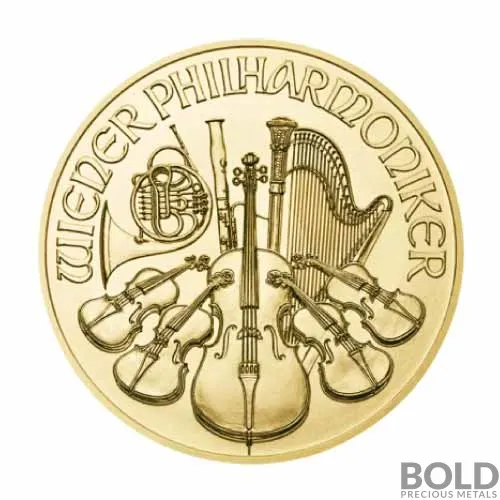
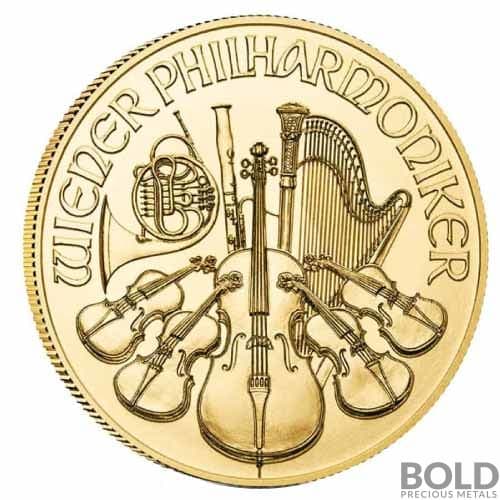
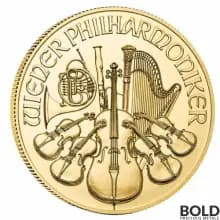
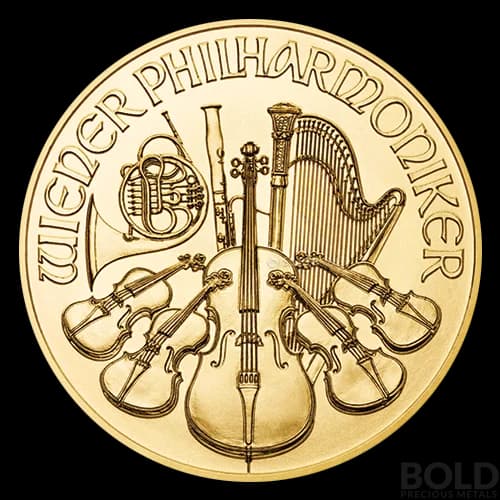
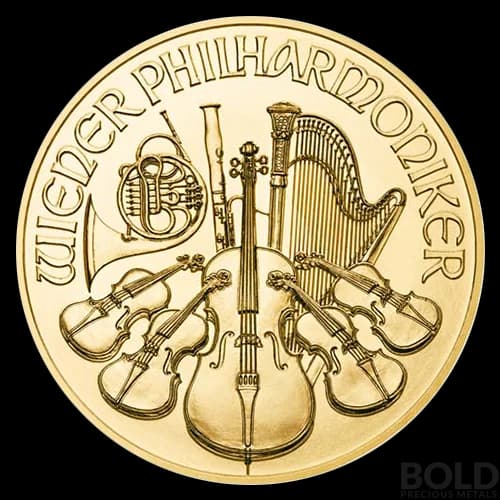
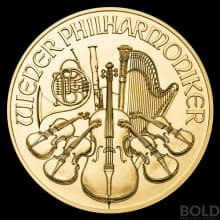
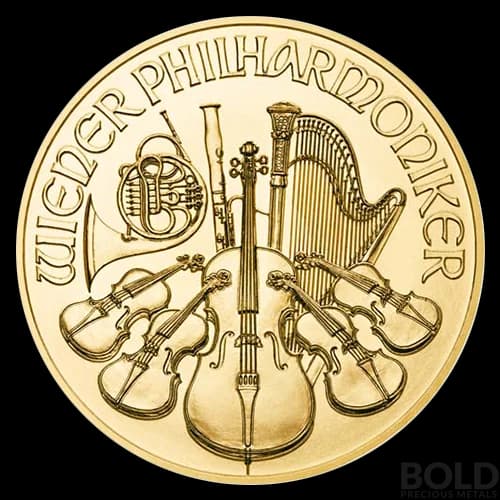
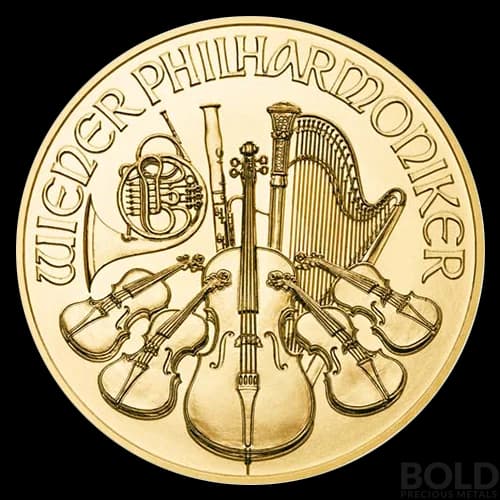
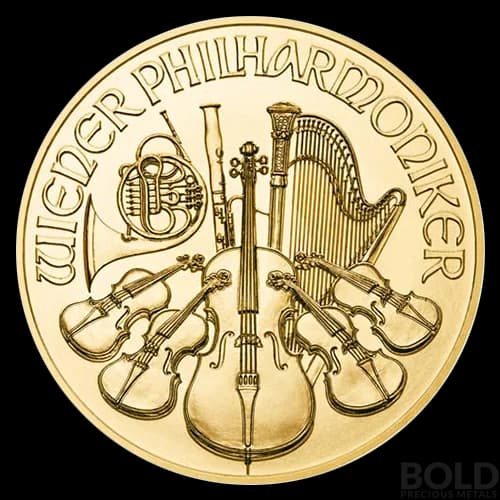
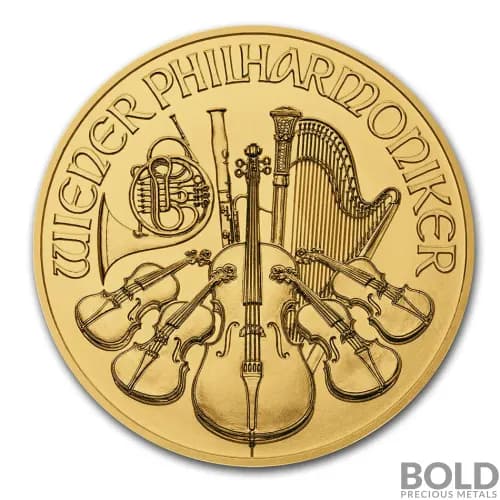
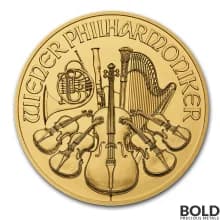
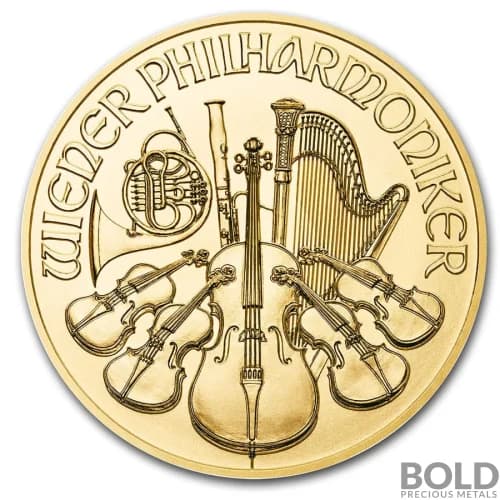
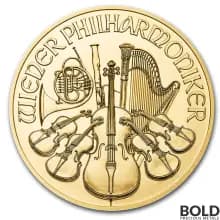
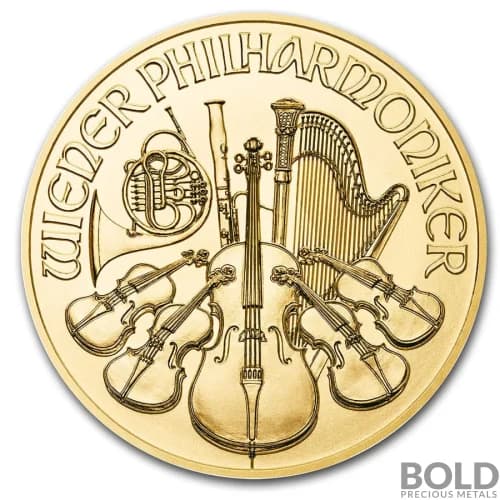
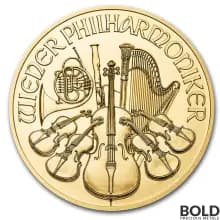
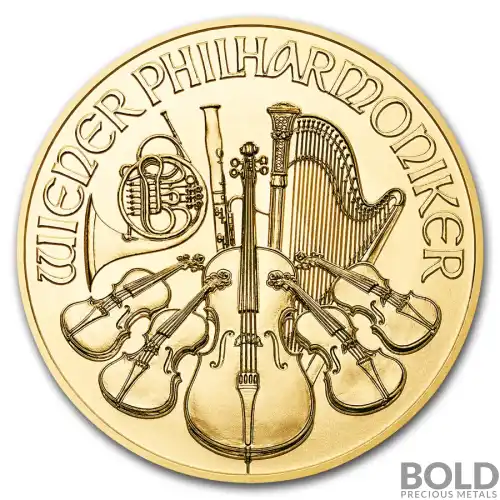
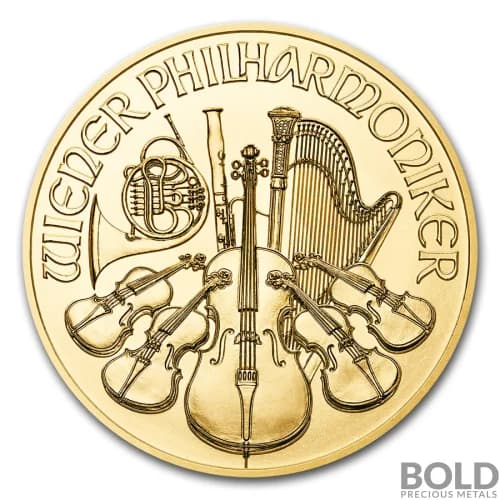
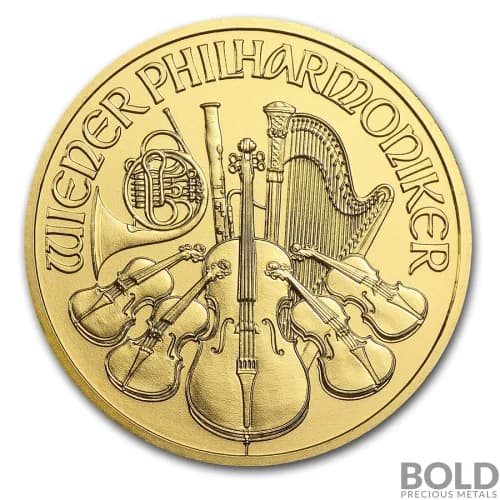
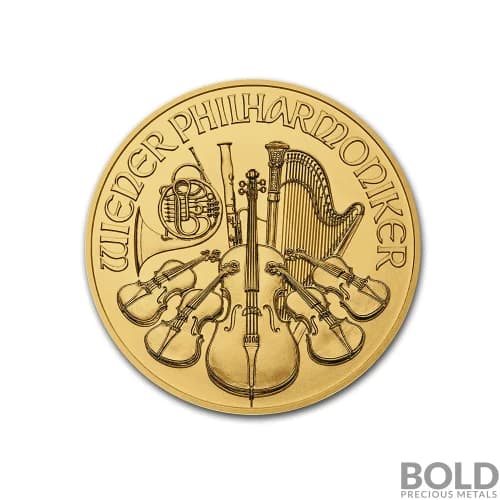
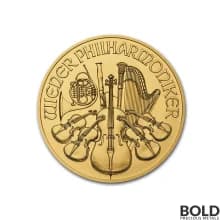
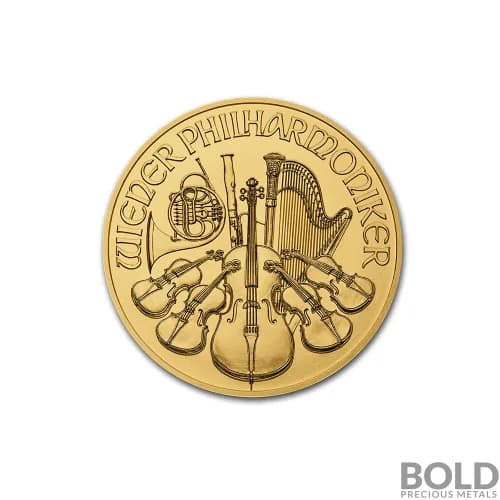
Eight classical instruments associated with the Vienna Philharmonic Orchestra — violin, cello, harp, French horn, bassoon, and others — arranged in an arc. The inscription reads WIENER PHILHARMONIKER along with weight, fineness, and year of issue. The Vienna Philharmonic was constituted in 1842, one of the oldest continuously performing orchestral bodies in the world.
Overlooked Fact — Pre-Euro Philharmonics
When the Philharmonic launched in 1989, its face value was denominated in Austrian Schillings — 2,000 ATS for the 1 oz coin. Austria's adoption of the Euro in 2002 converted all subsequent denominations to Euros (€100 for the 1 oz). Pre-2002 Schilling-denominated Philharmonics are occasionally sought by collectors interested in pre-Euro European monetary history — but for investment purposes they carry identical gold content and .9999 purity to post-2002 issues.
Dealer Insight — Ryan Cochran
"Consistent design is dramatically underrated by new buyers. When you go to sell, a coin that every dealer in the world recognizes on sight moves faster and at tighter spreads than a limited-edition or annually rotating design. I've seen Philharmonics liquidated in minutes at spot-adjacent prices in markets where lesser-known coins sat for days. The decades of unchanged design are a real-world liquidity advantage — and it's one I factor into recommendations for buyers who plan to exit their positions in 5 to 10 years."
The Austrian Mint (Münze Österreich) traces its origins to 1194 — one of the oldest operating mints in the world. Based in Vienna, the mint operates as a subsidiary of the Austrian National Bank and produces all Austrian legal tender coinage in addition to the Philharmonic bullion series. Its institutional credibility is not marketing language: the mint's sovereign backing and 800-year operating history make every Philharmonic it strikes a product of genuine governmental authority.
Did You Know? — The "Big Phil"
For collectors interested in institutional extremes: the Austrian Mint also produced the "Big Phil" — a commemorative 1,000 troy ounce gold coin measuring 37 cm in diameter and 2 cm thick, issued in 2004. While not a standard investment product, its existence demonstrates the Austrian Mint's technical capabilities and commitment to the Philharmonic brand at every scale.
Family-owned since 2015 and built on over 100,000 verified customer orders, BOLD Precious Metals is a dealer you can verify — not just trust.