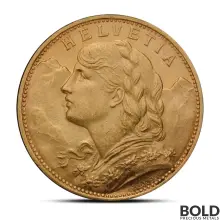
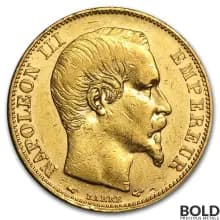
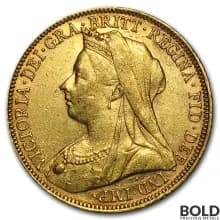
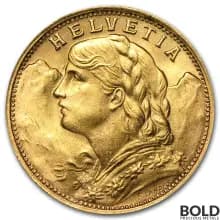
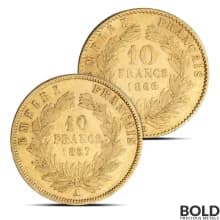
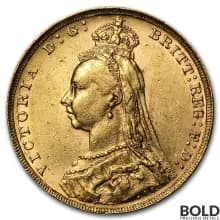
This category covers two distinct buying opportunities that deserve separate consideration. Historic European gold coins, French 20 Francs, Victorian Sovereigns, Dutch Guilders, carry .900 fine gold at near-spot premiums, with the added dimension of 19th-century minting history that no modern coin can replicate. Modern world sovereign coins, Austrian Philharmonic, South African Krugerrand, Perth Mint Kangaroo, carry .9167 to .9999 fine gold, IRA-eligible status, and active dealer buyback markets on every continent. The Philharmonic and Krugerrand consistently trade at tighter premiums over spot than the American Gold Eagle. The buyer's guide below covers both categories.

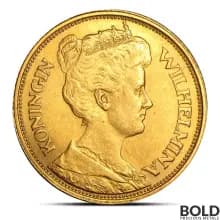
Netherlands 5 Guilder Gold Coin (Avg. Circ)
Out of Stock

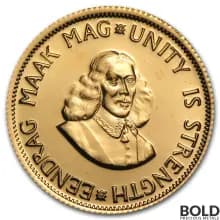
Gold World South African 2 Rand
Out of Stock

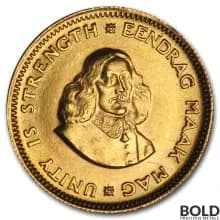
Gold World South African 1 Rand
Out of Stock

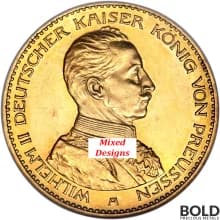
Gold World German 20 Mark
Out of Stock

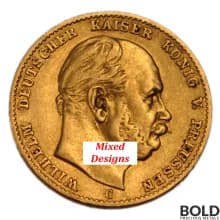
10 Mark German Gold Coin (Random Year)
Out of Stock

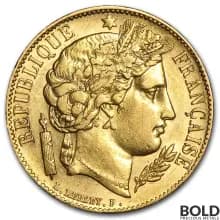
Gold World French 20 Franc Ceres
Out of Stock

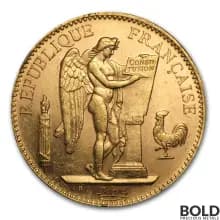
Gold World French 100 Franc
Out of Stock

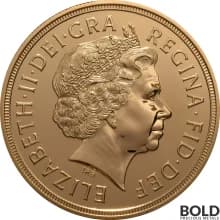
Gold World English 5 Pound Sovereign
Out of Stock

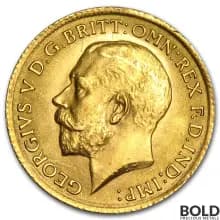
Gold World English 1/2 Sovereign
Out of Stock

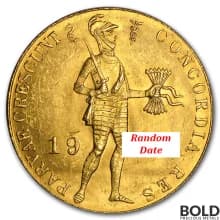
Gold World Dutch 1 Ducat - 0.1109 oz
Out of Stock

Premium over spot price — what you pay above the raw gold melt value — is the number that actually matters when you're buying bullion. In this category, two coins consistently beat the American Gold Eagle on premium efficiency: the Austrian Philharmonic and the South African Krugerrand.
The Philharmonic has been the best-selling gold coin in Europe since its debut in 1989. Struck by the Austrian Mint to .9999 fineness, it routinely trades at 1–3% over spot in standard market conditions. The Krugerrand, first minted in 1967 as the world's original gold bullion coin, carries a 22-karat (.9167 fine) composition identical to the American Gold Eagle — but trades at lower premiums for the same gold content.
Dealer Insight — The Krugerrand's 22-Karat "Problem"
Investors sometimes hesitate on the Krugerrand because of its 22-karat composition versus a .9999 fine coin. Here's what that actually means: a 1 oz Krugerrand contains exactly 1 troy ounce of fine gold — the coin itself is slightly heavier because copper alloy is added for durability. You're not getting less gold. You're getting the same gold in a harder, more scratch-resistant coin that's been trading in global dealer networks for over 50 years. In terms of international liquidity, the Krugerrand may be the most universally recognized gold coin in existence.
All six coins below are government-minted, globally recognized, and available at BOLD. Premiums fluctuate with spot price movements and market demand — check live product listings for current pricing.
| Coin | Purity | Weight | Typical Premium | Best For |
|---|---|---|---|---|
| Austrian Philharmonic | .9999 fine | 1 oz | 1–3% over spot | Premium-conscious investors, EU liquidity |
| South African Krugerrand | .9167 (22k) | 1 oz | 1–4% over spot | First-time world coin buyers, global liquidity |
| Chinese Gold Panda | .999 fine | 30g (˜0.965 oz) | 4–8% over spot | Collectors, Asian market exposure, annual designs |
| British Britannia | .9999 fine | 1 oz | 3–6% over spot | UK market liquidity, portfolio diversification |
| Perth Mint Kangaroo | .9999 fine | 1 oz | 2–5% over spot | Design collectors, strong dealer buyback demand |
| Royal Dutch Gold Lion | .9999 fine | 1 oz | 3–6% over spot | European portfolio diversification |
Teal-highlighted rows show the lowest-premium options for value-focused buyers. All prices at BOLD update live against the global spot market.
It depends entirely on what you're optimising for. Here's how to think about it clearly across three dimensions.
A 1 oz .9999 fine coin from the Perth Mint contains the same 31.1 grams of gold as one from the Royal Canadian Mint. The spot price doesn't care about the flag stamped on the reverse. For pure metal value, origin is irrelevant.
The Chinese Gold Panda commands consistent premiums in Asian markets. The British Britannia is the most liquid gold coin in the UK dealer market. If you're buying to resell in a specific geography, origin is a real and measurable variable.
The Austrian Philharmonic, South African Krugerrand, and Perth Mint Kangaroo are the three world gold coins I'd point any U.S.-based, premium-conscious buyer toward first. Strong buyback demand from U.S. dealers, recognized purity standards, and consistently low premiums at the 1 oz size.
Most bullion investors dismiss coin design as irrelevant to investment decisions. That's the wrong way to think about it. Design is directly tied to secondary market premiums on certain coins.
The Chinese Gold Panda changes its reverse design every year — a deliberate policy by the People's Bank of China in effect since 1982. The result: older Panda dates in original mint packaging consistently trade above current-year bullion premiums. A 2016 Gold Panda in original capsule is worth meaningfully more than a raw, uncapsulated example of the same year. This is one of the few bullion coins where keeping the original packaging directly affects resale value.
The Austrian Philharmonic maintains a consistent design — the great pipe organ of Vienna's Musikverein concert hall — which means no collector date premium, but also no risk of an older design trading at a discount. For pure bullion investors who want predictable pricing, consistency is the feature.
Overlooked Fact — Perth Mint Kangaroo
The Perth Mint's Kangaroo series also changes its reverse image annually, similar to the Panda, but with less aggressive premium stacking in the secondary market. This makes it a middle-ground option: design interest without the Panda's volatility on older dates. For buyers who want annual design variety without the collector premium risk, the Kangaroo is the play.
Four principles that separate buyers who build wealth in this market from those who overpay on every transaction.
Compare premiums to spot — not to face value
The legal tender face values on world gold coins (100 Euros on the Philharmonic, 50 Rand on the Krugerrand) are legally symbolic and bear no relationship to actual market value. The only number that matters is how much over the live gold spot price you're paying.
Prioritize 1 oz sizes for premium efficiency
Fractional world gold coins — 1/4 oz, 1/10 oz — carry significantly higher percentage premiums over spot, sometimes 2–4x the premium on the same coin in 1 oz format. Buy fractionals only when you have a specific reason (gifting, incremental stacking) and go full ounce whenever your budget allows.
Think about exit liquidity before you buy
The Philharmonic, Krugerrand, and Britannia are on BOLD's active buyback list alongside every major US dealer. Bids come back same-day. Niche coins from smaller mint programs require more time or deeper discounting to liquidate quickly at full value. If speed of exit matters, stick with the high-volume coins.
Mix origins for true portfolio diversification
Holding coins struck under different sovereignties, denominated in different currencies, from mints on different continents provides a layer of geopolitical and supply-chain diversification that a single-origin stack does not. This is real structural diversification — not just aesthetic variety.
IRA-Eligible World Gold Coins
IRS regulations require gold bullion coins to meet a minimum fineness of .995 for IRA eligibility. These coins qualify:
Contact our IRA team with questions about eligible world gold coins before placing your order.
Not IRA-Eligible
The Krugerrand's IRA ineligibility is its only meaningful limitation. For non-IRA stacking, it remains one of the strongest value plays in the 1 oz gold coin market — tighter premiums than any IRA-eligible equivalent.
After handling tens of thousands of ounces of world gold coins, here's how I'd match coin to buyer in this category.
.9999 fine, available in multiple sizes, some of the lowest premiums of any 1 oz gold coin on the market, IRA-eligible, and recognized by dealers on every continent. There's no scenario I've encountered in 15+ years where buying a Philharmonic was the wrong decision for a first-time world coin buyer.
The coin that invented the modern gold bullion market in 1967. Global dealer recognition is unmatched and premiums are competitive. The 22-karat composition is not a weakness — it's a feature if you ever plan to store or transport coins without capsules.
Annual design changes, strong Asian market demand, and a passionate collector community mean your coin can appreciate beyond its gold content over time. Keep it in original packaging. Buyers who accumulated early in closed Panda series have historically seen meaningful appreciation beyond melt value.
In most market conditions, the South African Krugerrand and Austrian Philharmonic consistently offer the lowest premiums over spot of any sovereign 1 oz gold coin. The Krugerrand typically trades at 1–4% over spot; the Philharmonic at 1–3%. Both have deep secondary markets globally. If premium minimization is your primary goal, these two coins are the benchmarks.
No. The Krugerrand's .9167 (22-karat) composition falls below the IRS minimum .995 fineness threshold for precious metals IRA inclusion. For IRA-eligible world gold coins, the Austrian Philharmonic, British Britannia, Perth Mint Kangaroo, and Chinese Gold Panda all qualify. Contact our IRA team for eligible product recommendations.
No — not when it's labeled as a 1 oz coin. A 1 oz 22-karat Krugerrand or American Gold Eagle contains exactly 1 troy ounce (31.1 grams) of pure gold. The coin itself is heavier than a .9999 fine coin because copper and silver alloy is added to reach 22-karat composition — but the fine gold content is identical. You're getting the same gold in a more durable, scratch-resistant format.
For mainstream world coins — Krugerrands, Philharmonics, Maple Leafs, Kangaroos — yes, essentially. Every major U.S. bullion dealer (including BOLD) recognizes and buys these coins without hesitation. The American Gold Eagle may command a slight premium in local coin shop transactions due to stronger domestic brand recognition, but for serious buyback programs, the difference is minimal. Niche world coins from smaller mint programs carries wider bid-ask spreads.
Starting in 2016, China switched the Gold Panda from a 1 troy ounce (31.1 gram) standard to a 30-gram metric standard to align with China's domestic measurement system. The 30-gram Panda contains approximately 0.9645 troy ounces of gold. Pre-2016 Pandas were struck at 1 troy ounce — a distinction that matters for value calculations and IRA eligibility confirmations. Always verify weight when comparing Panda years.
Yes. BOLD's buyback program covers all major world gold coins including Krugerrands, Philharmonics, Britannias, Kangaroos, and Gold Pandas. Coins in original mint packaging or capsules receive our best buyback rates. Request a quote online for a same-day offer — you're never locked into an illiquid position when you buy from BOLD.
Government Mints · Live Pricing · Real Buyback Program
A+ BBB-rated · 100,000+ Investors Served · Price-Match Guarantee · IRA-Eligible Options · Free Insured Shipping $199+


Affiliations


Copyright BOLD Precious Metals 2026