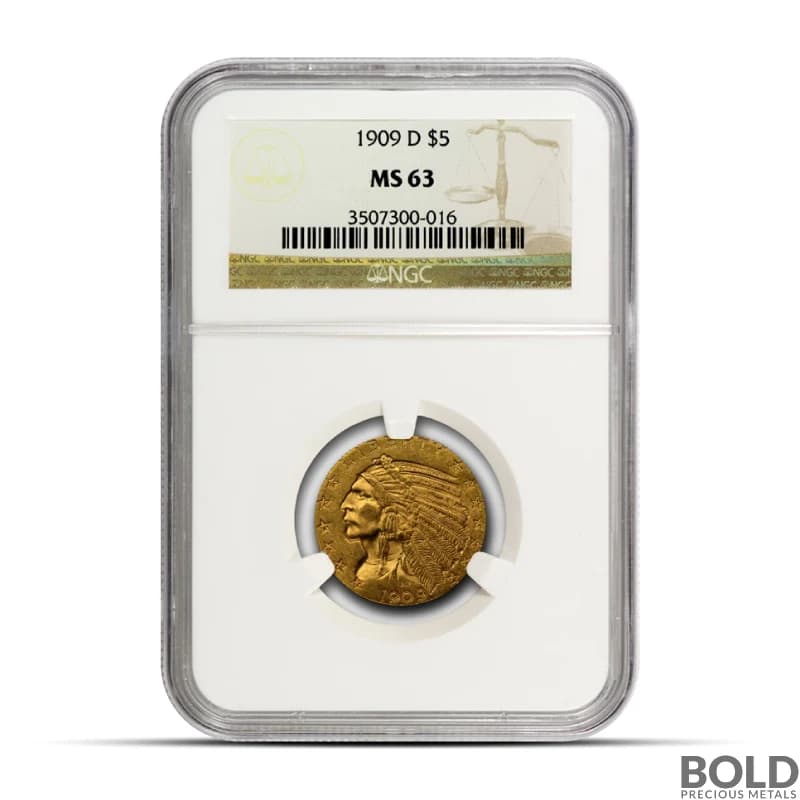
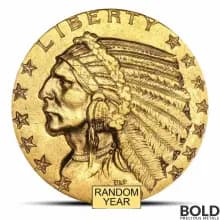
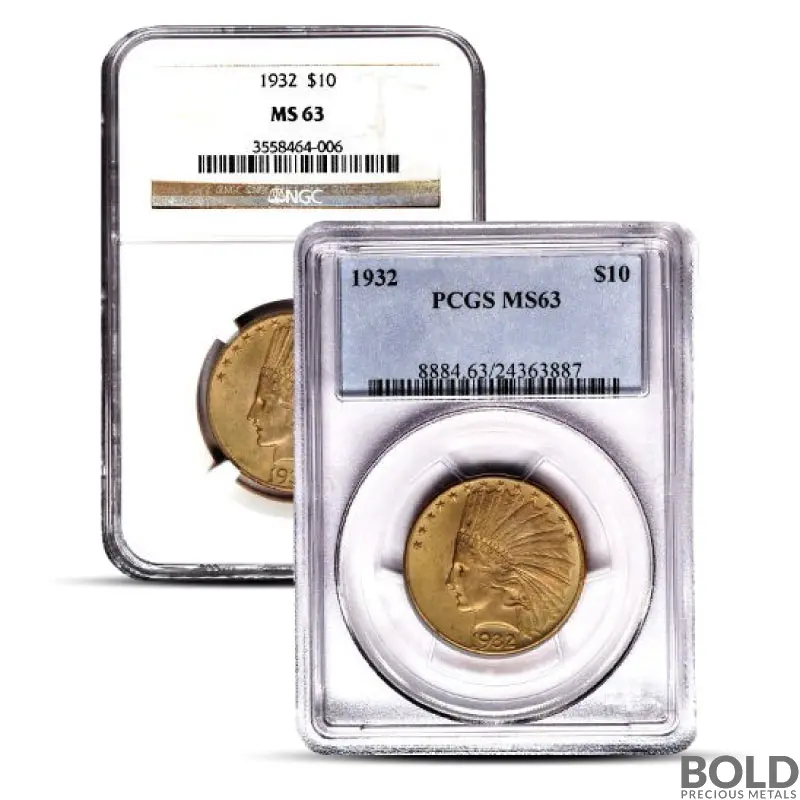
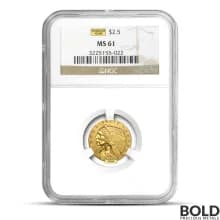
Discover a pivotal piece of American history with our curated collection of authentic Pre-1933 Indian Head Gold Coins for sale. Hailed as some of the most beautiful and innovative coins ever produced by the U.S. Mint, these stunning pieces represent a ""renaissance in American coinage"" driven by President Theodore Roosevelt. Each Indian head coin gold piece is struck from a durable composition of 90% gold and 10% copper, making it a valuable addition to any collection or investment portfolio. Secure your tangible piece of the nation's heritage today.
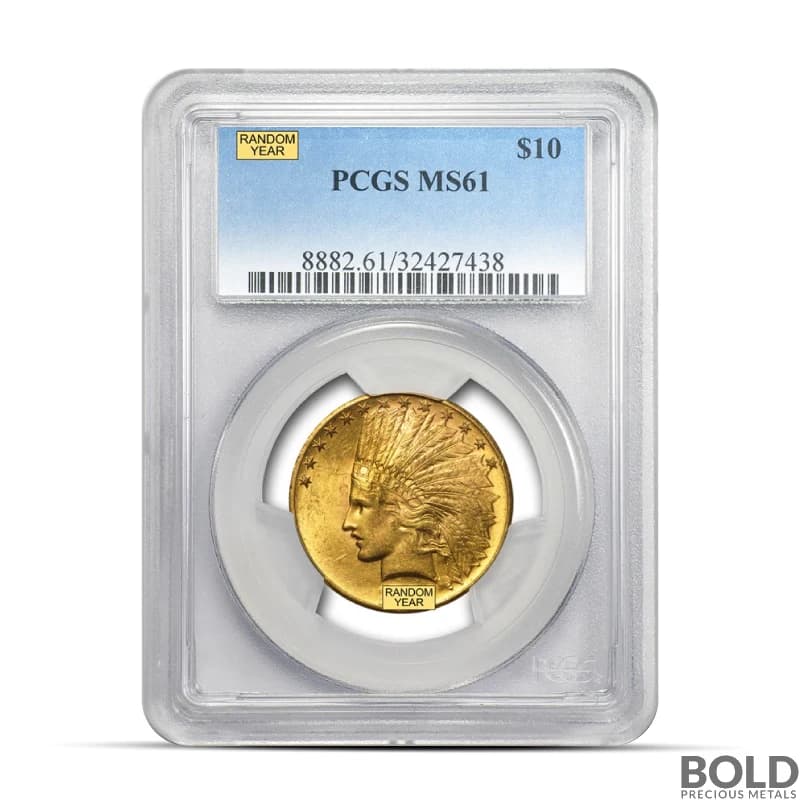
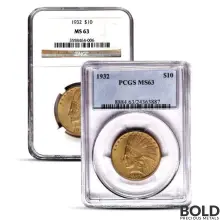
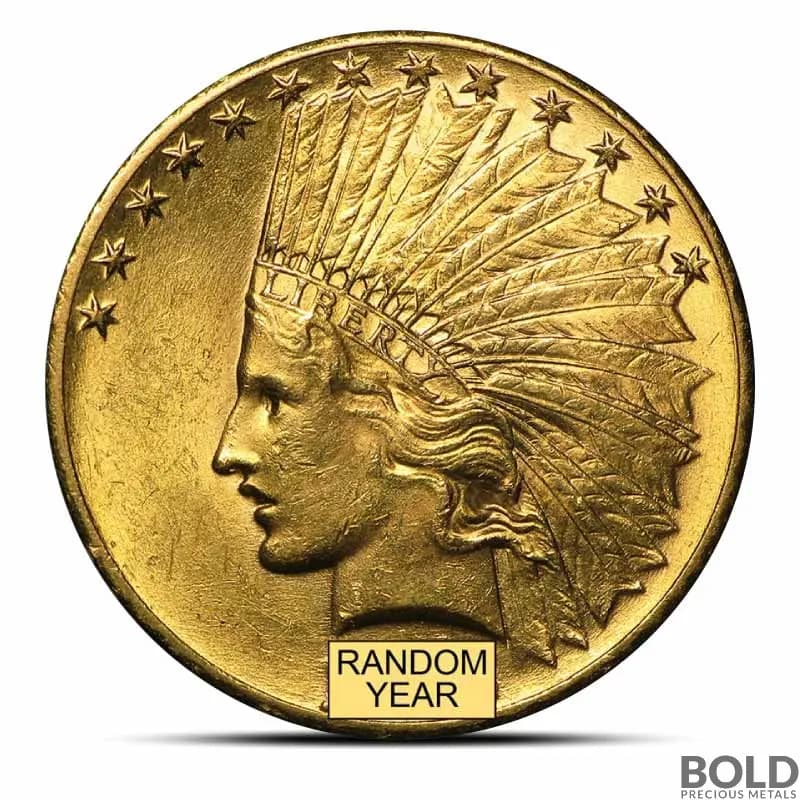
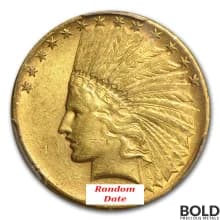
$10 Indian Gold Eagle Coin (MS61, NGC or PCGS, Random)
In Stock
AS LOW AS
$2,604.37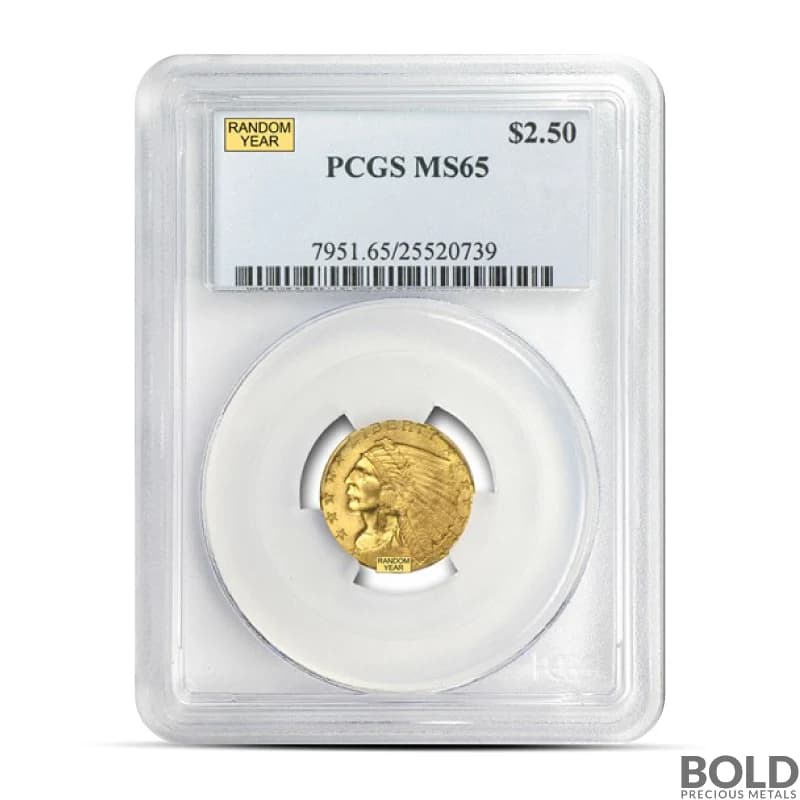
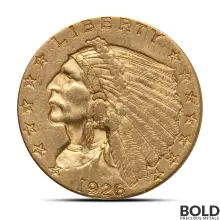
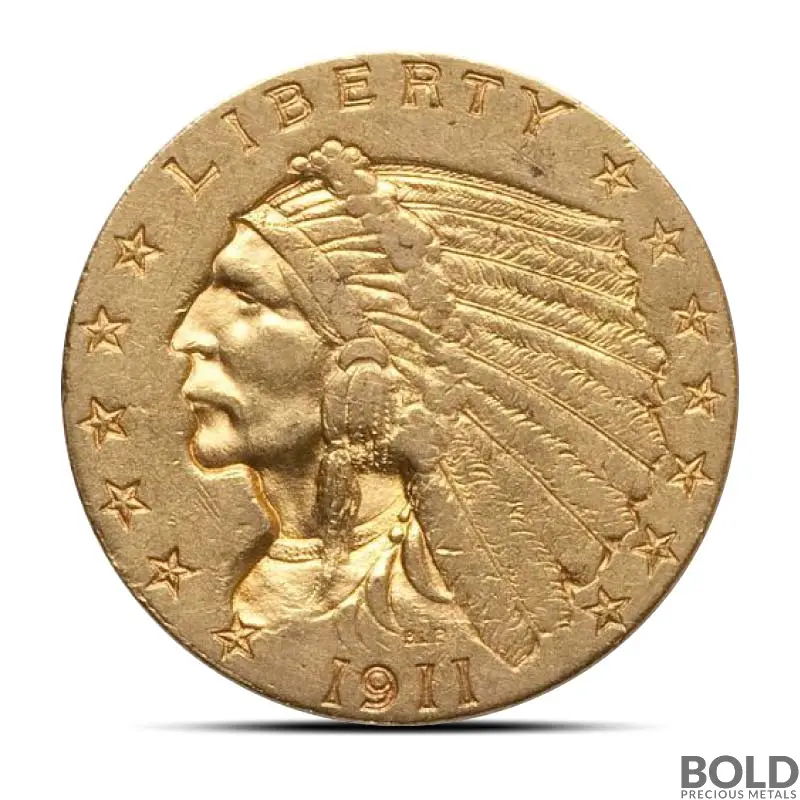
$2.50 Indian Quarter Gold Eagle Coin (MS65, NGC or PCGS, Random)
In Stock
AS LOW AS
$1,810.28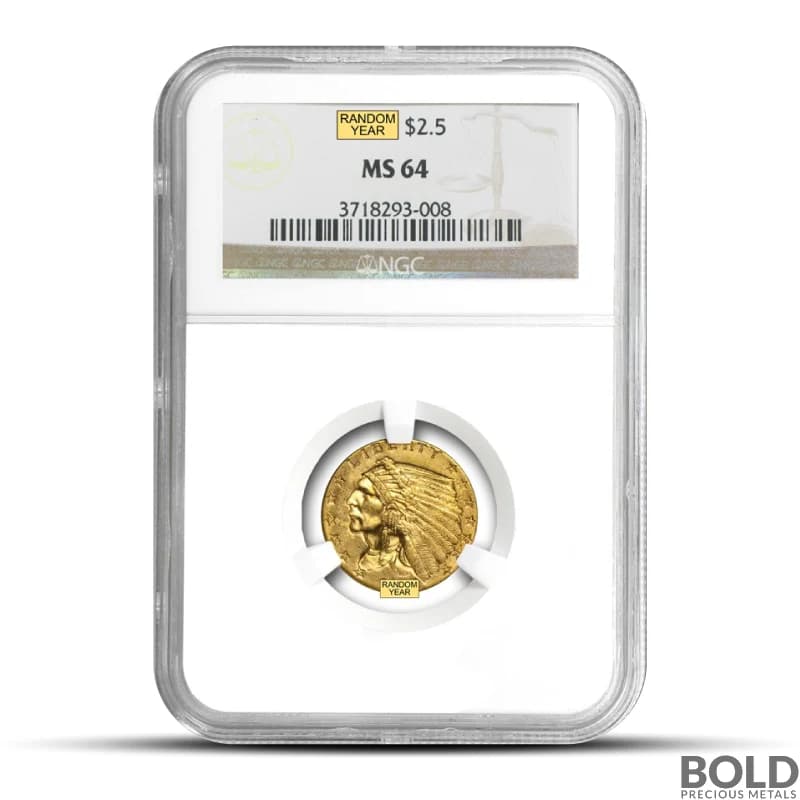
$2.50 Indian Quarter Gold Eagle Coin (MS64, NGC or PCGS, Random)
In Stock
AS LOW AS
$1,047.41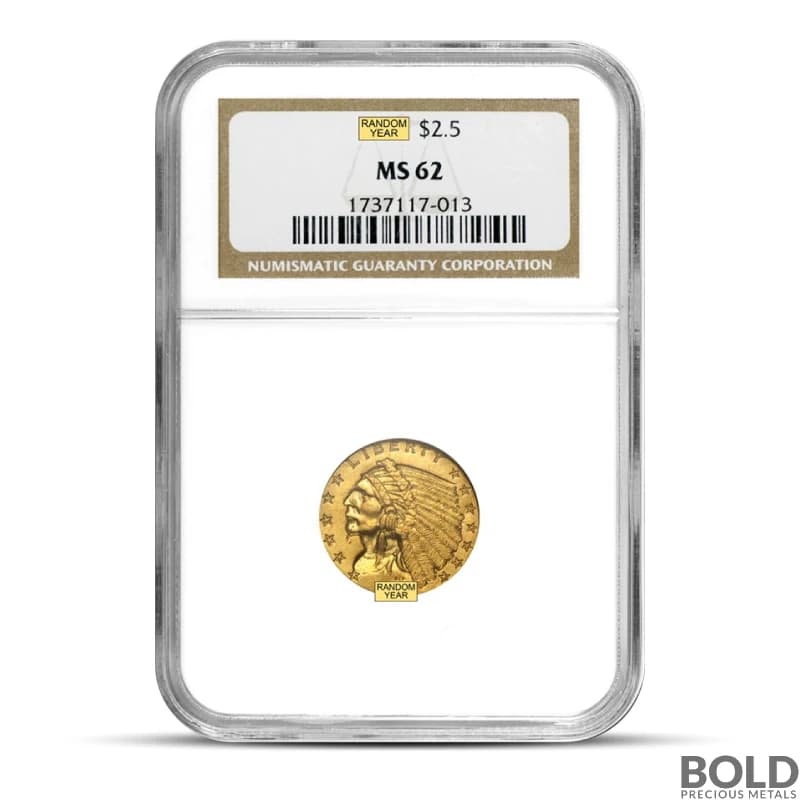
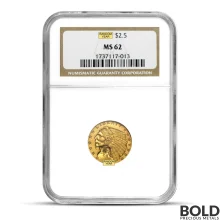
$2.50 Indian Quarter Gold Eagle Coin (MS62, NGC or PCGS, Random)
In Stock
AS LOW AS
$862.43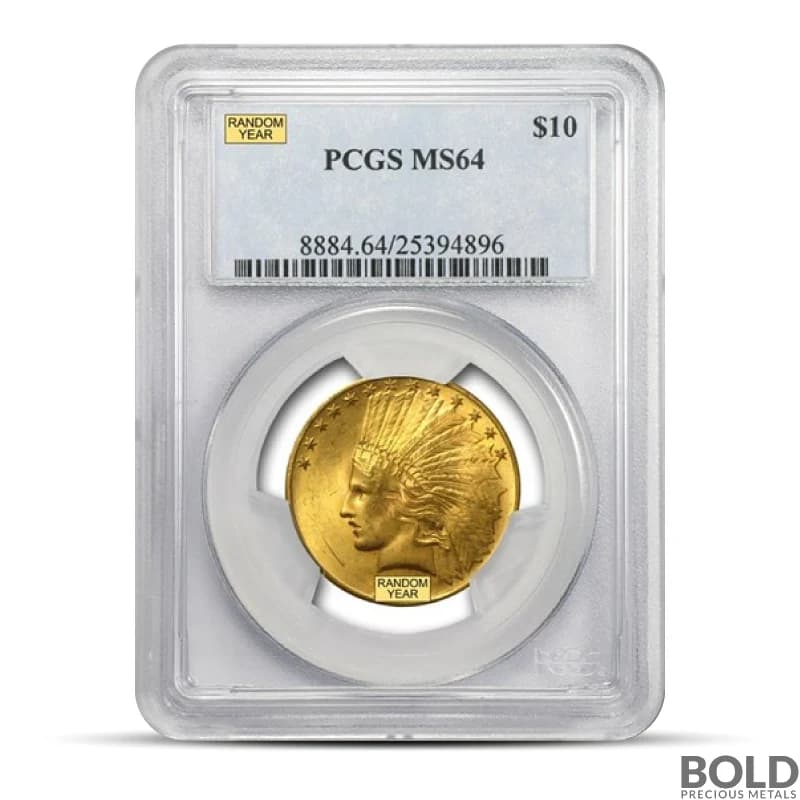
$10 Indian Gold Eagle Coin (MS64, NGC or PCGS, Random)
In Stock
AS LOW AS
$2,739.95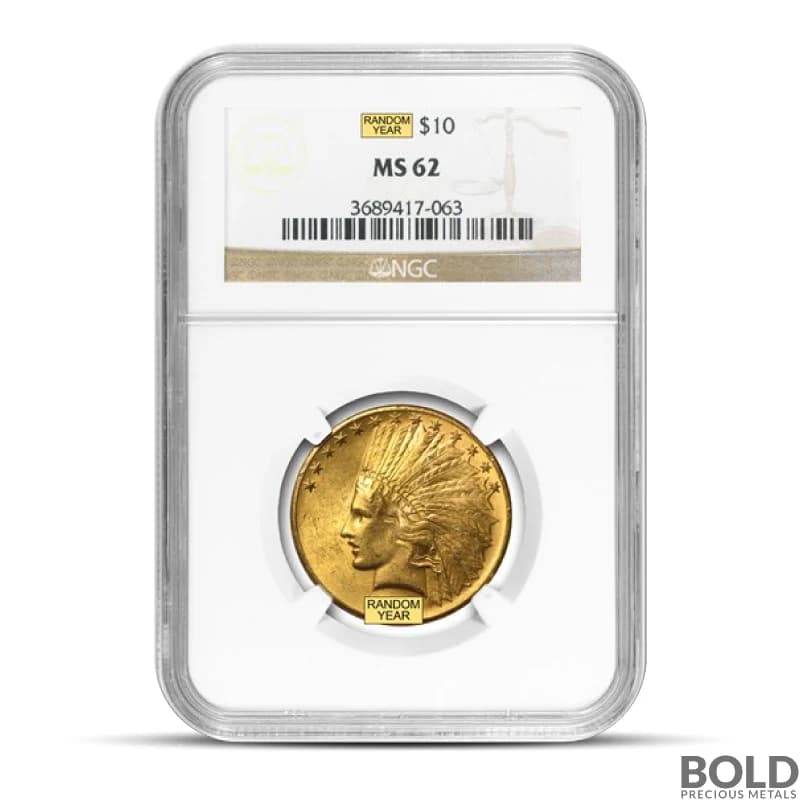
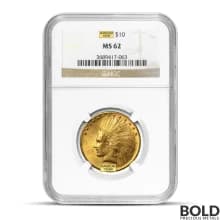
$10 Indian Gold Eagle Coin (MS62, NGC or PCGS, Random)
In Stock
AS LOW AS
$2,541.59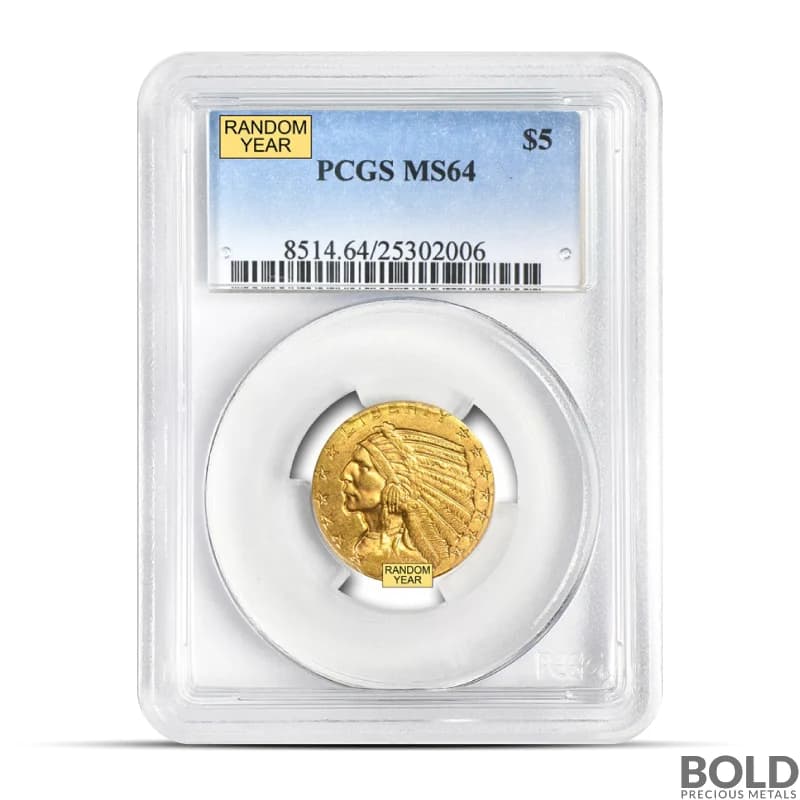
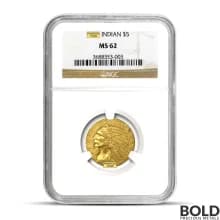
$5 Indian Gold Half Eagle Coin (MS64, Random)
Out of Stock
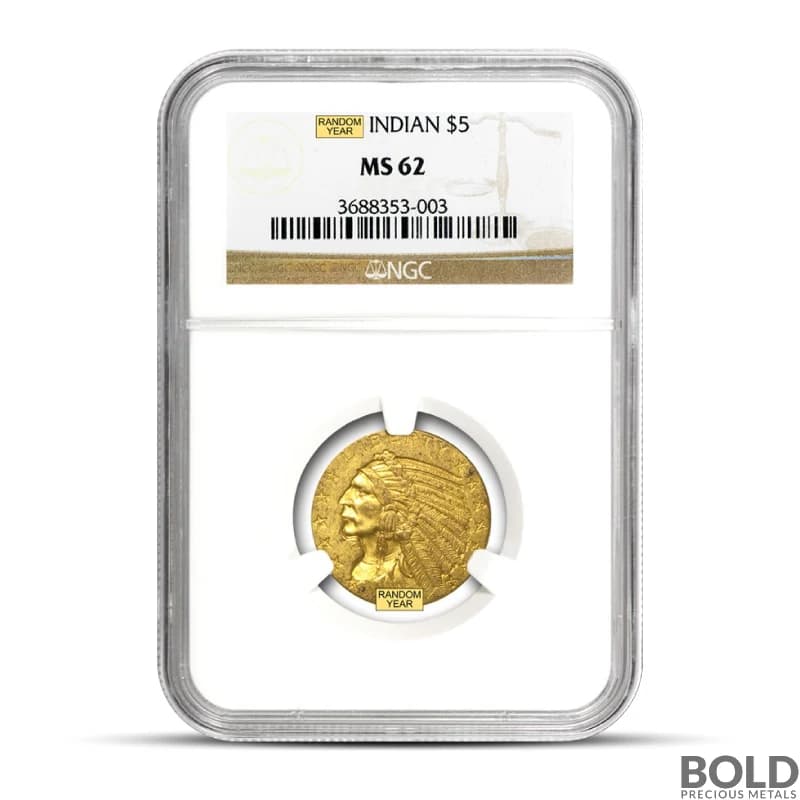
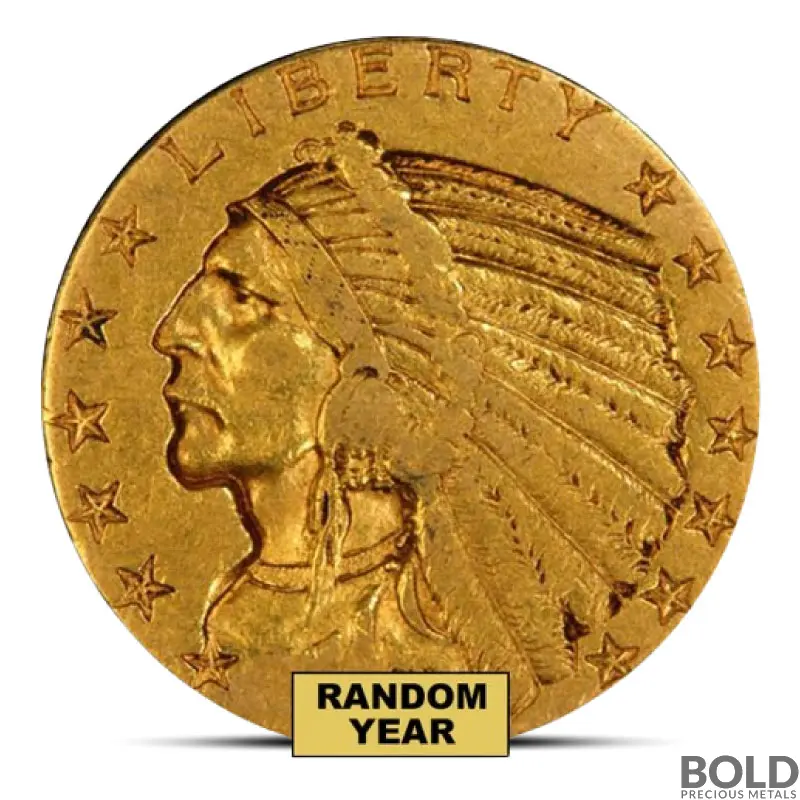
$5 Indian Gold Half Eagle Coin (MS62, Random)
Out of Stock
$5 Indian Gold Half Eagle Coin (VF, Random)
Out of Stock
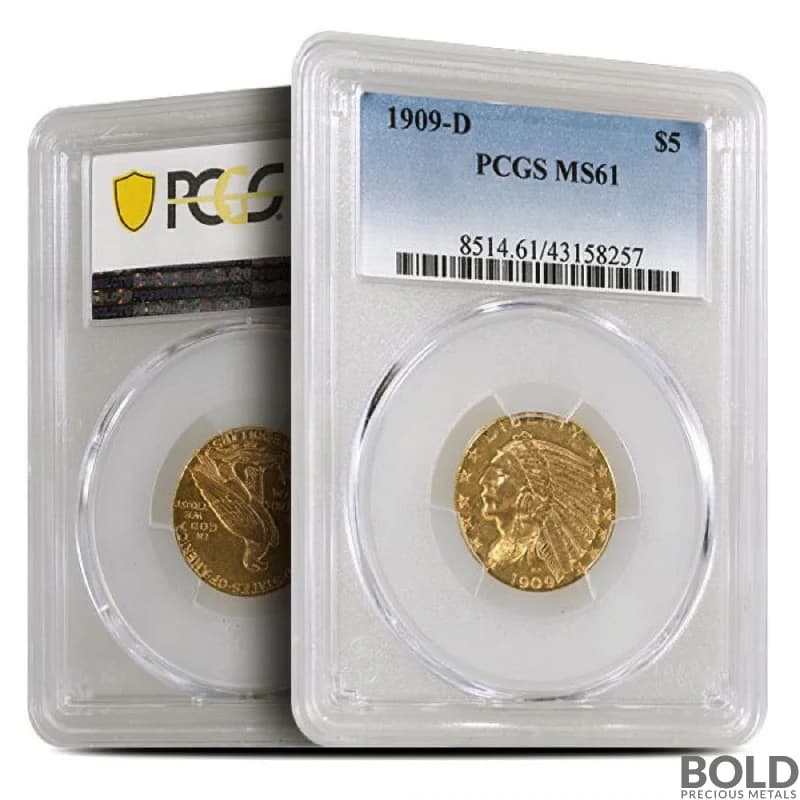
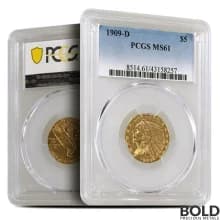
$5 Indian Gold Half Eagle Coin (MS61, Random)
Out of Stock
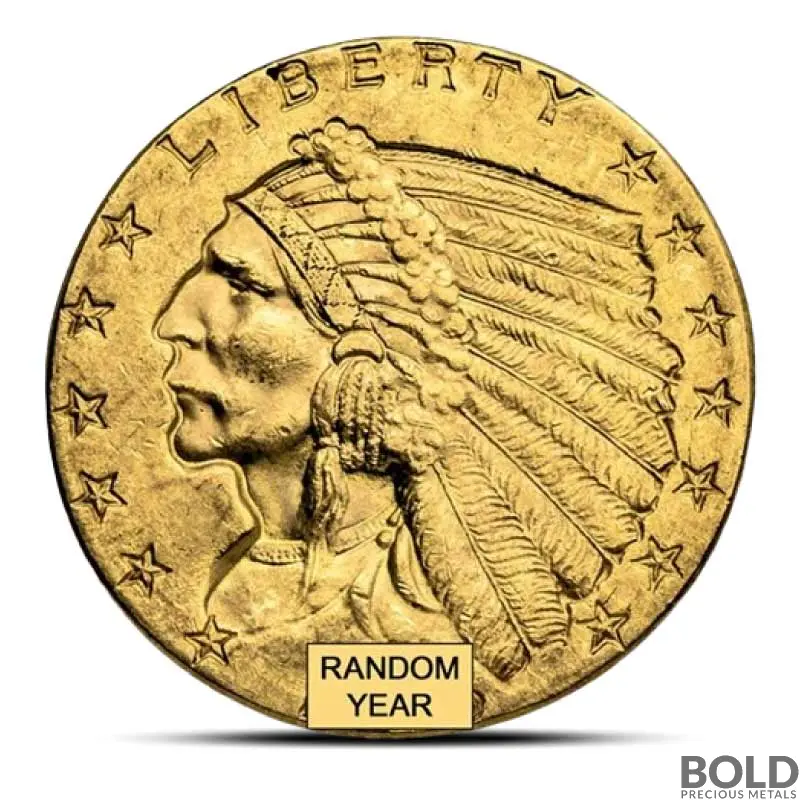
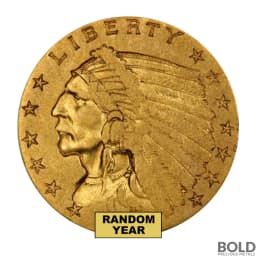
$2.50 Indian Quarter Gold Eagle Coin (BU)
Out of Stock
The term "Indian Head Gold Coin" covers three distinct denominations that most buyers lump together incorrectly. They share a thematic name but differ in gold content, design origin, and collector demand — and those differences matter at the point of purchase. Compare these alongside modern bullion in our full gold coins collection.
| Denomination | Face Value | Gold Content | Designer | Years Minted | Design Style |
|---|---|---|---|---|---|
| Quarter Eagle | $2.50 | 0.12094 oz | Bela Lyon Pratt | 1908–1929 | Incuse (sunken relief) |
| Half Eagle | $5.00 | 0.24187 oz | Bela Lyon Pratt | 1908–1929 | Incuse (sunken relief) |
| Eagle | $10.00 | 0.48375 oz | Augustus Saint-Gaudens | 1907–1933 | High relief / standard relief |
Teal-highlighted Eagle row is the most widely traded denomination and the highest gold content. Gold content stated in troy ounces — multiply by current spot price to calculate melt value.
Dealer Insight — Ryan Cochran
The $2.50 and $5 Indian Head coins by Bela Lyon Pratt used an incuse — or sunken — relief design, meaning the portrait is recessed into the coin's surface. This was a practical disaster in circulation: dirt, grease, and debris accumulated in those recessed fields. The result? A huge percentage of circulated Pratt-design Indian Heads show heavy field contamination and detail loss that grades harshly. If you're buying circulated $2.50 or $5 Indian Heads, inspect the fields closely — or buy PCGS or NGC slabbed examples where the grading is already done. The $10 Eagle by Saint-Gaudens uses conventional raised relief and grades more predictably.
The $10 Indian Head Eagle was struck at three U.S. mints: Philadelphia (no mint mark), Denver (D), and San Francisco (S). The difference in mintage between these facilities in any given year can be dramatic — and that directly impacts what you'll pay.
Mintage variance between facilities is dramatic — and rarely discussed
The 1920-S $10 Indian Head Eagle had a mintage of just 126,500 pieces. Compare that to the 1926 Philadelphia issue at 1,014,000 coins. Both are "1920s Indian Head Eagles" in casual conversation, but the San Francisco issue is roughly 8x rarer by original production — and multiples rarer in high grade because fewer were preserved.
Common-date vs. key-date pricing — a difference of multiples, not percentages
Common-date Philadelphia issues are priced close to their intrinsic gold value plus a standard numismatic premium. Low-mintage San Francisco and Denver issues, particularly in grades above MS-62, can command premiums well beyond that baseline. The same coin in the same date from a different mint is a different investment decision.
BOLD lists every coin with full mint mark and date transparency
All BOLD listings clearly identify the mint mark and date so you're buying with full information — not discovering the difference after the fact. Grade, mint mark, date, and gold content are stated plainly. We don't pad descriptions with numismatic jargon designed to obscure condition or hide problems.
Overlooked Fact — The 1907 Wire Rim vs. Rounded Rim
The 1907 $10 Indian Head Eagle exists in two distinct varieties: a wire rim version and a rounded rim version, produced during the design's first year as Mint technicians adjusted the die preparation process. Saint-Gaudens died in August 1907 and never saw his design enter full production. The wire rim variety — sometimes called the "extremely high relief" transitional piece — is one of the most distinct first-year-of-issue stories in American numismatics. Most buyers shopping "1907 Indian Head Eagles" don't realize they may be looking at two completely different coins depending on the rim type.
Indian Head Gold Coins trade across a wide range of grades, and the premium over melt value escalates sharply as condition improves. Understanding where you sit on that curve determines whether you're buying efficiently or overpaying for a grade jump that doesn't move the needle on resale.
| Grade Range | Condition | Typical Premium Over Melt | Best For |
|---|---|---|---|
| VF-20 to EF-45 | Circulated, visible wear on high points | 10–25% over melt | Bullion-focused buyers, gold content exposure |
| AU-50 to AU-58 | About uncirculated, light wear traces | 20–45% over melt | Best value balance of condition and cost |
| MS-60 to MS-62 | Uncirculated, contact marks present | 40–80% over melt | Collectors entering mint state without peak premiums |
| MS-63 and above | Choice uncirculated, minimal marks | 100–400%+ over melt | Registry collectors, rare date specialists |
Teal-highlighted AU-50 to AU-58 row represents Ryan's recommended value sweet spot for most buyers. Premium ranges are approximate and vary with date, mint mark, and live gold spot.
Ryan's Verdict on Grade
In my experience dealing pre-1933 gold, the AU-55 to MS-62 range is where most informed buyers land — and for good reason. You're getting a genuinely uncirculated or near-uncirculated coin with visible eye appeal, a documented scarcity story, and a premium that's defensible when you go to sell. The jump from MS-62 to MS-63 on common-date Indian Head Eagles can add 40–80% to the price for what often amounts to a few fewer contact marks on the cheek. For buyers who want pre-1933 gold exposure closer to melt value, a clean AU-50 or AU-55 is an honest coin at an honest price — and it has the same Executive Order 6102 survival story as the MS-65 examples.
Executive Order 6102, signed by President Roosevelt on April 5, 1933, required American citizens to surrender their gold coins, gold bullion, and gold certificates to Federal Reserve Banks by May 1, 1933. Failure to comply carried penalties of up to $10,000 and 10 years imprisonment under the Trading With the Enemy Act. Most privately held gold went in.
The majority of circulating Indian Head Gold Coins were melted down at the mint and recast as gold bars. This is documented history — not marketing copy — and it directly explains why even common-date Indian Head Eagles in circulated grades carry a premium over their raw gold content.
Coins survived the recall through a narrow set of circumstances: coin collections held limited exemptions, some coins were never found during the compliance period, and a portion were simply not turned in. Every example in the market today is competing for a fixed and irreversibly reduced population.
Indian Head Gold Coins are not going to be re-minted. No additional supply is being created. The baseline population is permanently reduced — which is why the pre-1933 gold premium has historically held across multiple gold price cycles and market conditions.
The $10 Indian Head Gold Eagle contains 0.48375 troy ounces of gold. It is composed of 90% gold and 10% copper, with a total weight of 16.72 grams. The $5 Half Eagle contains 0.24187 troy oz and the $2.50 Quarter Eagle contains 0.12094 troy oz. Multiply any of these figures by the current gold spot price to calculate approximate melt value before numismatic premium.
No. Pre-1933 U.S. gold coins including Indian Head Gold Coins do not meet IRS purity requirements for gold IRAs (minimum .995 fine). Gold IRAs require modern bullion coins such as American Gold Eagles or Gold Buffalos, or LBMA-approved gold bars. Indian Head Gold Coins are better suited to taxable accounts or direct personal ownership.
Authentication by PCGS or NGC is the gold standard for pre-1933 U.S. gold. Counterfeit Indian Head Gold Coins do exist — particularly in higher grades — and third-party grading slabs eliminate authentication risk entirely. BOLD's slabbed inventory comes pre-certified. For raw (unslabbed) coins, weight and diameter measurements are a useful first screen, but professional certification is the only definitive answer.
Among $10 Indian Head Eagles, the 1920-S, 1930-S, and 1933 issues are among the lowest-mintage and most conditionally scarce dates. The 1933 $10 Indian Head Eagle had a mintage of 312,500 but almost none were released into circulation before the gold recall — making high-grade examples extremely rare. Among the Pratt-designed smaller denominations, the 1911-D $2.50 Quarter Eagle is a key date with a mintage of just 55,680.
For most buyers, the AU-55 to MS-62 range delivers the best balance of condition, eye appeal, and defensible premium. A clean AU-50 or AU-55 is an honest coin at an honest price with the same Executive Order 6102 survival story as the high-grade examples. The jump from MS-62 to MS-63 can add 40–80% to the price for a marginal condition difference — a trade-off worth understanding before you commit. For pure gold content exposure close to melt value, circulated VF to EF examples are a rational choice.
Executive Order 6102 was signed by President Roosevelt on April 5, 1933, requiring Americans to surrender privately held gold to Federal Reserve Banks. The majority of Indian Head Gold Coins in circulation were melted down as a result. The survivors — those that escaped due to exemptions, collection status, or non-compliance — represent a permanently and irreversibly reduced population. This documented scarcity directly explains why pre-1933 gold commands a premium over raw gold content, and why that premium has historically held across multiple gold price cycles.
All Denominations · All Grades · Authenticated & Accurately Described
A+ BBB-rated · 100,000+ Investors Served · Grade & Mint Mark Transparency · Free Insured Shipping $199+


Affiliations











Copyright BOLD Precious Metals 2026